

Idaho Rental Property Insurance: Landlord Coverage That Protects Your Investment
Owning rental property in Idaho comes with real financial risk. A standard homeowners policy won’t protect your investment if a tenant gets injured or a fire damages the building.
We at Matt Anderson Insurance see landlords make this mistake constantly-they assume their basic coverage is enough. Idaho rental property insurance is specifically designed to fill those gaps and protect what you’ve worked hard to build.
What Your Landlord Policy Actually Covers
Dwelling Coverage Protects Your Building Structure
Landlord insurance in Idaho protects three core areas that standard homeowners policies ignore completely. Dwelling coverage pays to repair or rebuild the rental structure itself after fire, wind, hail, theft, or vandalism damages it. This is your primary protection and typically represents 60 to 70 percent of your annual premium because the rebuild cost drives the entire policy value. If a tenant accidentally starts a kitchen fire or a winter storm tears through the roof, dwelling coverage handles the structural repairs so you don’t write a check from your own pocket. The Idaho average for landlord insurance runs between $950 and $1,400 annually, with that wide range reflecting differences in property age, replacement cost, and local risk factors.
Liability Coverage Protects You from Tenant and Visitor Injuries
Liability coverage is where landlord insurance separates itself from homeowners policies in ways that matter financially. If a tenant slips on your icy driveway and breaks their leg, or a visitor suffers injury due to an unsafe condition you failed to fix, liability protection covers their medical bills, legal costs, and settlement amounts up to your policy limit. Most landlord policies provide $1 million per occurrence and $2 million aggregate, which is substantial but not unlimited. You can request higher limits if you own multiple properties or rent to larger groups.
Loss of Rental Income Replaces Your Cash Flow During Repairs
The third component, loss of rental income, reimburses you for rent payments you would have collected while the property sits uninhabitable after a covered loss. If a fire forces tenants out for three months of repairs, this coverage replaces that lost income so your cash flow doesn’t collapse. Many landlords skip this endorsement to save money, then face real hardship when a claim happens. The Idaho Department of Insurance emphasizes confirming which specific perils trigger loss of rental income coverage and how long the benefit lasts, since policies vary. Some cover only fire and lightning, while others include wind and hail. Understanding these details before disaster strikes prevents nasty surprises when you file a claim.
Now that you know what landlord insurance covers, the next step is recognizing where standard homeowners policies fall short for rental properties.
Why Homeowners Insurance Fails Rental Properties
Insurance companies treat rental properties and owner-occupied homes completely differently because the risk profile is fundamentally different. A homeowners policy assumes you live in the house and maintain it carefully. A rental property has tenants you don’t know well, higher turnover, more foot traffic, and liability exposure that homeowners policies simply refuse to cover.
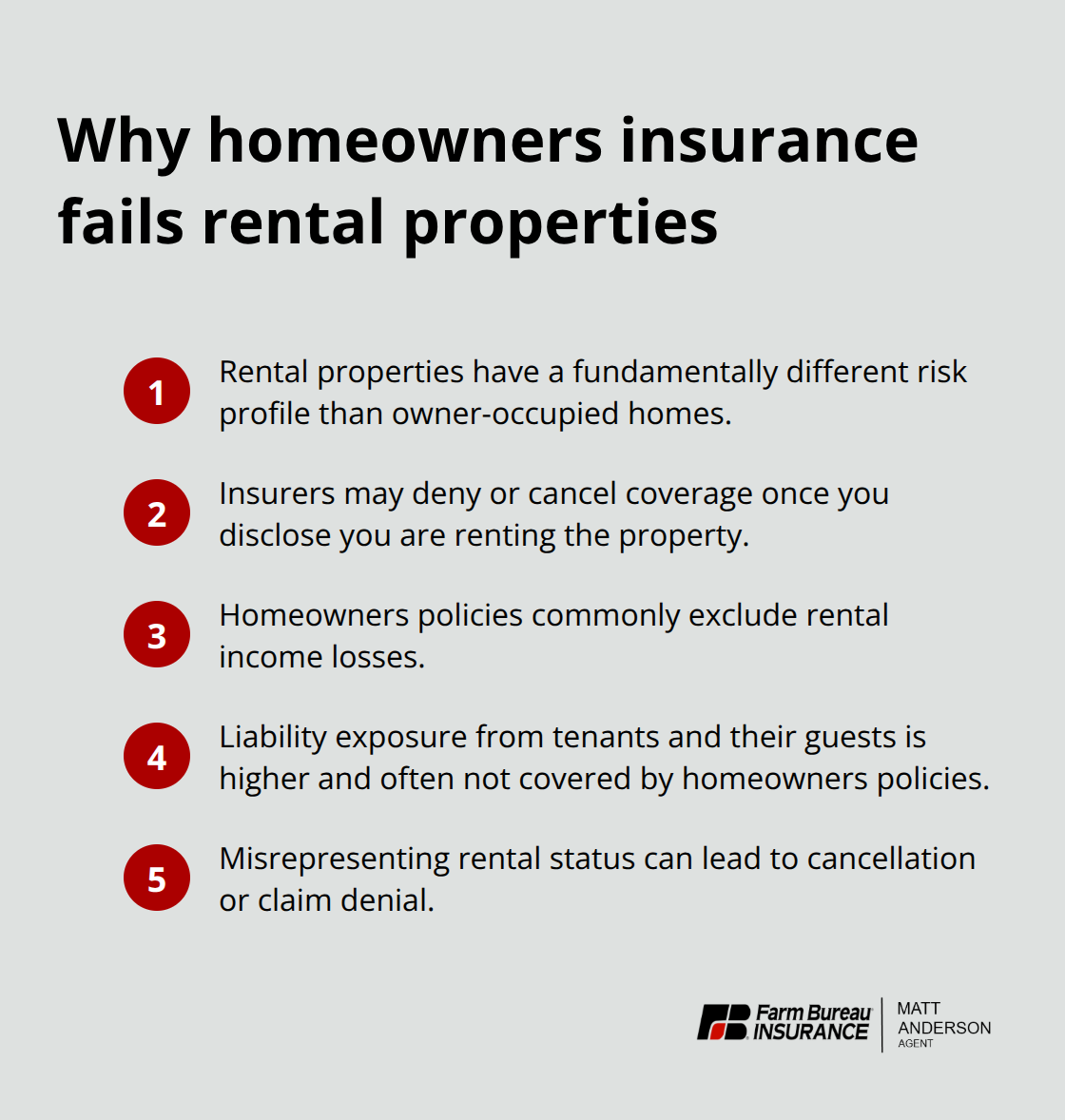
When you disclose to your insurer that you’re renting out the property, they will either deny coverage outright or cancel your policy. The Idaho Department of Insurance has documented cases where landlords filed claims only to discover their homeowners policy excluded rental income losses entirely, leaving them without protection during months of repairs. You can file a complaint with the Idaho Department of Insurance if your claim is wrongfully denied. This isn’t a gray area-homeowners policies explicitly state they do not cover rental properties, and claiming coverage you don’t have creates a documented reason for denial if you ever file a claim.
Tenant-Related Risks Standard Policies Ignore
Homeowners policies were designed for owner-occupied properties and completely miss the financial damage that tenant behavior causes. If a tenant intentionally damages the rental unit beyond normal wear and tear, standard homeowners coverage won’t reimburse you because the policy assumes the person living there has a financial stake in protecting it. Landlord policies specifically cover malicious damage and tenant-caused destruction that goes beyond simple negligence. Medical liability also shifts dramatically with tenants. When a guest visits an owner-occupied home, homeowners liability covers injuries. When a tenant’s guest is injured on your rental property, homeowners policies treat it as a rental property claim and deny it. Idaho landlords routinely discover this gap too late. Loss of rental income coverage doesn’t exist on homeowners policies at all, which means if a covered loss makes the property uninhabitable for repairs, you absorb every dollar of lost rent yourself. A three-month repair after a fire could cost you thousands in missing income while your mortgage and maintenance expenses continue.
How Landlord Policies Close the Protection Gaps
Landlord insurance in Idaho is built specifically for the financial realities of rental operations. Coverage extends to tenant-caused damage, liability claims from tenant injuries or visitor injuries on the property, and critically, loss of rental income during repairs. The Idaho average of $950 to $1,400 annually reflects these expanded protections compared to homeowners policies. Landlord policies also clarify exactly which perils trigger loss of rental income so you know upfront whether fire alone qualifies or if wind and hail are included. You can add endorsements for specific risks like vandalism protection or higher liability limits without the insurer using rental status as grounds to deny coverage. Proper landlord insurance prevents the cancellation and denial problems that occur when homeowners policies are misrepresented as covering rental properties.
Understanding what landlord insurance covers is only half the battle-choosing the right limits and deductibles for your specific Idaho property requires careful assessment of your building’s value and the risks it faces.
How to Choose the Right Coverage Limits for Your Idaho Rental
Calculate Your True Rebuild Cost, Not Market Value
Start with your property’s actual rebuild cost, not its market value. The Idaho Department of Insurance stresses that replacement cost is what matters for dwelling coverage because you need enough to physically reconstruct the building after a total loss. A $300,000 purchase price does not equal $300,000 in rebuild expenses if the land accounts for $100,000 of that value. Local Idaho contractors can provide accurate rebuild estimates per square foot. Properties in northern Idaho mountain towns often cost more to rebuild due to material transport and labor availability compared to Boise-area rentals. Once you know your true rebuild cost, set your dwelling limit at or slightly above that figure.
Avoid Underinsurance Penalties That Reduce Payouts
Underinsuring by 10 percent to save premiums backfires through coinsurance penalties that reduce your claim payout dollar-for-dollar. If your home costs $250,000 to rebuild and you insure it for only $225,000, a $100,000 fire loss gets reduced proportionally, leaving you to cover the gap yourself. Document any recent upgrades like new roofing, updated electrical systems, or plumbing replacements because these justify higher rebuild costs and can actually lower your per-dollar premium through demonstrated reduced risk.
Select a Deductible That Matches Your Risk Tolerance
Your deductible choice directly impacts both your annual premium and your out-of-pocket exposure after a claim. Idaho landlords commonly choose $1,000 or $2,500 deductibles to balance affordability with reasonable risk retention. Jumping to a $5,000 deductible saves roughly 15 to 20 percent on annual premiums but means you absorb that full amount before coverage kicks in on any claim. If your rental property sits in a high-wind or wildfire zone, a lower deductible makes financial sense because claims happen more frequently. Conversely, if your property has strong safety features like monitored alarms, updated fire suppression systems, or water leak detection devices, you qualify for premium discounts that offset lower deductible costs.
Set Loss of Rental Income Coverage Based on Repair Timelines
Loss of rental income coverage requires separate attention because most standard policies exclude it entirely. Set that limit based on your monthly rent multiplied by the longest repair timeline you realistically face. A $1,500-per-month rental should carry at least $4,500 to $6,000 in loss of rental income coverage to handle a typical two to four-month rebuild after fire or major structural damage.
Adjust Liability Limits for Your Property Portfolio
Liability limits of $1 million per occurrence work for single-family rentals, but if you own multiple properties or rent to groups larger than a typical family, request $2 million limits. Property values and rebuild costs shift with Idaho inflation and local construction market changes, so review your coverage annually to keep pace with these shifts.
Final Thoughts
Idaho rental property insurance protects your investment in ways that standard homeowners policies simply cannot. Dwelling coverage rebuilds your structure after fire, wind, or vandalism. Liability protection shields you from tenant and visitor injury claims that would otherwise drain your personal finances. Loss of rental income replaces the cash flow you lose while repairs happen, keeping your mortgage payments and operating costs covered during downtime.
Choosing the right coverage means calculating your actual rebuild cost, not your purchase price, and setting limits that match that figure without underinsurance penalties. Your deductible should reflect your risk tolerance and your property’s safety features. Loss of rental income coverage deserves its own careful assessment based on how long repairs typically take in your area. Liability limits of $1 million work for most single-family rentals, but larger portfolios or group rentals warrant higher protection.
Contact Matt Anderson Insurance today to discuss your Idaho rental property insurance needs and receive a personalized quote that protects what you’ve built. Our licensed agents understand the specific risks that properties face across the state, from winter storm damage in northern Idaho to wildfire exposure in mountain communities. We work with you to customize coverage that matches your property’s actual value and your portfolio’s complexity.
The information provided in this blog is for general informational purposes only and does not constitute legal, financial, or insurance advice. Coverage options, terms, and availability may vary. Please consult with a licensed professional for advice specific to your situation. Artificial intelligence may have been used to generate text and images in some blog articles.

