Homeowners Insurance Bundling Idaho: Discounts For Bundled Coverage

Bundling your homeowners and auto insurance in Idaho can cut your premiums significantly. Most insurers offer discounts between 15% and 25% when you combine policies, and we at Matt Anderson Insurance see these savings add up fast for families across the state.

The key is knowing which combinations work best for your situation and how to maximize every available discount. This guide walks you through real savings examples, popular bundle options, and why working with a local agency makes the difference.

How Much Can You Actually Save by Bundling

Bundling works because insurers reward customer loyalty with discounts that stack on top of your base premium. When you combine homeowners and auto coverage with the same carrier, you typically save with a bundling discount, though the actual dollar amount depends entirely on your location, home value, and driving history. In Idaho specifically, bundling saves homeowners roughly 17% overall according to rate data, but this varies significantly by ZIP code and insurer.

State Farm, Farmers, and Allstate Lead Idaho Discounts

State Farm offers the largest Idaho home-and-auto bundle discount on average at about 24%, cutting a typical combined premium from $2,748 to $2,084 annually. Farmers yields an average bundle discount of around 21%, lowering a typical combined rate from $3,867 to about $3,073.
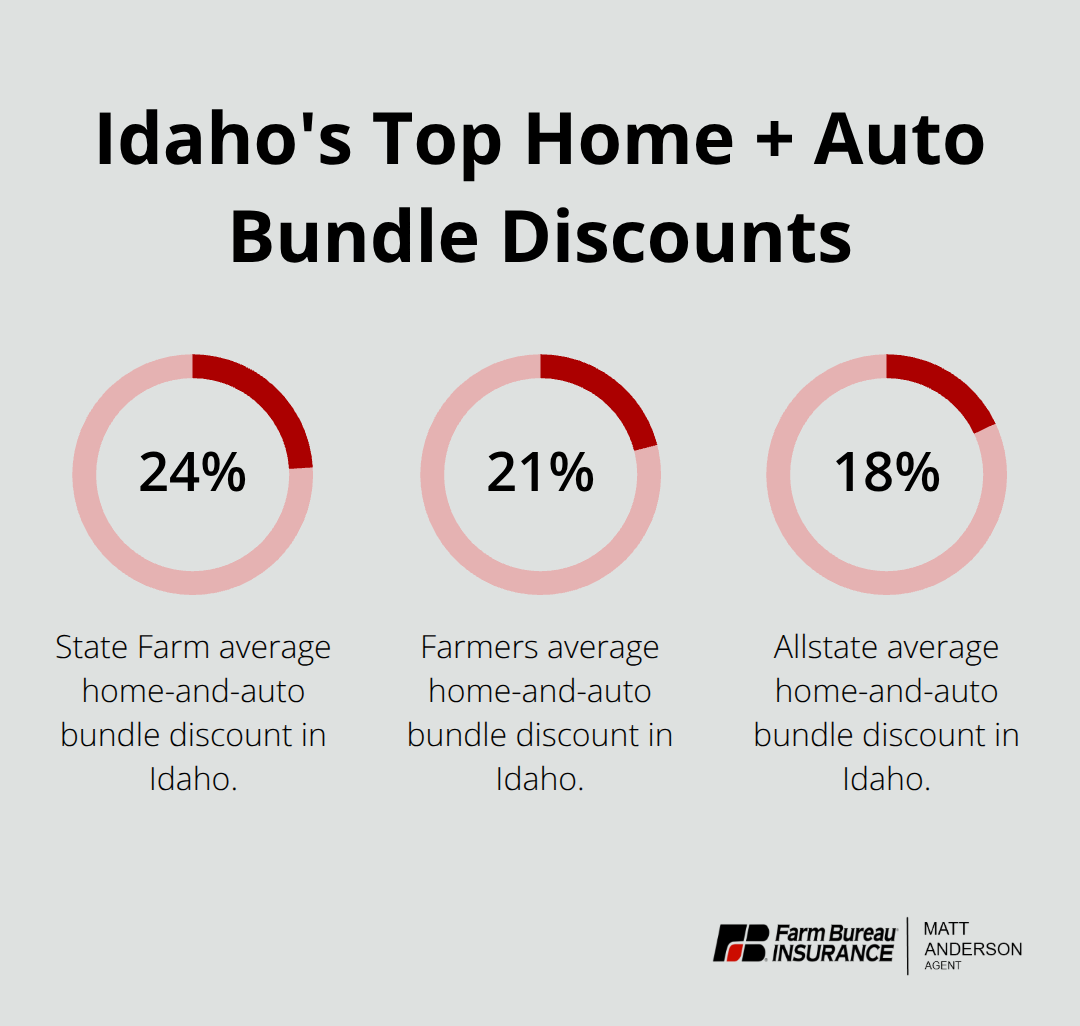
Chart showing average Idaho bundle discount percentages for State Farm, Farmers, and Allstate. - Homeowners insurance bundling Idaho

Allstate shows an average bundle discount of 18% in Idaho, reducing the pre-discount $5,221 to $4,256. Idaho Farm Bureau provides an average of 10% bundle discount but includes benefits like a single renewal date and the same claims team, which simplifies management even if the percentage is lower.

The critical point here is that you should compare final combined annual premiums after discounts, not just the discount percentage itself, because base rates differ dramatically between carriers. A higher percentage from one insurer may not beat a lower percentage from another when you look at what you actually pay.

Your ZIP Code Determines a Significant Portion of Your Premium

Where you live in Idaho determines a significant portion of your premium before any discount applies. ZIP code 83523 carries the highest bundled rates in the state at around $3,756 after discounts, while ZIP code 83708 is the cheapest at approximately $3,180. This $576 annual difference reflects local risk factors (weather exposure, crime rates, distance to fire hydrants, fire department quality, and rebuilding costs).
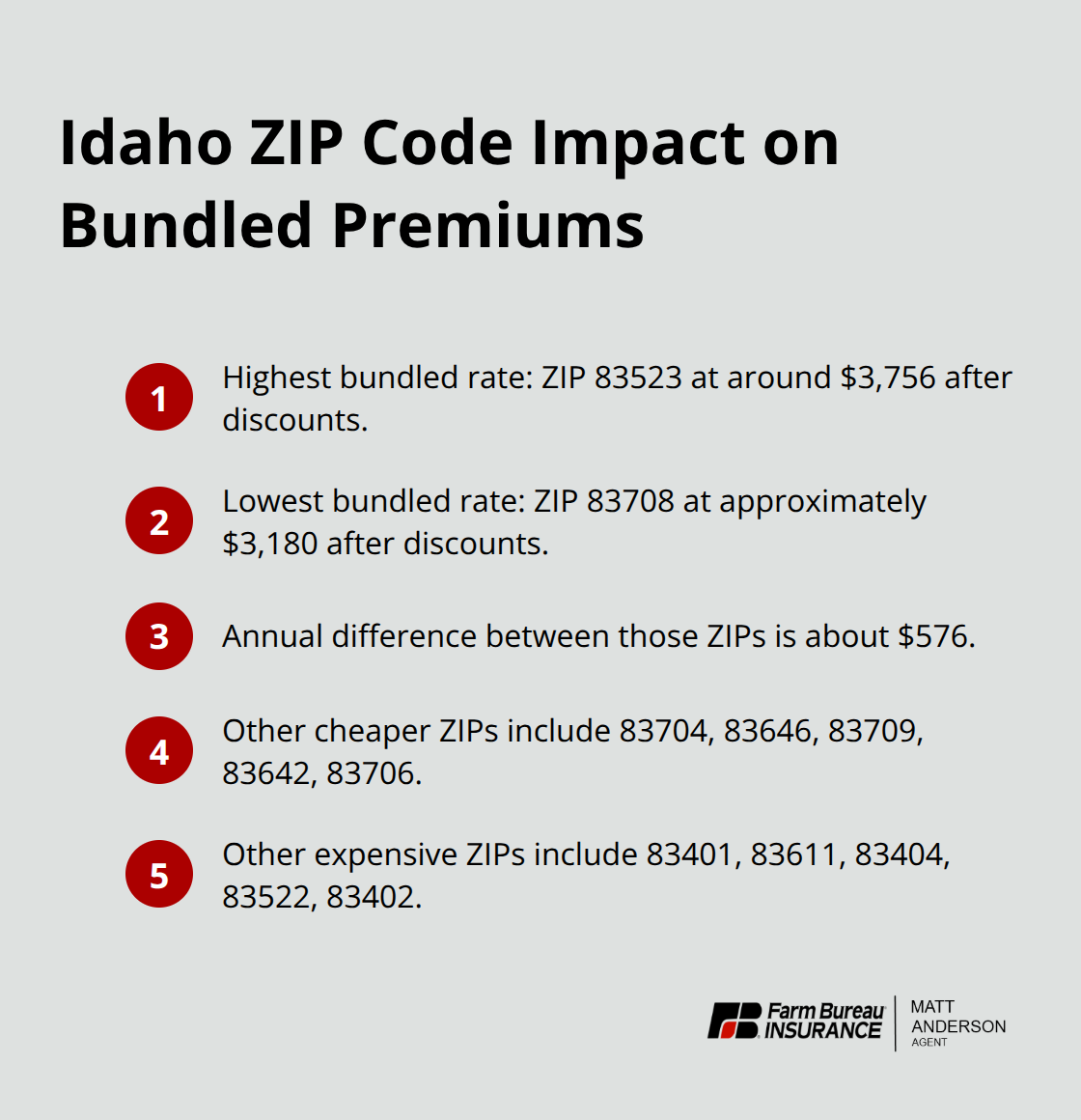
Key Idaho ZIP code insights for bundled homeowners and auto insurance rates. - Homeowners insurance bundling Idaho

If you move within Idaho, you must compare bundle rates for your new ZIP code before finalizing your move, since location can shift your savings dramatically. The cheapest Idaho ZIPs for bundled coverage include 83708, 83704, 83646, 83709, 83642, 83706, 83716, 83712, 83725, and 83702. The most expensive include 83523, 83401, 83611, 83404, 83522, 83402, 83406, 83217, 83467, and 83245. These differences mean that bundling savings depend on where your property sits, not just on which insurer you choose.

Real Numbers Show Why Bundling Wins Over Separate Policies

A homeowner paying $1,510 annually for homeowners coverage plus $1,200 for auto insurance pays $2,710 separately. With a 17% bundling discount applied to the combined premium, that same coverage drops to approximately $2,249, saving $461 per year or about $3,827 over a decade. If you qualify for a carrier offering a 24% discount like State Farm, your savings increase substantially.

The gap widens further when you factor in loyalty discounts, claim-free discounts for years without claims, or discounts for safety features like home security systems and upgraded electrical systems. The reality is that a lower discount percentage from one carrier sometimes beats a higher percentage from another due to different base rates. Shopping around with a local agent who can run quotes across multiple carriers is essential to find your best rate.

What Happens When You Add More Coverage

Most Idaho families stop at home and auto bundling, but you can stack additional savings when you add umbrella coverage or other policies to your bundle. Each additional policy you add to your existing bundle typically qualifies for multi-policy discounts that compound your overall savings. The more you consolidate with a single carrier, the more negotiating power you gain to tailor coverage to your specific needs and risk profile.

Which Bundle Options Work Best for Idaho Families

Home and auto insurance bundles remain the most practical choice for Idaho families because they address your two largest insurance expenses simultaneously. State Farm, Farmers, and Allstate dominate this market in Idaho with competitive discounts, but the real advantage comes from consolidating your renewal dates, claims processes, and billing into a single carrier. When you bundle home and auto, you simplify your annual insurance management significantly-one renewal notice instead of two, one customer service number for questions, and one claims team if something happens. Bundling home and auto translates to real dollars that add up year after year, especially when you factor in loyalty discounts that many carriers apply after you stay bundled for multiple years.

Adding Umbrella Coverage Multiplies Your Savings

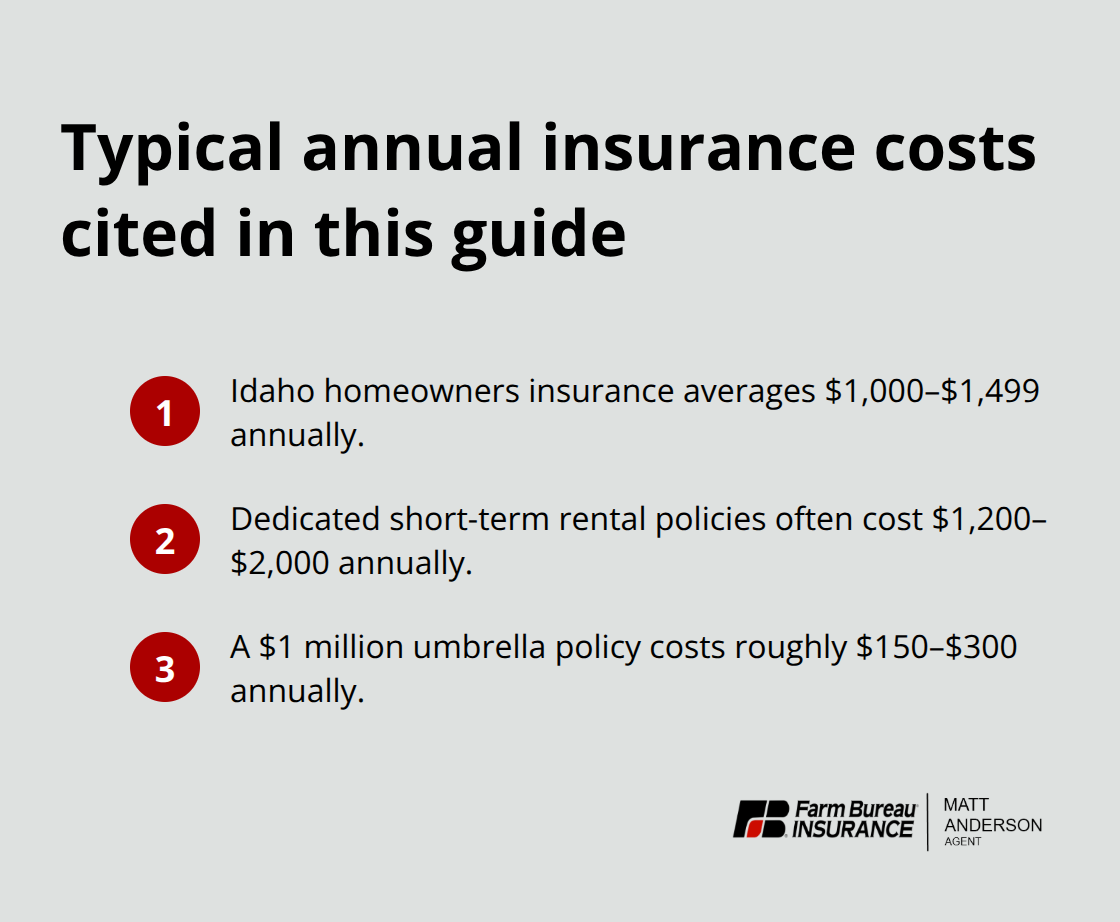
Umbrella insurance protects your personal assets if a liability claim exceeds your home or auto policy limits, and bundling it with your existing home and auto coverage qualifies you for additional multi-policy discounts that most Idaho families overlook. A homeowner with a $1 million umbrella policy bundled with home and auto might save 5% to 10% on the umbrella premium alone, plus potentially higher discounts on the underlying policies. This coverage costs roughly $150 to $300 annually for $1 million in protection but becomes significantly cheaper when bundled. Idaho families with substantial assets, second properties, or regular social gatherings should strongly consider umbrella coverage-the extra layer of liability protection justifies the cost, and bundling makes it affordable.

Farm and Commercial Coverage for Rural Idaho Properties

Rural Idaho properties with farm operations or rental income need specialized bundles that standard home and auto policies do not cover. Farm and commercial bundles combine personal coverage with business protection, addressing equipment, livestock, farm structures, and liability exposure unique to agricultural operations. A farm bundling package might include homeowners coverage, farm auto, equipment coverage, and commercial liability in one consolidated policy, delivering discounts that standalone policies cannot match. Rental properties similarly benefit from bundled commercial coverage paired with your personal policies-you consolidate management and gain discounts while protecting both your primary residence and income-producing assets with a single carrier.

How Local Agencies Identify Your Best Bundle Options

Local Idaho agencies compare multiple carriers to identify which bundle combinations save you the most money based on your specific situation. An independent agent reviews your home value, driving history, farm operations (if applicable), and asset level to recommend the right coverage options and carrier. This personalized approach reveals discounts you might miss if you shop with a single large insurer, since different carriers excel at different bundle combinations. The agent handles all the paperwork, coordinates your policies, and serves as your single point of contact when you need to make changes or file a claim-a significant advantage over managing multiple carriers on your own.

How to Maximize Your Idaho Bundle Savings

Annual Reviews Reveal Hidden Discounts

You must review your coverage each year before renewal if you want to keep your bundling discount competitive. Most Idaho homeowners set their policies and forget them, missing out on additional discounts that emerge as your life changes or as carriers adjust their offerings. When you review your bundle annually, you identify new discounts for safety features you’ve added (security systems, upgraded electrical wiring, new roofs with impact-resistant materials), claim-free years that qualify for loyalty reductions, or changes in your home value that affect coverage levels. Carriers like State Farm, Farmers, and Allstate regularly introduce new discount categories, and a quick annual conversation with your agent reveals which ones apply to your specific situation.
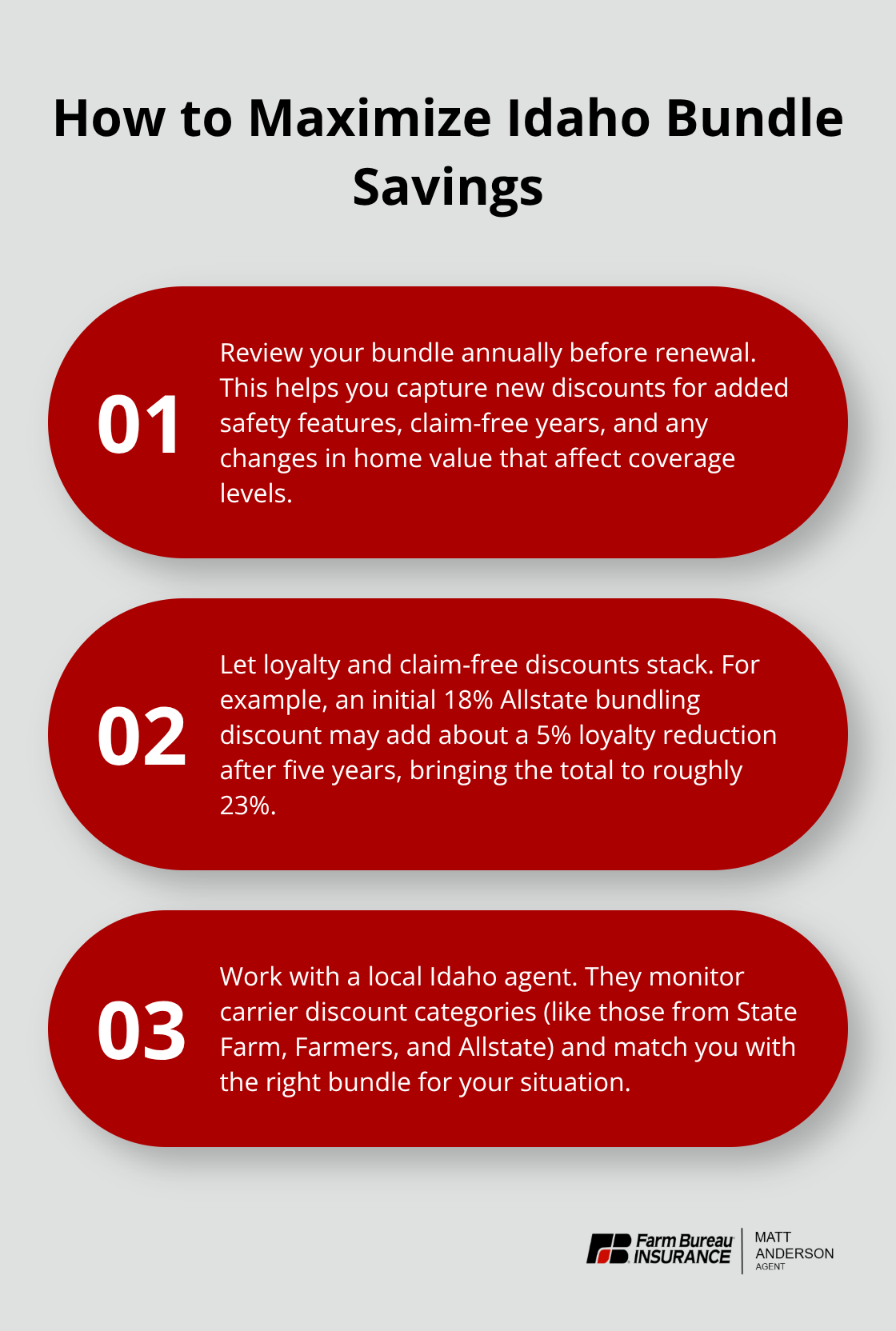
Three practical ways Idaho homeowners can maximize bundle savings.

Your agent identifies these opportunities during your renewal conversation, ensuring you capture every discount available to your situation.

Loyalty Discounts Compound Over Time

Multi-policy loyalty discounts compound your savings significantly when you stay bundled with the same carrier for multiple years. Most carriers reward customers who maintain continuous bundled coverage with the same provider with additional percentage reductions on top of your base bundling discount. A homeowner receiving an initial 18% bundling discount from Allstate might earn an additional 5% loyalty discount after five years of continuous bundled coverage, effectively lowering their total discount to approximately 23%.

Some carriers also offer claim-free discounts that apply when you haven’t filed a homeowners or auto claim for three to five years, adding another layer of savings for responsible homeowners. The strategy here is straightforward: stay bundled with a single carrier long enough to accumulate loyalty benefits, since switching carriers resets these discounts to zero.

Local Agents Manage Your Bundle Strategically

A local Idaho agency gives you access to carriers offering competitive loyalty programs while ensuring your coverage stays aligned with your actual needs. Your agent reviews your bundle annually, confirms you’re receiving every discount you qualify for, and coordinates all policy changes without the administrative burden of managing multiple carriers yourself. This ongoing relationship transforms bundling from a one-time discount into a dynamic savings strategy that grows stronger each year you maintain your coverage.

Final Thoughts

Homeowners insurance bundling in Idaho works best when you have an agent who understands your state’s specific risks and coordinates coverage across multiple carriers on your behalf. Idaho faces winter hazards like frozen pipes and ice dams, summer risks including thunderstorms and hail, and wildfire exposure in certain regions-each factor affects your premium and coverage needs differently depending on where you live. A local agent knows which carriers offer the strongest coverage for these risks, which discounts apply to your specific situation, and how your ZIP code influences your final rate.

When you bundle with a local agency, you receive streamlined claims support across all your policies. Instead of contacting separate carriers when something happens, you work with one team that coordinates your homeowners claim, auto claim, or umbrella claim through a single process. This coordination matters when you face a major loss-your agent ensures nothing falls through the cracks and that all your policies work together to cover your damages completely.

The real advantage of working with a local Idaho agency is having one point of contact for every insurance question you encounter. Whether you need to adjust your coverage limits, add a new vehicle, report a claim, or explore additional discounts, you reach out to the same person who knows your complete insurance picture. Contact Matt Anderson Insurance to review your homeowners insurance bundling Idaho options and discover how much you can save by consolidating your coverage with a local agency that understands your state.

The information provided in this blog is for general informational purposes only and does not constitute legal, financial, or insurance advice. Coverage options, terms, and availability may vary. Please consult with a licensed professional for advice specific to your situation. Artificial intelligence may have been used to generate text and images in some blog articles.

Idaho Farm Bureau Homeowners: A Community-Backed Policy Choice

Homeowners across Idaho are discovering that Farm Bureau policies offer real value through local support and competitive rates. At Matt Anderson Insurance, we’ve seen firsthand how Idaho Farm Bureau homeowners benefit from personalized service and strong financial backing when claims happen.

This guide walks you through why Farm Bureau stands out for Idaho families, what coverage options protect your home, and how their approach compares to larger national insurers.

Why Idaho Families Trust Farm Bureau

Local Agents Who Know Idaho Risks

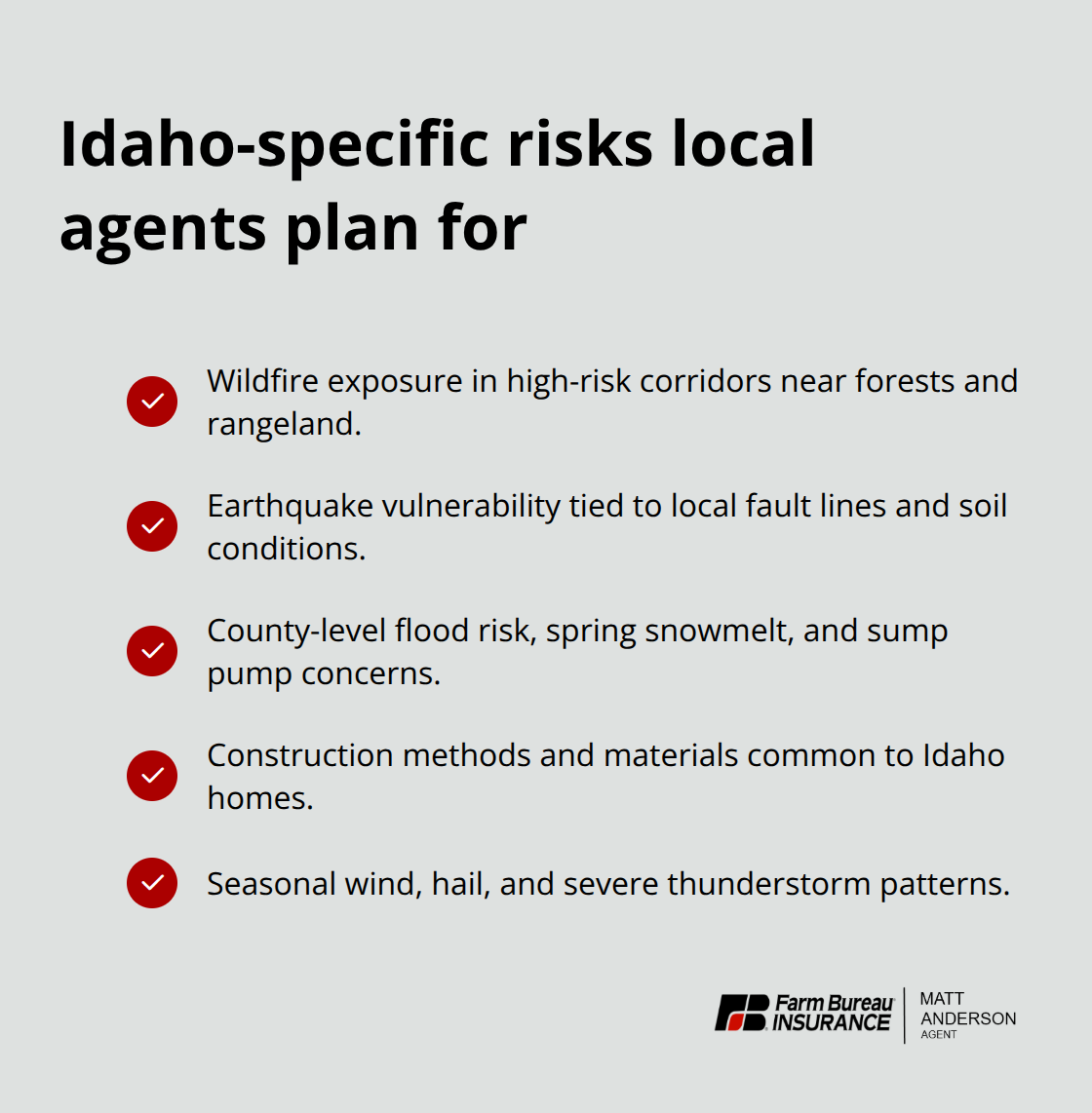
Idaho homeowners need agents who understand local hazards-wildfire exposure, earthquake vulnerability, and flood risk in specific counties. Farm Bureau delivers that expertise. Their agents know Idaho properties inside and out, which means when you call with a claim or coverage question, you talk to someone familiar with how homes in your area are actually built and what threats they face. That local knowledge saves time and prevents coverage gaps that national call centers often miss.

Checklist of Idaho-specific homeowner risks that local Farm Bureau agents consider - Idaho Farm Bureau homeowners

Financial Stability Backs Real Claims Support

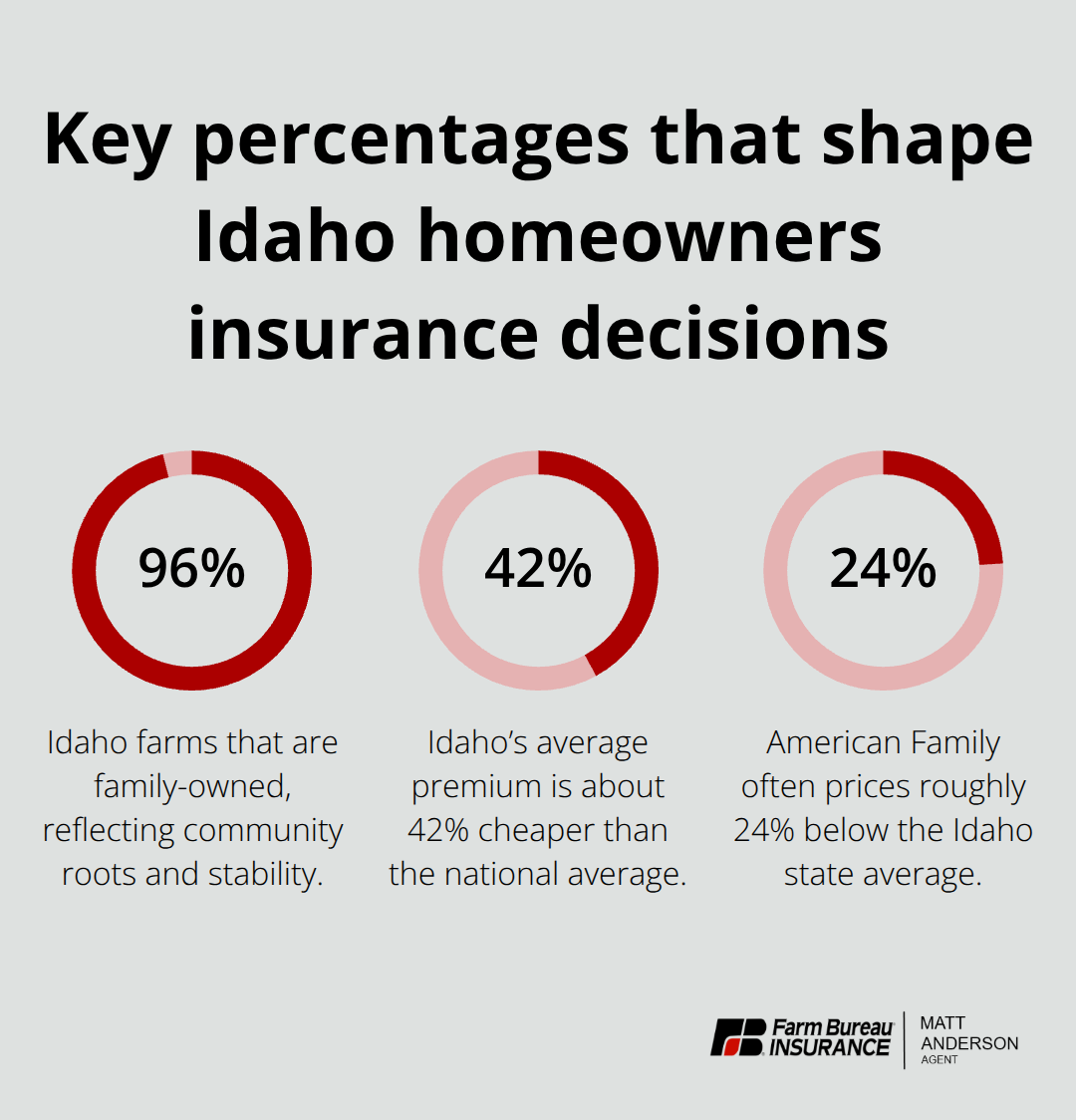
The financial numbers matter. About 96 percent of Idaho farms are family-owned, and that community focus extends to how Farm Bureau operates. Their financial stability supports fast, reliable claims processing when a pipe bursts or a storm damages your roof. Families count on that speed when damage happens, and Farm Bureau’s track record reflects their commitment to Idaho homeowners.

Bundling Cuts Your Overall Premium

Bundling auto, farm, or boat coverage with your home policy typically cuts your overall premium by 10 to 15 percent, depending on your insurer. We recommend getting specific quotes from Farm Bureau and comparing them side by side with national carriers, because bundling discounts vary significantly. The key is comparing identical coverage limits and deductibles across quotes. Idaho homeowners also benefit from Farm Bureau’s endorsement options tailored to state hazards.

Endorsements Address Real Idaho Threats

Water backup coverage protects against sump pump failures and heavy rain damage-a real concern in flood-prone Idaho counties. Personal articles floaters cover valuable items like jewelry or electronics separately from your standard policy limits. These endorsements address actual risks Idaho homes face, not theoretical add-ons. When you evaluate any homeowners policy, ask your agent which endorsements apply to your property’s location and what they cost. That conversation with a local agent beats generic online quotes every time.

Your coverage options matter just as much as your agent’s local knowledge. Understanding what Farm Bureau policies actually protect-and what gaps might exist-helps you make the right choice for your home.

Coverage Options That Protect Idaho Homes

How Farm Bureau Policies Cover Your Dwelling and Structures

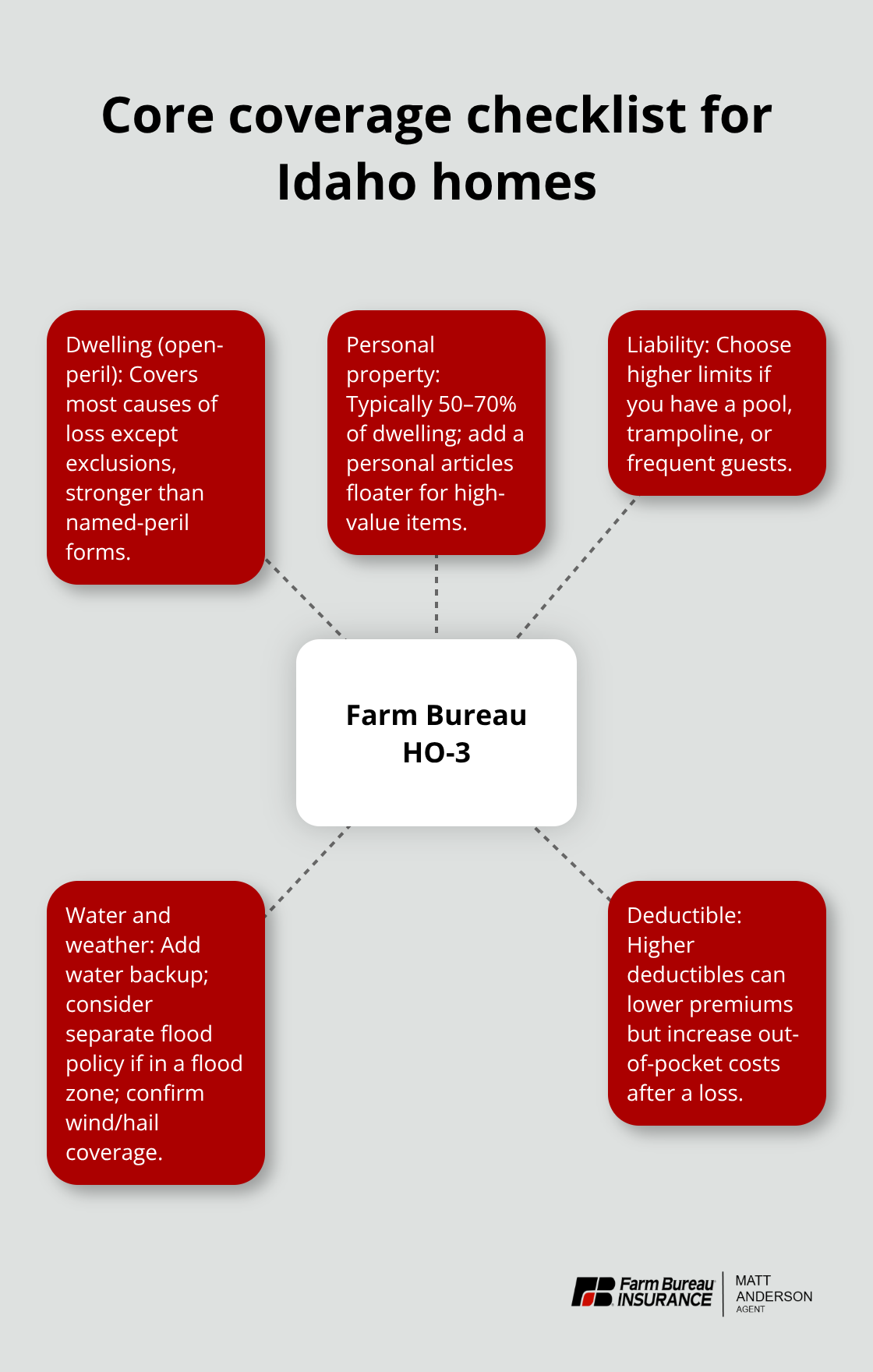
Idaho Farm Bureau homeowners policies protect your dwelling structure on an open-peril basis, which means they cover damage from most causes except those specifically excluded in your policy. That’s stronger than named-peril coverage, which only pays for damage listed in your contract. Your dwelling coverage pays to rebuild or repair the house itself, while other structures coverage handles detached garages, sheds, or fences. The standard form in Idaho is the HO-3, and it provides solid protection for the physical building you live in.

Personal Property Coverage and High-Value Items

Personal property coverage reimburses you for furniture, electronics, and clothing inside your home if theft or weather damage occurs. The standard HO-3 limits personal property to a percentage of your dwelling coverage, typically 50 to 70 percent. If you own high-value items like jewelry, cameras, or collectibles, that percentage won’t cover replacement costs. You need a personal articles floater, which costs extra but covers those items separately and often at replacement cost rather than actual cash value. Most Idaho homeowners underestimate what their belongings are worth until they need to replace everything after a fire or theft.

Liability Protection When Accidents Happen

Liability coverage protects you financially when someone is injured on your property or you accidentally damage someone else’s property. Farm Bureau policies typically include liability coverage that pays legal costs and damages up to your limit, usually between $100,000 and $500,000 depending on what you choose. Idaho homeowners with pools, trampolines, or who frequently host guests should lean toward higher limits because injury claims add up fast.

Water Damage and Weather-Related Endorsements

Water damage coverage is essential in Idaho, where heavy spring snowmelt and summer thunderstorms cause basement flooding and sump pump failures. Standard policies exclude flood damage from natural water events, so you need either water backup coverage as an endorsement or a separate flood insurance policy through the National Flood Insurance Program if you’re in a designated flood zone. Weather-related endorsements like wind and hail coverage are sometimes separate from your base policy, so ask your agent whether your coverage includes damage from severe storms or if you need additional protection.

Hub-and-spoke showing essential Farm Bureau HO-3 coverage areas for Idaho homeowners - Idaho Farm Bureau homeowners

Choosing the Right Deductible for Your Budget

The cost difference between a $500 deductible and a $1,000 deductible typically saves you 10 to 15 percent on your annual premium, but only raise your deductible if you can actually pay that amount out of pocket after a loss without financial strain. Your deductible choice directly affects both your monthly costs and your financial readiness when damage happens. Understanding these coverage pieces helps you compare Farm Bureau policies against other Idaho insurers and spot where your protection might fall short.

How Farm Bureau Stacks Up Against National Insurers

Price Versus Local Expertise

Farm Bureau homeowners policies in Idaho cost about $2,528 annually for a $300,000 dwelling, according to Bankrate’s 2025 analysis. That price sits above the Idaho state average of roughly $1,409 per year-about 42 percent cheaper than the national average-but the difference reflects what you actually receive. National carriers like USAA, State Farm, Allstate, and Travelers operate through call centers and online systems built to process claims at scale, not to understand that your Meridian home sits in a wildfire corridor or that your Coeur d’Alene property faces seasonal flood risk. Farm Bureau agents know these specifics because they live in Idaho communities and work with local properties every day.

Percentage chart highlighting 96% family-owned farms, 42% Idaho vs. national average gap, and 24% carrier discount difference

Customer Satisfaction and Eligibility Across Carriers

USAA ranks highest in customer satisfaction according to JD Power surveys, but eligibility requires military service or veteran status, which excludes most Idaho residents. State Farm offers strong online tools and maintains a broad local agent network across the state. American Family typically undercuts the state average by roughly 24 percent. Travelers provides green home endorsements for LEED-certified features. None of these options, however, combine local presence with Idaho-specific coverage the way Farm Bureau does, and that combination carries a cost premium that reflects actual expertise rather than processing efficiency.

Claims Handling and Regional Knowledge

The real difference emerges when you file a claim. Farm Bureau agents handle claims through people who understand Idaho property construction, local building codes, and how claims adjusters evaluate damage in your region. National insurers route claims through regional centers where adjusters may have never experienced an Idaho winter or handled properties built to withstand earthquake risk. Speed and accuracy matter when your home needs repairs, and local knowledge accelerates both.

Bundling Options and Specialized Coverage

Bundling auto, farm, or boat coverage with your home policy saves 10 to 15 percent across carriers, but Farm Bureau’s bundling options include coverage for snowmobiles, boats, and ATVs that national carriers often exclude or charge separately. This tailored approach addresses how Idaho families actually live-with recreational equipment and farm assets that standard national policies treat as afterthoughts. The bundling savings compound when you add multiple policies, making the overall premium comparison more favorable than a homeowners-only quote suggests.

Making Your Decision

The answer to whether Farm Bureau’s premium justifies the local expertise depends on your risk tolerance and whether you value having an agent who already knows your property’s specific threats versus saving money upfront with a national company that treats your claim like any other in their system.

Final Thoughts

Idaho Farm Bureau homeowners policies deliver what national carriers cannot: an agent who understands your specific property risks and a company rooted in your community. When a wildfire threatens your neighborhood or spring snowmelt floods your basement, you need someone who has handled similar claims in your exact region, not a claims processor working through a national queue. Farm Bureau’s local presence and Idaho-specific endorsements address real threats your home faces, and that expertise justifies the premium difference for families who prioritize reliability over the lowest upfront cost.

The decision ultimately hinges on what matters most to you. If you want the absolute lowest rate and don’t mind managing claims through a national call center, carriers like American Family or State Farm offer competitive pricing. If you value having an agent who knows your property’s earthquake vulnerability, flood risk, and local building standards, Idaho Farm Bureau homeowners coverage delivers that peace of mind. Most Idaho homeowners fall somewhere in between, which is why comparing actual quotes side by side matters more than relying on averages.

Contact Matt Anderson Insurance to request quotes from Idaho Farm Bureau and compare them directly with other carriers using identical coverage limits and deductibles. Ask about bundling discounts for auto, farm, or boat coverage, and request specific endorsements for water backup and personal articles if you need them. Your agent can walk you through which coverage options match your property’s actual risks rather than selling you generic add-ons.

The information provided in this blog is for general informational purposes only and does not constitute legal, financial, or insurance advice. Coverage options, terms, and availability may vary. Please consult with a licensed professional for advice specific to your situation. Artificial intelligence may have been used to generate text and images in some blog articles.
Idaho Rental Property Insurance: Landlord Coverage That Protects Your Investment

Owning rental property in Idaho comes with real financial risk. A standard homeowners policy won’t protect your investment if a tenant gets injured or a fire damages the building.

We at Matt Anderson Insurance see landlords make this mistake constantly-they assume their basic coverage is enough. Idaho rental property insurance is specifically designed to fill those gaps and protect what you’ve worked hard to build.

What Your Landlord Policy Actually Covers

Dwelling Coverage Protects Your Building Structure

Landlord insurance in Idaho protects three core areas that standard homeowners policies ignore completely. Dwelling coverage pays to repair or rebuild the rental structure itself after fire, wind, hail, theft, or vandalism damages it. This is your primary protection and typically represents 60 to 70 percent of your annual premium because the rebuild cost drives the entire policy value. If a tenant accidentally starts a kitchen fire or a winter storm tears through the roof, dwelling coverage handles the structural repairs so you don’t write a check from your own pocket. The Idaho average for landlord insurance runs between $950 and $1,400 annually, with that wide range reflecting differences in property age, replacement cost, and local risk factors.

Liability Coverage Protects You from Tenant and Visitor Injuries

Liability coverage is where landlord insurance separates itself from homeowners policies in ways that matter financially. If a tenant slips on your icy driveway and breaks their leg, or a visitor suffers injury due to an unsafe condition you failed to fix, liability protection covers their medical bills, legal costs, and settlement amounts up to your policy limit. Most landlord policies provide $1 million per occurrence and $2 million aggregate, which is substantial but not unlimited. You can request higher limits if you own multiple properties or rent to larger groups.

Loss of Rental Income Replaces Your Cash Flow During Repairs

The third component, loss of rental income, reimburses you for rent payments you would have collected while the property sits uninhabitable after a covered loss. If a fire forces tenants out for three months of repairs, this coverage replaces that lost income so your cash flow doesn’t collapse. Many landlords skip this endorsement to save money, then face real hardship when a claim happens. The Idaho Department of Insurance emphasizes confirming which specific perils trigger loss of rental income coverage and how long the benefit lasts, since policies vary. Some cover only fire and lightning, while others include wind and hail. Understanding these details before disaster strikes prevents nasty surprises when you file a claim.

Now that you know what landlord insurance covers, the next step is recognizing where standard homeowners policies fall short for rental properties.

Why Homeowners Insurance Fails Rental Properties

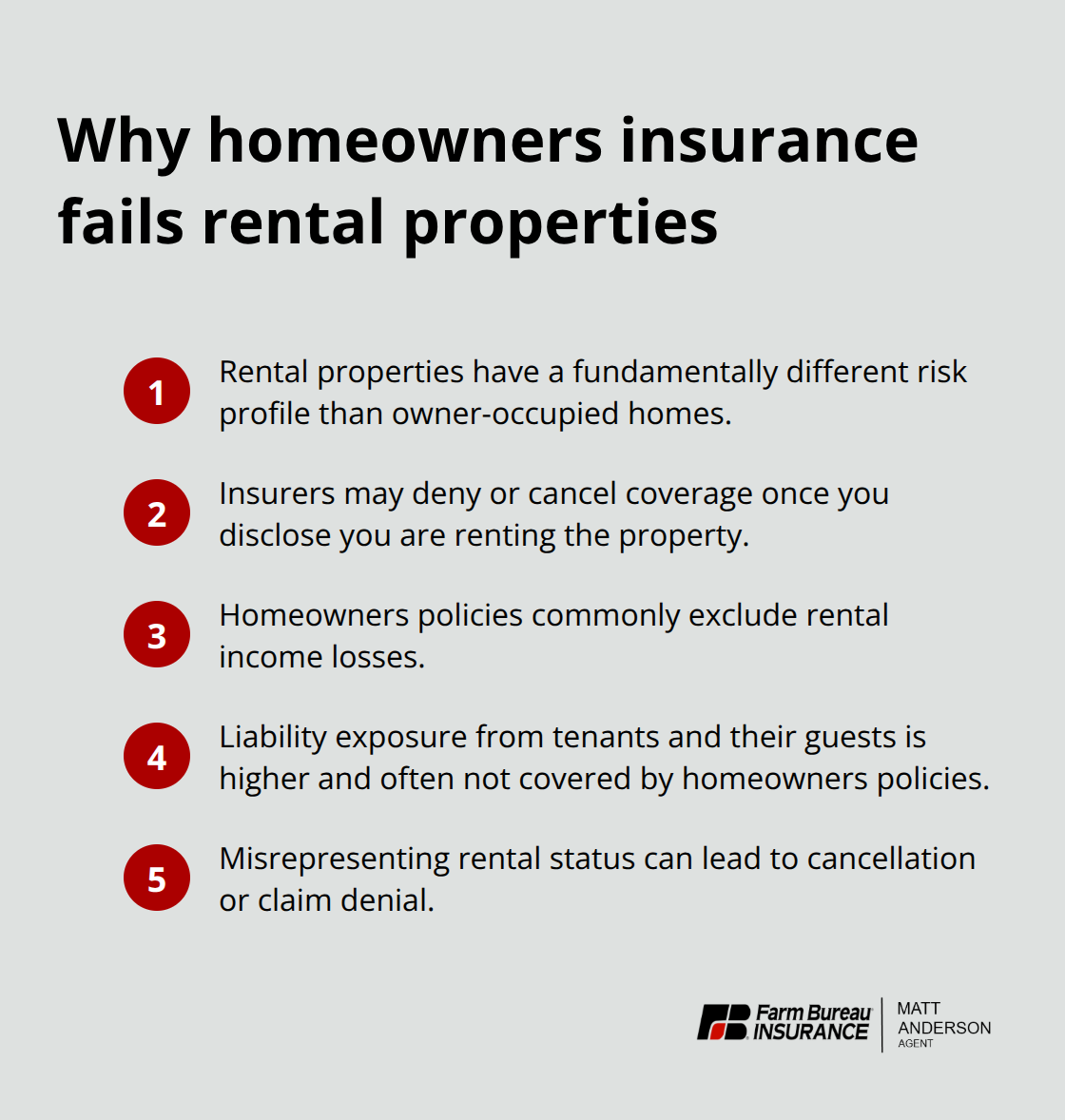
Insurance companies treat rental properties and owner-occupied homes completely differently because the risk profile is fundamentally different. A homeowners policy assumes you live in the house and maintain it carefully. A rental property has tenants you don’t know well, higher turnover, more foot traffic, and liability exposure that homeowners policies simply refuse to cover.

Compact list of reasons homeowners policies don’t fit rental properties - Idaho rental property insurance

When you disclose to your insurer that you’re renting out the property, they will either deny coverage outright or cancel your policy. The Idaho Department of Insurance has documented cases where landlords filed claims only to discover their homeowners policy excluded rental income losses entirely, leaving them without protection during months of repairs. You can file a complaint with the Idaho Department of Insurance if your claim is wrongfully denied. This isn’t a gray area-homeowners policies explicitly state they do not cover rental properties, and claiming coverage you don’t have creates a documented reason for denial if you ever file a claim.

Tenant-Related Risks Standard Policies Ignore

Homeowners policies were designed for owner-occupied properties and completely miss the financial damage that tenant behavior causes. If a tenant intentionally damages the rental unit beyond normal wear and tear, standard homeowners coverage won’t reimburse you because the policy assumes the person living there has a financial stake in protecting it. Landlord policies specifically cover malicious damage and tenant-caused destruction that goes beyond simple negligence. Medical liability also shifts dramatically with tenants. When a guest visits an owner-occupied home, homeowners liability covers injuries. When a tenant’s guest is injured on your rental property, homeowners policies treat it as a rental property claim and deny it. Idaho landlords routinely discover this gap too late. Loss of rental income coverage doesn’t exist on homeowners policies at all, which means if a covered loss makes the property uninhabitable for repairs, you absorb every dollar of lost rent yourself. A three-month repair after a fire could cost you thousands in missing income while your mortgage and maintenance expenses continue.

How Landlord Policies Close the Protection Gaps

Landlord insurance in Idaho is built specifically for the financial realities of rental operations. Coverage extends to tenant-caused damage, liability claims from tenant injuries or visitor injuries on the property, and critically, loss of rental income during repairs. The Idaho average of $950 to $1,400 annually reflects these expanded protections compared to homeowners policies. Landlord policies also clarify exactly which perils trigger loss of rental income so you know upfront whether fire alone qualifies or if wind and hail are included. You can add endorsements for specific risks like vandalism protection or higher liability limits without the insurer using rental status as grounds to deny coverage. Proper landlord insurance prevents the cancellation and denial problems that occur when homeowners policies are misrepresented as covering rental properties.

Understanding what landlord insurance covers is only half the battle-choosing the right limits and deductibles for your specific Idaho property requires careful assessment of your building’s value and the risks it faces.

How to Choose the Right Coverage Limits for Your Idaho Rental

Calculate Your True Rebuild Cost, Not Market Value

Start with your property’s actual rebuild cost, not its market value. The Idaho Department of Insurance stresses that replacement cost is what matters for dwelling coverage because you need enough to physically reconstruct the building after a total loss. A $300,000 purchase price does not equal $300,000 in rebuild expenses if the land accounts for $100,000 of that value. Local Idaho contractors can provide accurate rebuild estimates per square foot. Properties in northern Idaho mountain towns often cost more to rebuild due to material transport and labor availability compared to Boise-area rentals. Once you know your true rebuild cost, set your dwelling limit at or slightly above that figure.

Avoid Underinsurance Penalties That Reduce Payouts

Underinsuring by 10 percent to save premiums backfires through coinsurance penalties that reduce your claim payout dollar-for-dollar. If your home costs $250,000 to rebuild and you insure it for only $225,000, a $100,000 fire loss gets reduced proportionally, leaving you to cover the gap yourself. Document any recent upgrades like new roofing, updated electrical systems, or plumbing replacements because these justify higher rebuild costs and can actually lower your per-dollar premium through demonstrated reduced risk.

Select a Deductible That Matches Your Risk Tolerance

Your deductible choice directly impacts both your annual premium and your out-of-pocket exposure after a claim. Idaho landlords commonly choose $1,000 or $2,500 deductibles to balance affordability with reasonable risk retention. Jumping to a $5,000 deductible saves roughly 15 to 20 percent on annual premiums but means you absorb that full amount before coverage kicks in on any claim. If your rental property sits in a high-wind or wildfire zone, a lower deductible makes financial sense because claims happen more frequently. Conversely, if your property has strong safety features like monitored alarms, updated fire suppression systems, or water leak detection devices, you qualify for premium discounts that offset lower deductible costs.

Set Loss of Rental Income Coverage Based on Repair Timelines

Loss of rental income coverage requires separate attention because most standard policies exclude it entirely. Set that limit based on your monthly rent multiplied by the longest repair timeline you realistically face. A $1,500-per-month rental should carry at least $4,500 to $6,000 in loss of rental income coverage to handle a typical two to four-month rebuild after fire or major structural damage.

Adjust Liability Limits for Your Property Portfolio

Liability limits of $1 million per occurrence work for single-family rentals, but if you own multiple properties or rent to groups larger than a typical family, request $2 million limits. Property values and rebuild costs shift with Idaho inflation and local construction market changes, so review your coverage annually to keep pace with these shifts.

Final Thoughts

Idaho rental property insurance protects your investment in ways that standard homeowners policies simply cannot. Dwelling coverage rebuilds your structure after fire, wind, or vandalism. Liability protection shields you from tenant and visitor injury claims that would otherwise drain your personal finances. Loss of rental income replaces the cash flow you lose while repairs happen, keeping your mortgage payments and operating costs covered during downtime.

Choosing the right coverage means calculating your actual rebuild cost, not your purchase price, and setting limits that match that figure without underinsurance penalties. Your deductible should reflect your risk tolerance and your property’s safety features. Loss of rental income coverage deserves its own careful assessment based on how long repairs typically take in your area. Liability limits of $1 million work for most single-family rentals, but larger portfolios or group rentals warrant higher protection.

Contact Matt Anderson Insurance today to discuss your Idaho rental property insurance needs and receive a personalized quote that protects what you’ve built. Our licensed agents understand the specific risks that properties face across the state, from winter storm damage in northern Idaho to wildfire exposure in mountain communities. We work with you to customize coverage that matches your property’s actual value and your portfolio’s complexity.

The information provided in this blog is for general informational purposes only and does not constitute legal, financial, or insurance advice. Coverage options, terms, and availability may vary. Please consult with a licensed professional for advice specific to your situation. Artificial intelligence may have been used to generate text and images in some blog articles.
Idaho Professional Contractor Insurance: Protecting Your Business And Clients

Running a contracting business in Idaho means managing real risks every day. One accident on a job site or a client injury can quickly turn into a lawsuit that threatens everything you’ve built.

At Matt Anderson Insurance, we help Idaho contractors understand why professional contractor insurance isn’t optional-it’s essential. This coverage protects your business, your team, and your clients from the financial damage that comes when things go wrong.

What Your Contractor Insurance Actually Covers

General liability insurance forms the foundation of contractor protection, and Idaho law requires it. This coverage pays for medical bills, legal defense costs, and settlements when someone gets injured on your job site or when your work damages client property. Idaho law requires general liability insurance as mandated by the Idaho Contractors Board, but that bare minimum leaves you exposed on real projects. The Hartford offers rates starting around $77 per month with limits ranging from $300,000 to $2 million per occurrence. Most Idaho contractors carry $1 million per occurrence and $2 million aggregate because client contracts and project requirements commonly demand those higher limits. Bodily injury coverage handles medical costs and lost wages when someone gets hurt, while property damage coverage repairs or replaces client property damaged by your work. Both components include defense costs if a lawsuit arises, protecting your cash flow when claims happen.

Tools and Equipment Need Their Own Protection

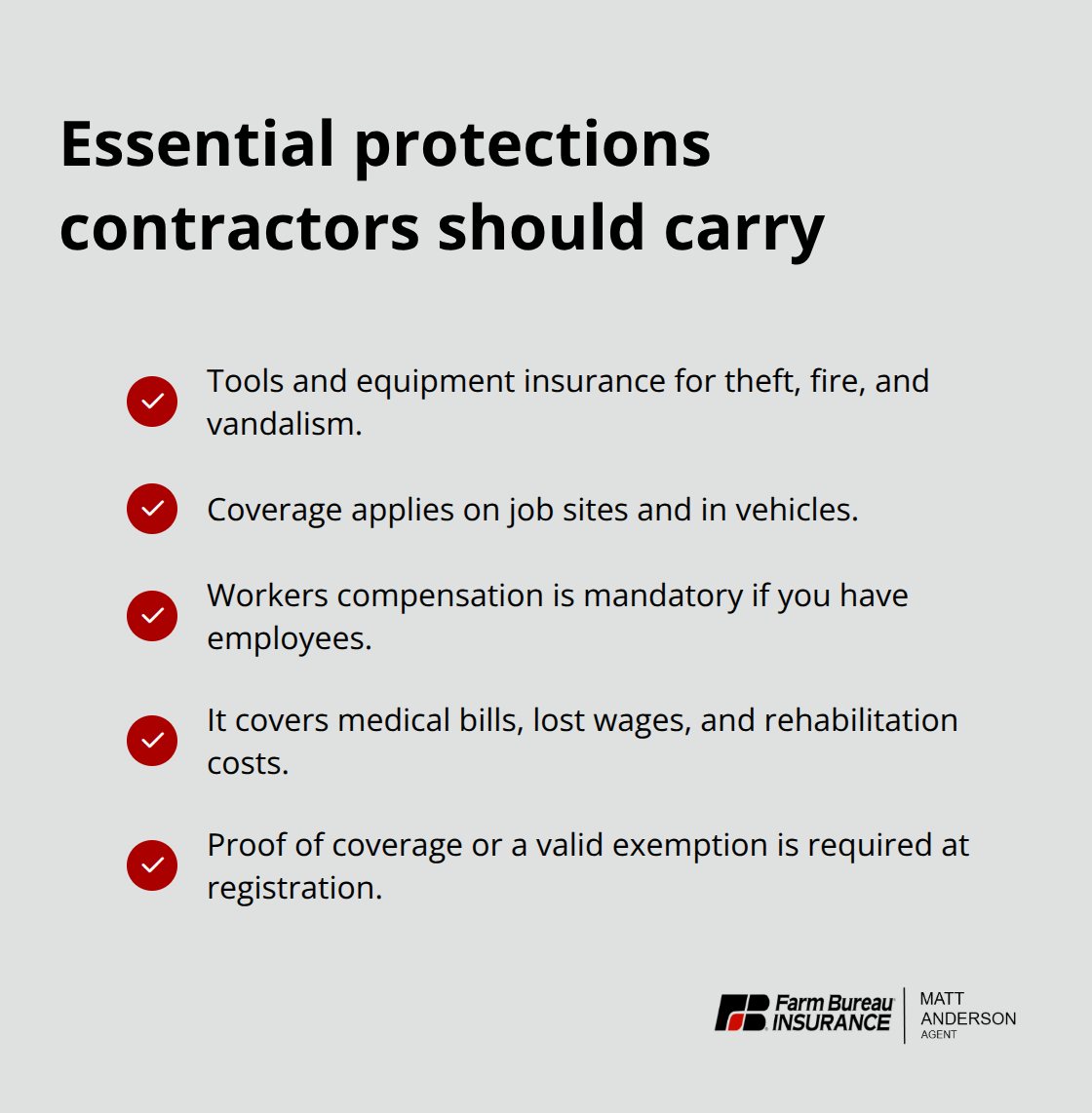
Tools, equipment, and job site materials represent significant financial assets that standard liability policies do not cover. Tools and equipment insurance protects against theft, fire, vandalism, and other losses on the job site or in your vehicle. A single theft can wipe out weeks of profit, especially for specialty trades, which makes this coverage highly recommended. Workers compensation is mandatory in Idaho if you have employees, and it covers medical expenses, lost wages, and rehabilitation costs when a worker gets injured on the job.

Checklist of key coverages and compliance items Idaho contractors should maintain - Idaho professional contractor insurance

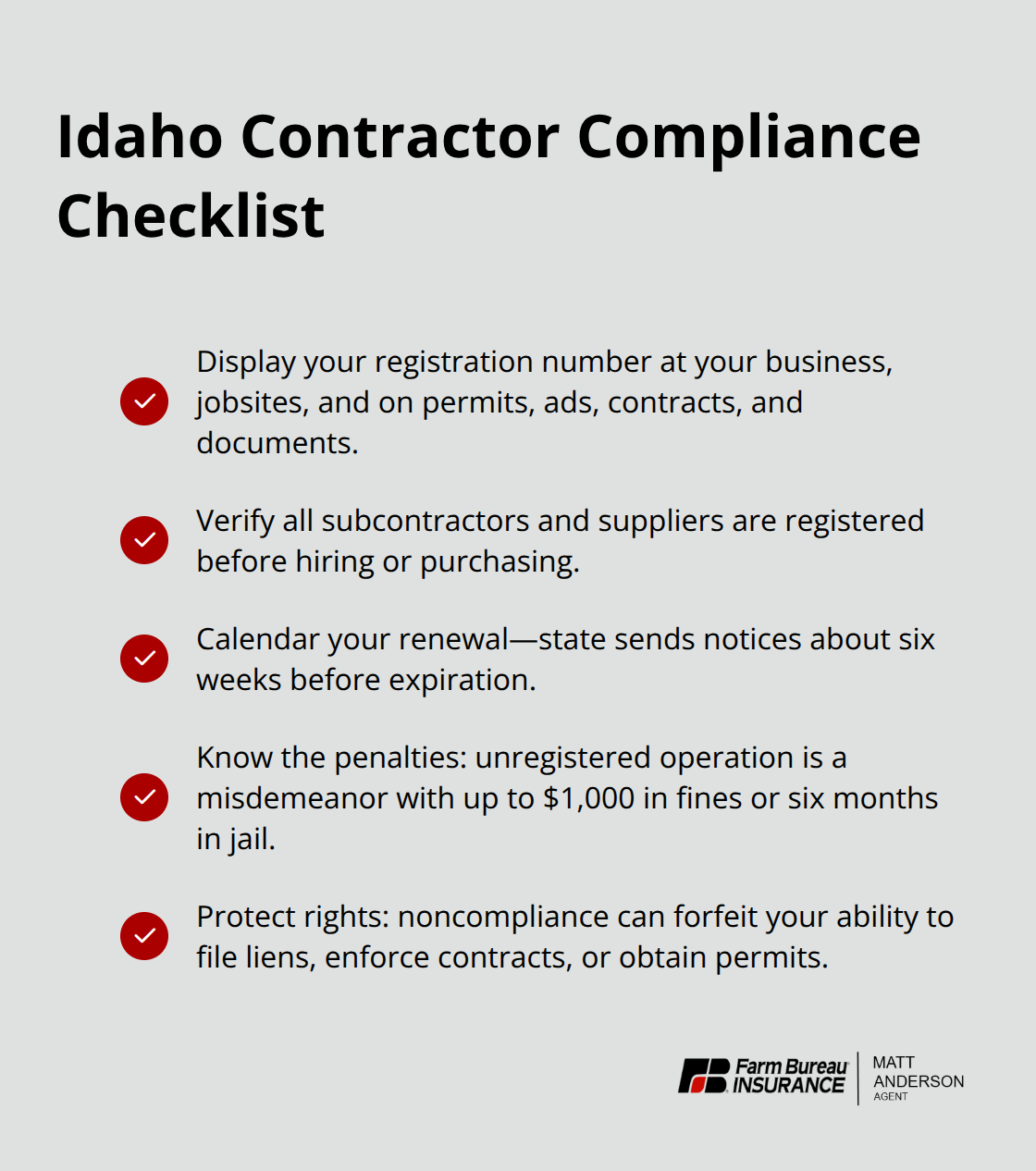
You must provide proof of coverage or a valid exemption when you register with the Idaho Contractors Board.

Commercial Auto and Property Coverage

Commercial auto insurance is essential since Idaho minimum requirements are $25,000 bodily injury per person, $50,000 per accident, and $15,000 property damage (though contractors typically carry higher limits). Your vehicles face unique risks on job sites and during transport between locations. Commercial property insurance also protects owned or leased business property from damage or vandalism, which matters when you maintain a shop, office, or storage facility.

Adjusting Coverage as Your Business Grows

When you work on multiple job sites across different counties or expand your service area, your coverage needs change. You should review your policies annually to verify that your endorsements still match your actual risk and that defense costs are structured to maximize your protection. This assessment becomes especially important before you bid on larger projects or hire additional team members.

Why Your Idaho Contractor Registration Requires Real Insurance

The Legal Mandate Behind Coverage Requirements

Idaho law makes this straightforward: if you register as a contractor with the Idaho Contractors Board for projects over $2,000, you must carry general liability insurance with a minimum of $300,000 single limit. The state treats this requirement as a legal mandate tied directly to your ability to operate and collect payment. Without proof of coverage when you register, the Board will not approve your application.

Compact list of Idaho contractor legal requirements and consequences - Idaho professional contractor insurance

Operating without registration blocks your access to building permits, eliminates your lien rights on unpaid jobs, and exposes you to a misdemeanor charge carrying up to $1,000 in fines or six months in jail under Idaho Code. In fiscal year 2025, the Idaho Department of Professional and Licensing reported 485 contractor complaints, many involving uninsured or underinsured contractors who left clients and subcontractors facing financial loss.

Why the Minimum Coverage Falls Short

The $300,000 minimum Idaho requires proves inadequate for real-world projects, and clients recognize this gap. General contractors and property owners now demand that you name them as additional insured on a certificate of insurance before they sign a contract or cut a check. Most Idaho contractors carry $1 million per occurrence and $2 million aggregate specifically because client contracts and project requirements commonly demand those higher limits. A single accident on a job site can cost thousands in medical bills, legal fees, and settlements-far exceeding the bare minimum. When you bid on projects over $500,000, clients require at least $1 million per occurrence, and larger commercial work routinely calls for $2 million or higher.

Documentation That Wins Contracts

Clients also require proof that your workers compensation coverage remains active and that your general liability policy includes products and completed operations coverage. Without these protections in place and documented, you lose bids, delay project starts, and signal to clients that you lack experience or financial stability. Carrying adequate coverage backed by an Idaho-licensed insurer positions you as a professional and removes obstacles to winning work. The right coverage demonstrates that you take client protection seriously and that you can handle the financial consequences when accidents happen.

Moving Forward With Confidence

Understanding your registration requirements and carrying coverage that exceeds the minimum sets you apart in Idaho’s construction market. The next step involves selecting the right coverage limits and deductibles for your specific trade and project types-a decision that depends on your annual revenue, the size of jobs you typically handle, and the risks unique to your work.

How to Match Coverage Limits to Your Actual Project Risk

Starting with your annual revenue and typical job values gives you a concrete foundation for coverage decisions. If you handle residential remodels under $50,000, a $300,000 limit satisfies legal requirements, but the moment clients demand certificates of insurance naming them as additional insured, you’ll find that bare minimum insufficient. Most Idaho contractors working on projects between $50,000 and $500,000 operate effectively with $1 million per occurrence and $2 million aggregate-the same limits that client contracts and project requirements commonly demand.

Scaling Coverage to Project Size

For commercial work or projects exceeding $500,000, clients routinely require at least $1 million per occurrence and often push toward $2 million or higher. The Hartford offers flexible combinations from $300,000 to $2 million per occurrence with aggregate options up to $4 million, allowing you to match your limits to the projects you actually bid. Your deductible choice affects cash flow more than many contractors realize: common Idaho deductibles run $1,000 or $2,500, but selecting a $5,000 deductible can cut premiums by roughly 15 to 20 percent if your business can absorb that cost when a claim occurs.

Understanding Defense Costs and Settlement Funds

Some policies include defense costs inside the coverage limit, while others pay defense costs separately-a critical distinction that determines how much remains available for settlements. Before committing to any quote, compare offers from at least three Idaho-licensed insurers to understand price differences, whether limits align with your project mix, and how each handles defense costs versus settlement funds.

Specialty Trades and Endorsement Gaps

Contractors performing electrical, plumbing, HVAC, or fire sprinkler work may hold licenses from the Division of Occupational and Professional Licenses (DOPL) that exempt them from contractor registration when operating within their scope, but general liability insurance requirements do not disappear. Endorsements such as contractual liability coverage or products-completed operations fill gaps that standard policies leave exposed and often prove worth the additional cost on real job sites.

Adjusting Coverage as Your Business Evolves

When you work across multiple counties or expand service areas, your coverage needs shift, making annual policy reviews essential to verify that coverage limits align with current project values and contractual requirements. Larger projects or new employee hires warrant immediate coverage assessment before you bid or start work, since underestimating risk exposes your business to claims exceeding your limits. We at Matt Anderson Insurance help Idaho contractors evaluate these endorsements and adjust coverage as operations evolve, ensuring protection grows alongside your business rather than lagging behind it.

Final Thoughts

Professional contractor insurance in Idaho protects more than just your business-it protects your clients, your team, and your financial future. The state requires a minimum of $300,000 in general liability coverage to register with the Idaho Contractors Board, but that baseline leaves you exposed on real projects where clients demand $1 million per occurrence and higher limits. One accident costs thousands in medical bills, legal fees, and settlements, making adequate coverage non-negotiable.

Start with an honest assessment of your annual revenue, the typical size of projects you bid, and the specific risks your trade faces. Compare quotes from at least three Idaho-licensed insurers to understand how defense costs are structured, whether limits align with your project mix, and what endorsements fill gaps in standard policies. Your deductible choice matters too-a $5,000 deductible reduces premiums by 15 to 20 percent, but only if your business can absorb that cost when a claim occurs.

Percentage savings range when selecting a $5,000 deductible on contractor insurance

Idaho professional contractor insurance extends beyond general liability to include workers compensation (mandatory if you have employees), tools and equipment coverage (which protects against theft and job site losses), and commercial auto insurance (which covers the unique risks your vehicles face during transport and on-site work). As your business grows across multiple counties or takes on larger projects, annual policy reviews keep your coverage aligned with your actual risk. Contact Matt Anderson Insurance today to discuss how comprehensive contractor coverage gives you the confidence to bid bigger projects and operate without financial worry.

The information provided in this blog is for general informational purposes only and does not constitute legal, financial, or insurance advice. Coverage options, terms, and availability may vary. Please consult with a licensed professional for advice specific to your situation. Artificial intelligence may have been used to generate text and images in some blog articles.

Idaho Home Insurance Claims: A Step-By-Step Guide To Filing

Home damage happens fast. When it does, knowing how to file an Idaho home insurance claim can mean the difference between a smooth recovery and months of frustration.

At Matt Anderson Insurance, we’ve helped countless Idaho homeowners navigate the claims process. This guide walks you through each step, from the moment damage occurs to getting your claim resolved.

What to Do Right After Damage Strikes

Prioritize Safety First

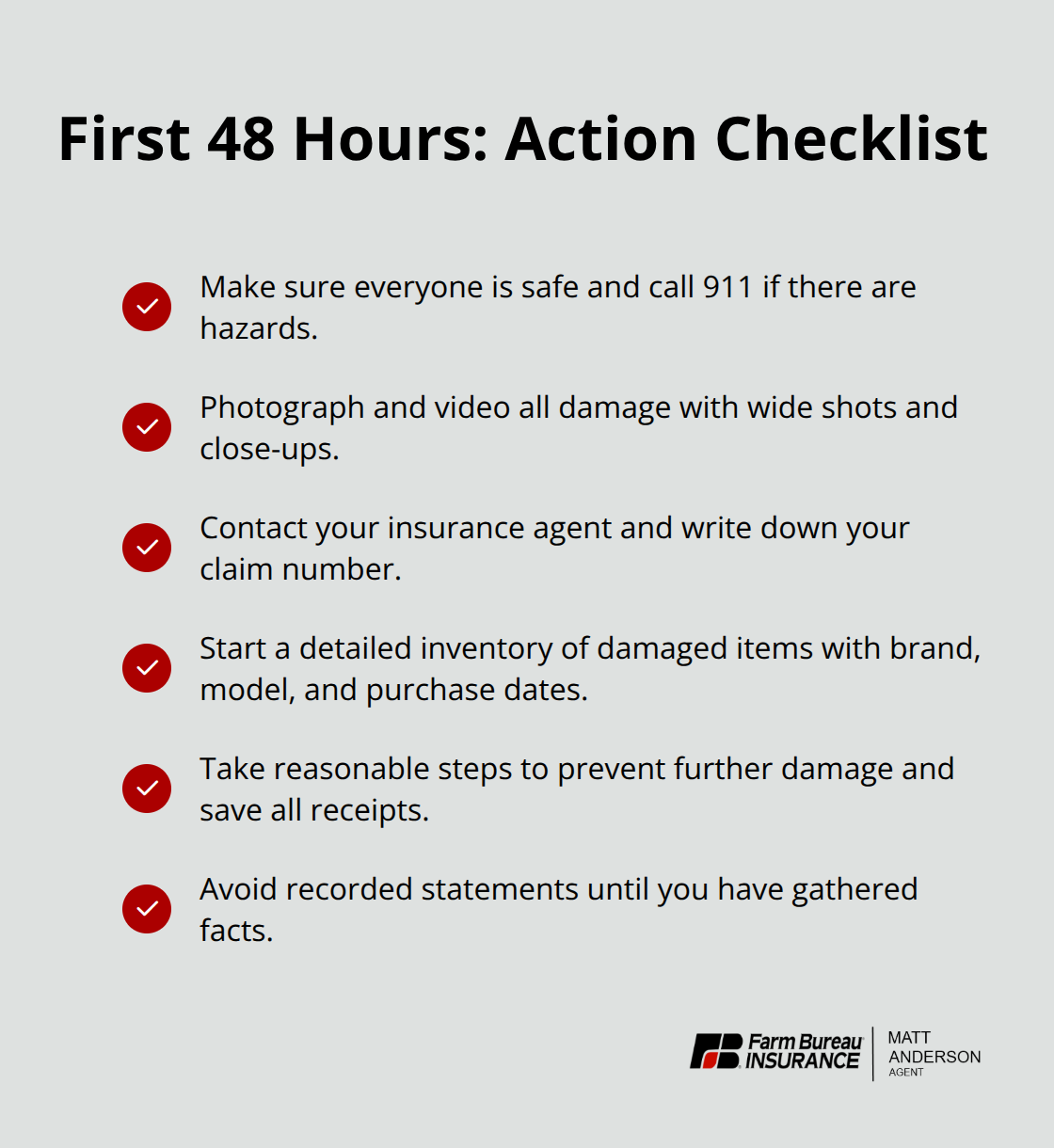
The first few hours after home damage occurs are critical. Your actions during this window directly influence how smoothly your claim moves forward and how much you’ll ultimately recover. Start by making sure everyone in your home is safe. If there’s a risk of gas leaks, downed power lines, or structural collapse, leave immediately and call 911. Once safety is confirmed, your next priority is documentation.

Document the Damage Thoroughly

Take multiple photos and videos from multiple angles of every damaged area-wide shots showing the overall scope, then close-ups of specific damage. Use your smartphone or camera in good lighting and shoot from different positions. Include the exterior of your home, interior rooms, the roof if visible, and any personal items that were damaged. The more detailed your visual record, the harder it is for an adjuster to dispute the extent of loss. If weather permits, capture images before any cleanup or temporary repairs.

Contact Your Insurance Agent Immediately

Call your insurance agent right away. Have your policy number ready and be prepared to describe what happened, when it happened, and what damage you see. Your agent will walk you through the next steps and assign a claim number-write this down and use it for all future communications. While you’re documenting, also start listing damaged items. Write down the brand, model, purchase date, and estimated value of anything that was damaged or destroyed. If you have receipts, warranty papers, or credit card statements, gather those now. Many homeowners underestimate the value of their possessions simply because they lack records.

Prevent Further Damage and Avoid Early Statements

Take reasonable steps to prevent further damage-tarp a damaged roof, board up broken windows, or stop a water leak-but don’t start major repairs or cleanup. Document what you do for mitigation and keep all receipts, as your insurer may reimburse these expenses. Avoid making recorded statements to the insurance company until you’ve had time to gather facts and think clearly about what happened.

Checklist of immediate steps after Idaho home damage to protect your claim - Idaho home insurance claims

Once you’ve completed these initial steps, your agent will guide you toward the next phase: understanding your policy coverage and preparing your formal claim submission.

Understanding Your Idaho Policy Before Filing

Review Your Coverage and Deductibles

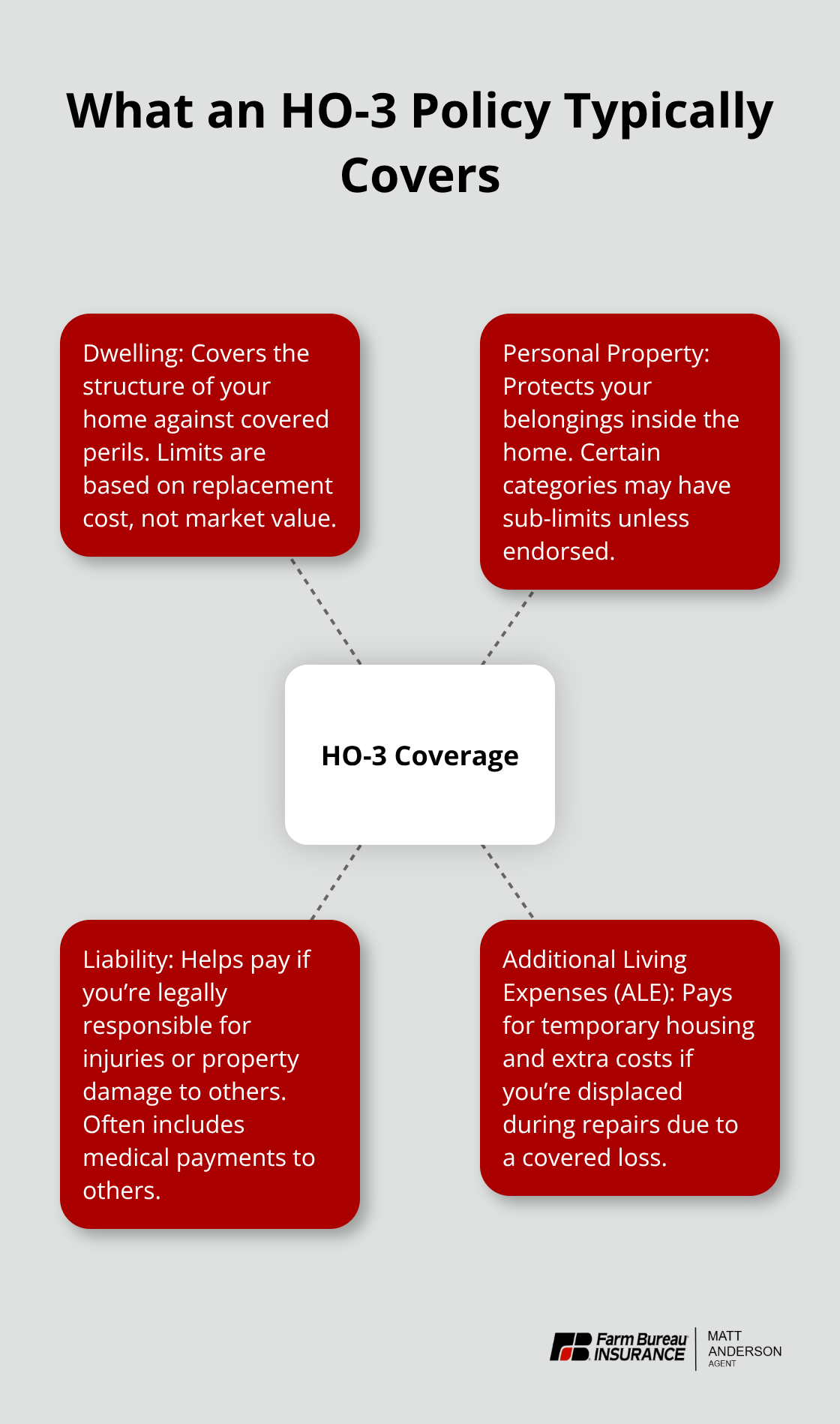
Your homeowners policy is a contract, and the fine print determines what you recover. Spend time reviewing your declarations page-the summary document that lists your coverage types, limits, and deductibles. Most Idaho homeowners carry a standard HO-3 policy, which covers the dwelling structure, personal property, liability, and additional living expenses if you’re displaced. The critical numbers are your coverage limit (the maximum the insurer will pay for dwelling damage) and your deductible (what you pay out of pocket). A common mistake occurs when homeowners assume their home’s replacement cost equals its market value.

Hub-and-spoke infographic showing standard HO-3 homeowners insurance coverage areas - Idaho home insurance claims

It doesn’t. Replacement cost is what it actually costs to rebuild your home with new materials, which often runs 15 to 25 percent higher than market value in Idaho’s current construction environment.

Identify Policy Exclusions and Endorsements

Your policy also contains exclusions-damage from floods, earthquakes, and wear-and-tear are almost never covered under a standard homeowners policy. If you live in a flood-prone area or near the Yellowstone Caldera, you’ll need separate flood and earthquake policies. Review any endorsements your agent added to your policy; these are modifications that expand or restrict coverage. For example, you may have an endorsement for replacement cost on personal property, which means your insurer reimburses what it costs to replace an item new, not what it’s worth after depreciation.

Gather Required Documentation

Once you understand your coverage, gather all documentation required for your claim submission. Your insurer will request a detailed inventory of damaged items, repair estimates from licensed contractors, photos of the damage, and proof of loss-a sworn statement describing what happened and the extent of damage. The Idaho Department of Insurance recommends using IRS Publication 584 to document personal property losses; this free resource walks you through calculating replacement values for household contents.

Prepare for the Adjuster Inspection

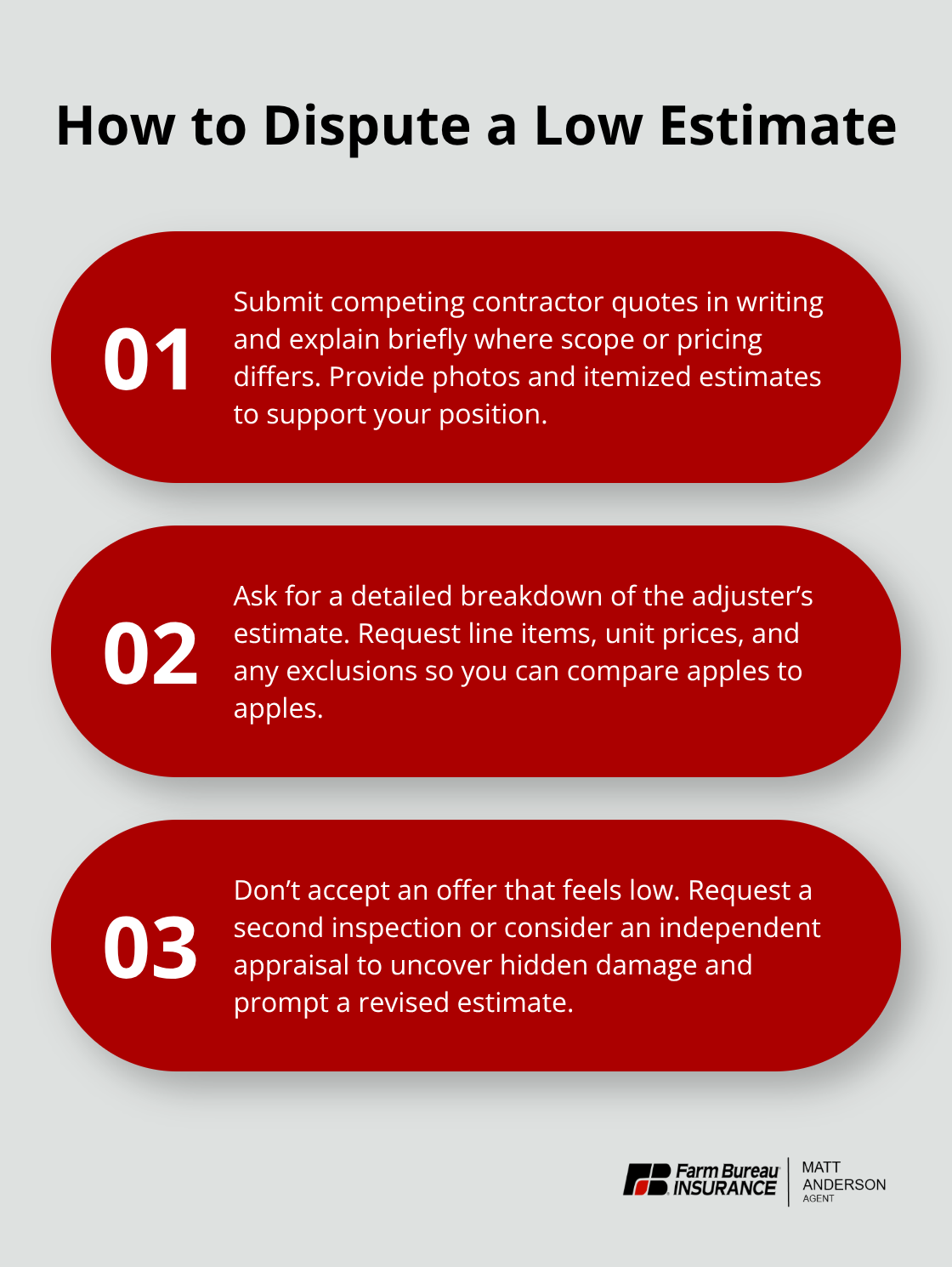
When the adjuster contacts you, they’ll verify the information in your claim, inspect the damage in person, and prepare an estimate. This is where many homeowners encounter friction. Adjusters work for the insurance company, not for you, and their priority is controlling costs. If the adjuster’s estimate seems low compared to contractor quotes you’ve obtained, provide those quotes in writing and ask for a detailed explanation of any discrepancies. Don’t accept the first settlement offer if you believe it’s unfair. Request a second inspection or hire an independent appraiser to review the damage assessment. The cost of an independent appraisal typically ranges from 300 to 800 dollars, but it often uncovers hidden damage-water intrusion, structural issues, or mold-that the initial adjuster missed. Keep all communications in writing via email, and log the dates, names, and details of phone conversations. This paper trail protects you if a dispute arises later.

With your policy reviewed and documentation in hand, you’re ready to submit your formal claim and work with the adjuster to establish the scope of repairs needed.

How to Speed Up Your Claim Settlement

Organize Your Documentation Immediately

Once your adjuster inspects the damage and provides an initial estimate, the resolution phase begins. Organization becomes your competitive advantage at this point. Create a dedicated file-physical or digital-containing every piece of documentation related to your claim. Include the adjuster’s inspection report, all contractor estimates you obtained, photos organized by room or damage type, receipts for mitigation work, your detailed inventory of damaged items with purchase dates and values, and copies of every email or written communication with your insurance company. Use a spreadsheet to track dates, claim numbers, adjuster names, and the substance of each conversation. The Idaho Department of Insurance reports that organized, complete documentation settle faster than those submitted piecemeal.

Submit Information Quickly and Completely

Insurance companies process thousands of claims annually, and yours moves faster when the adjuster doesn’t need to chase missing information. When you respond to adjuster requests, include a cover email summarizing what you’re submitting and reference your claim number on every document. Try to respond to adjuster requests within 48 hours whenever possible. Insurance companies set internal deadlines for claim closure, and delays on your end extend the entire timeline. If the adjuster requests items you don’t have, communicate in writing that you cannot provide them and explain why-don’t go silent.

Challenge Low Estimates with Evidence

If you disagree with the adjuster’s estimate, submit your own contractor quotes in writing with a brief explanation of why you believe the scope of repairs differs. Many adjusters underestimate hidden damage like water intrusion or structural issues that only surface during actual repairs. Ask the adjuster for a detailed breakdown of how they calculated the repair costs and what specific items or areas they excluded.

Three-step guide to challenging a low home insurance estimate with evidence

Don’t accept a settlement offer immediately if it feels low.

File an Appeal if the Offer Is Unfair

If you believe the offer is unfair after reviewing the adjuster’s reasoning, file a formal appeal with your insurance company. Most carriers allow a second inspection or independent appraisal at minimal cost. If your insurer denies coverage entirely or refuses to budge on a significantly low offer, contact the Idaho Department of Insurance Consumer Affairs team at 208-334-4250. They cannot force settlement, but they investigate whether the insurer violated Idaho Insurance Code provisions or acted in bad faith.

Final Thoughts

Filing Idaho home insurance claims works best when you act fast after damage strikes, document everything thoroughly, and stay organized throughout the process. Contact your insurance agent immediately with your policy number ready, review your coverage limits and deductible, and submit a complete inventory of damaged items with purchase dates, contractor estimates, and supporting receipts. Respond to adjuster requests within 48 hours when possible, challenge any low estimates with your own quotes in writing, and file a formal appeal if the settlement offer seems unfair.

We at Matt Anderson Insurance understand that navigating Idaho home insurance claims can feel stressful and complicated. Our licensed agents guide you through every step, from the initial damage assessment to final settlement, and help you understand what your policy covers and advocate for fair treatment from the insurance company. We also work with you to identify coverage gaps and recommend adjustments that better protect your home against future losses.

Your next step is simple: review your current homeowners policy and contact us if you have questions about your coverage or deductibles. Visit Matt Anderson Insurance to speak with an agent about your specific needs and get a quote today.

The information provided in this blog is for general informational purposes only and does not constitute legal, financial, or insurance advice. Coverage options, terms, and availability may vary. Please consult with a licensed professional for advice specific to your situation. Artificial intelligence may have been used to generate text and images in some blog articles.
Idaho Liability Auto Insurance: Understanding Your Auto Liability Coverage

A single accident can wipe out your savings and damage your financial security for years. Idaho liability auto insurance is the legal shield that protects you from paying those costs out of pocket.

Most Idaho drivers carry only the minimum coverage required by law-and that’s a mistake. We at Matt Anderson Insurance see firsthand how inadequate limits leave drivers exposed to serious financial risk.

What Liability Coverage Actually Means

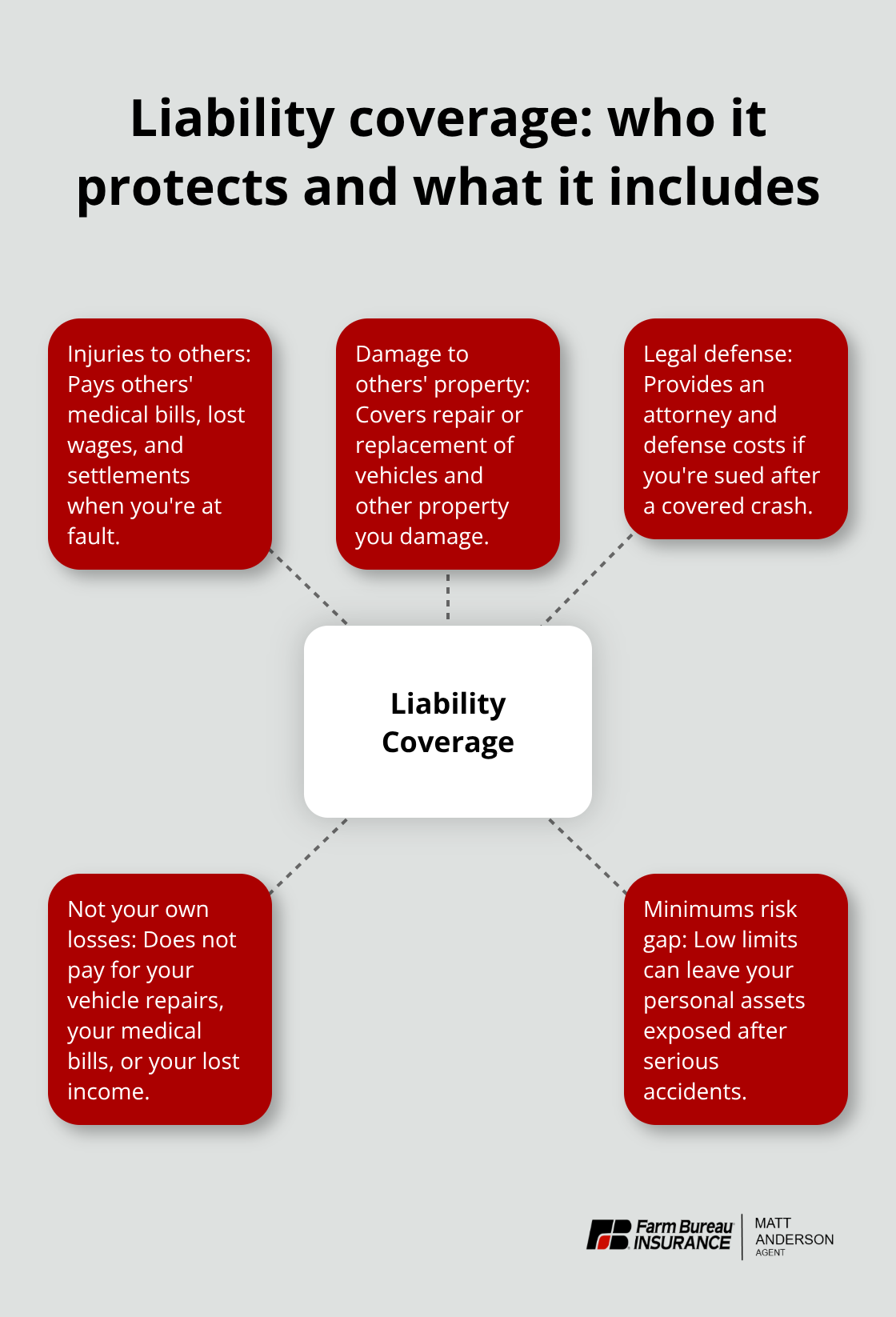
Auto liability insurance pays for injuries and property damage you cause to other people when you’re at fault in a crash. Idaho law requires you to carry a minimum of $15,000 in Property Damage Liability coverage, according to the Idaho Department of Insurance. If you hit another car and injure the driver, your bodily injury coverage pays for their medical bills, lost wages, and legal settlements up to your limit. Property damage liability covers the cost to repair or replace the other vehicle and any other property you damage. The critical distinction is that liability insurance protects the other person-not you. It doesn’t pay for your own vehicle repairs, your medical bills, or your lost income. That’s why so many Idaho drivers who carry only minimums end up financially devastated after serious accidents.

Visualizing what Idaho auto liability does and does not cover - Idaho liability auto insurance

The Real Cost of Staying at Minimum Limits

Idaho’s minimum coverage amounts sound adequate until you see actual accident costs. A single serious injury claim can easily exceed $50,000 in medical expenses alone, not counting pain and suffering or long-term care. If you hit a vehicle with multiple occupants or cause injury to a high-income earner, you could owe far more than your policy covers. At that point, creditors can pursue your wages, bank accounts, and assets to satisfy the judgment. Moving from the state minimum to $100,000 per person and $300,000 per accident typically costs only an additional $10 to $20 per month, yet it dramatically reduces your personal liability risk. Many Idaho drivers don’t realize they can customize their limits to match their actual financial situation and the value of what they own.

How Liability Coverage Protects Your Long-Term Security

Without adequate liability coverage, a serious accident can trigger a lawsuit that follows you for years. Idaho courts regularly award damages well above the state minimums, especially in cases involving permanent injuries or multiple victims. Your liability policy also provides legal defense, meaning the insurance company pays for your attorney if you’re sued. This protection is invaluable because legal fees alone can reach tens of thousands of dollars before a case is resolved. Higher liability limits also give you negotiating power in settlement discussions-insurers with larger available coverage can resolve claims faster and for less total cost than fighting over inadequate minimums. The financial security you build through your home, retirement accounts, and business interests all becomes vulnerable if you’re underinsured.

What Happens When Your Limits Fall Short

Most Idaho drivers assume their minimum coverage will handle typical accidents. In reality, medical costs, vehicle damage, and legal judgments often far exceed what your policy can cover. A crash involving a newer luxury vehicle, multiple injured passengers, or long-term medical care can quickly exhaust your policy limits and leave you personally liable for the remainder. Courts don’t stop collecting damages just because your insurance runs out-they pursue your personal assets instead. This is where the gap between minimum coverage and adequate protection becomes painfully clear, and it’s why understanding your actual exposure matters far more than simply meeting the legal minimum.

What Coverage Limits Actually Mean in Idaho

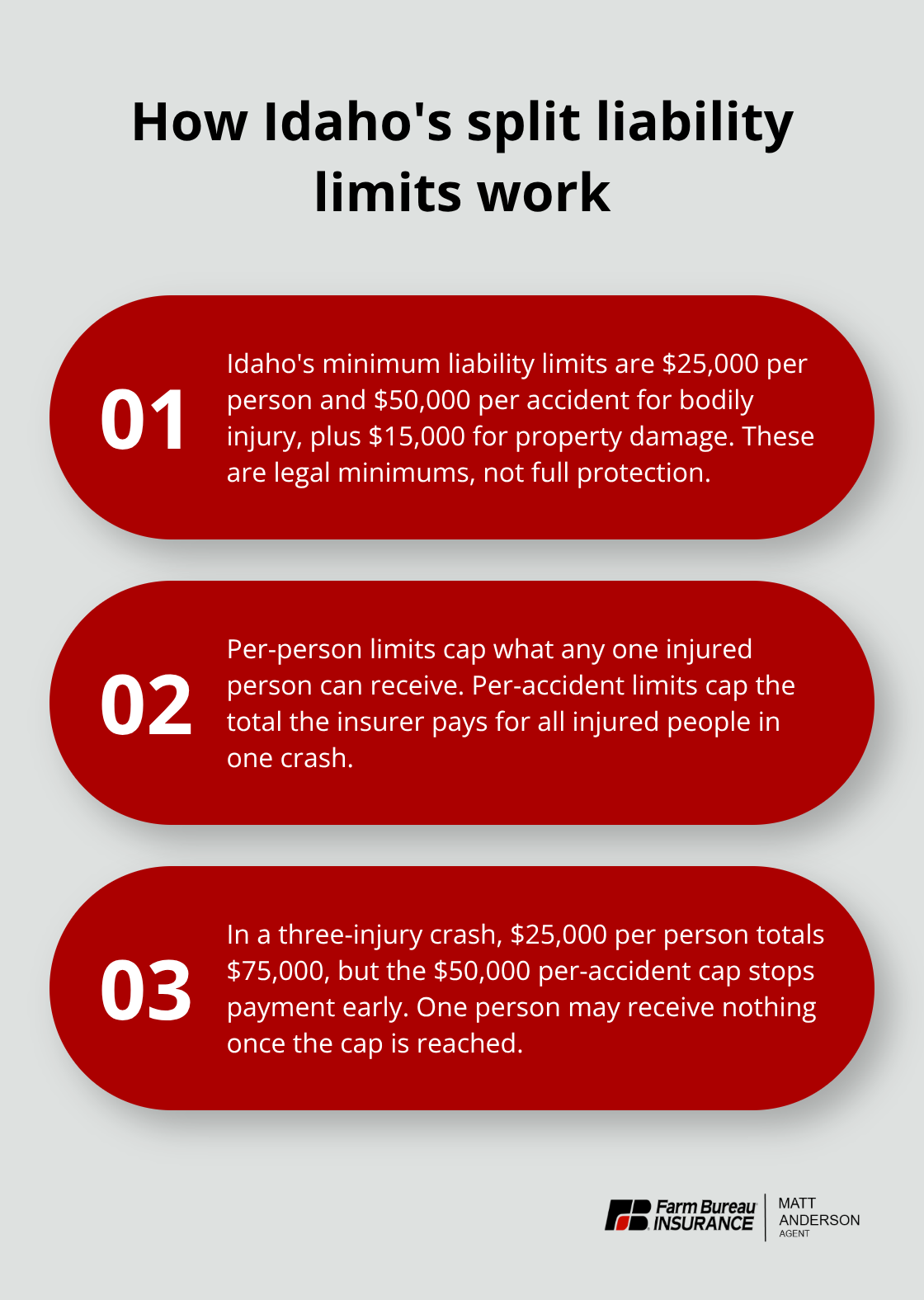
Bodily injury liability and property damage liability work together as your legal protection, but they operate independently with separate limits. Idaho’s minimum is $25,000 per person and $50,000 per accident for bodily injury, plus $15,000 per accident for property damage. The per-person limit applies to any single injured person, while the per-accident limit caps your total payout across all injured parties in one crash. If you cause an accident with three injured people and your limit is $25,000 per person, your policy pays up to $25,000 to each person-totaling $75,000-until you hit your per-accident cap of $50,000. That means the third person receives nothing from your insurance.

Three key facts about Idaho’s per-person and per-accident auto liability limits - Idaho liability auto insurance

Property damage works with a single per-accident limit, so a crash that damages two vehicles splits your $15,000 limit between them.

Why Most Idaho Drivers Stay Underprotected

Most Idaho drivers stay at minimums because they don’t understand these limits are split, not separate pools of money for each incident. Moving to $100,000 per person and $300,000 per accident costs roughly $12 to $18 monthly but protects you when crashes involve multiple people or expensive vehicles. This modest increase in premium transforms your financial exposure from catastrophic to manageable.

Real Costs Show Why Minimums Fail

A 2024 analysis by the National Safety Council found that the average hospital stay for a serious car accident injury costs $35,000 to $50,000 before any long-term care or lost wages. If you injure someone earning $75,000 annually and they miss six months of work, you owe $37,500 in lost wages alone. Add medical bills, pain and suffering settlements, and legal fees, and you’re easily at $100,000 to $150,000-far beyond Idaho’s $25,000 minimum. Luxury vehicles involved in accidents push property damage claims past $50,000 quickly.

Umbrella Coverage Fills the Gap

Umbrella coverage sits above your auto liability limits and activates when your primary policy maxes out, protecting your home equity and retirement accounts from judgment claims. You can purchase umbrella policies starting at $1 million for drivers with significant assets, and they typically cost only $100 to $200 annually. Without this layer, a serious accident judgment forces asset liquidation or wage garnishment for years. The combination of higher auto liability limits plus umbrella protection creates a financial fortress that minimum coverage simply cannot provide.

Understanding your actual exposure to liability claims reveals why so many Idaho drivers face devastating consequences after serious accidents. The next section examines the specific types of liability coverage available and how each one protects different aspects of your financial security.

Where Idaho Drivers Go Wrong with Liability Coverage

Most Idaho drivers lock in minimum coverage at age 25 and never revisit it for the next 30 years. Life changes dramatically-you buy a home worth $350,000, your income doubles, you marry and have children-but your liability limits stay frozen. This pattern repeats constantly, and it creates a financial disaster waiting to happen. The problem isn’t that drivers are careless; it’s that they don’t understand what happens when a judgment exceeds their coverage. Idaho courts don’t care about your policy limits. If you owe $200,000 and your insurance pays $50,000, creditors pursue the remaining $150,000 through wage garnishment, asset seizure, and liens against your home. A single accident can trigger 10 years of financial hardship because you saved $15 monthly by staying at minimums.

The Mistake of Treating Liability as Optional

Drivers often assume they need collision and comprehensive for their own vehicle but skip higher liability limits because they don’t see direct benefit to themselves. This backward thinking costs Idaho drivers hundreds of thousands annually. If you own a home, have retirement savings, or earn a decent income, your liability exposure far exceeds the state minimum. A crash involving a family in a newer luxury SUV-common on Idaho roads-generates medical bills, vehicle damage, and pain-and-suffering claims that routinely hit $150,000 to $300,000. Your $50,000 auto policy limit covers only a fraction of that total.

Ignoring Life Changes That Increase Your Risk

The third critical mistake happens after major life changes. You get married, purchase property, start a business, or receive an inheritance, but you never adjust your liability coverage to match your new financial situation. Many Idaho drivers carry minimum limits while protecting $400,000 in home equity-an obvious mismatch. Life changes should trigger an automatic coverage review. Getting married, buying a home, starting a business, or significant income increases all require reassessing your liability exposure. Most people spend more time planning a vacation than reviewing insurance that protects everything they own.

How to Fix Your Coverage Today

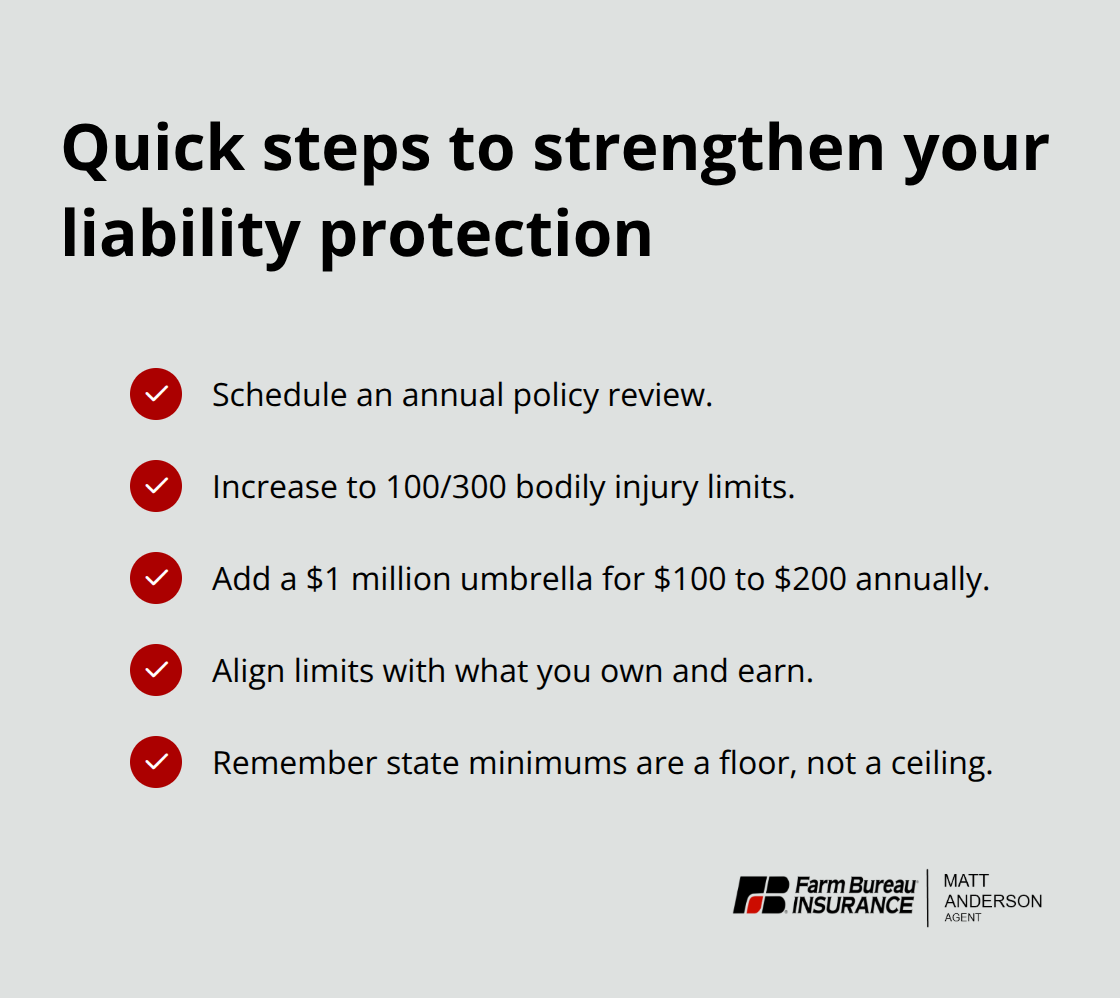
The solution is straightforward: schedule an annual policy review, not as a chore but as essential financial maintenance. Increasing to $100,000 per person and $300,000 per accident costs roughly $12 to $20 monthly-less than a streaming subscription-yet eliminates catastrophic financial risk. Adding umbrella coverage at $1 million for $100 to $200 annually creates a financial safety net that minimum coverage cannot provide. Your liability limits should reflect what you own and earn, not what the state legally requires.

Action checklist for Idaho drivers to increase liability and add umbrella coverage

Idaho’s minimums exist as a floor, not a ceiling, and staying there while building real wealth is financial negligence disguised as prudence.

Final Thoughts

Idaho liability auto insurance protects everything you’ve worked to build, not just your legal obligation to carry coverage. A single serious accident triggers judgments that exceed your policy limits, forcing wage garnishment, asset seizure, and years of financial hardship-but moving from Idaho’s $25,000 per person minimum to $100,000 per person costs only $12 to $20 monthly. Adding umbrella coverage at $1 million for $100 to $200 annually creates a financial fortress that protects your home, retirement accounts, and future earnings.

We at Matt Anderson Insurance work with Idaho drivers every day to align their coverage with their actual financial situation rather than the legal minimum. Our licensed agents understand Idaho’s specific requirements and help you build a protection strategy that covers your home, your income, and your family’s security. We offer comprehensive personal coverage including auto, home, umbrella, and more, with bundling discounts that reduce your total cost while increasing your protection.

Start by reviewing your current policy limits today-if you’re carrying minimums, schedule a conversation with one of our agents to discuss higher liability limits and umbrella coverage options. Contact Matt Anderson Insurance to schedule your free policy review and get the coverage that matches your real financial situation, not just the legal requirement.

The information provided in this blog is for general informational purposes only and does not constitute legal, financial, or insurance advice. Coverage options, terms, and availability may vary. Please consult with a licensed professional for advice specific to your situation. Artificial intelligence may have been used to generate text and images in some blog articles.

Idaho Auto Insurance Discounts: Ways To Lower Your Premiums

Idaho auto insurance premiums don’t have to drain your budget. There are real discounts available right now that most drivers overlook, and we at Matt Anderson Insurance want to show you exactly how to claim them.

This guide walks through the discounts you qualify for, proven strategies to cut costs, and how working with a local agent gets you the best rates in your area.

Idaho Auto Insurance Discounts That Actually Lower Your Premiums

Safe Driving Rewards Your Clean Record

Safe driving is the single most effective way to reduce what you pay for auto insurance in Idaho, and carriers reward it aggressively. If your household has no accidents or traffic violations, you qualify for a good driver discount that can lower your premium noticeably. State Farm, for example, offers a Good Driving Discount for drivers without claims in the household, and their Defensive Driving Course Discount applies to drivers 55 and older who completed an approved Motor Vehicle Accident Prevention Course within the last three years. A clean driving history directly translates to lower premiums, and staying accident-free protects that discount year after year.

Bundling Multiple Policies Unlocks Substantial Savings

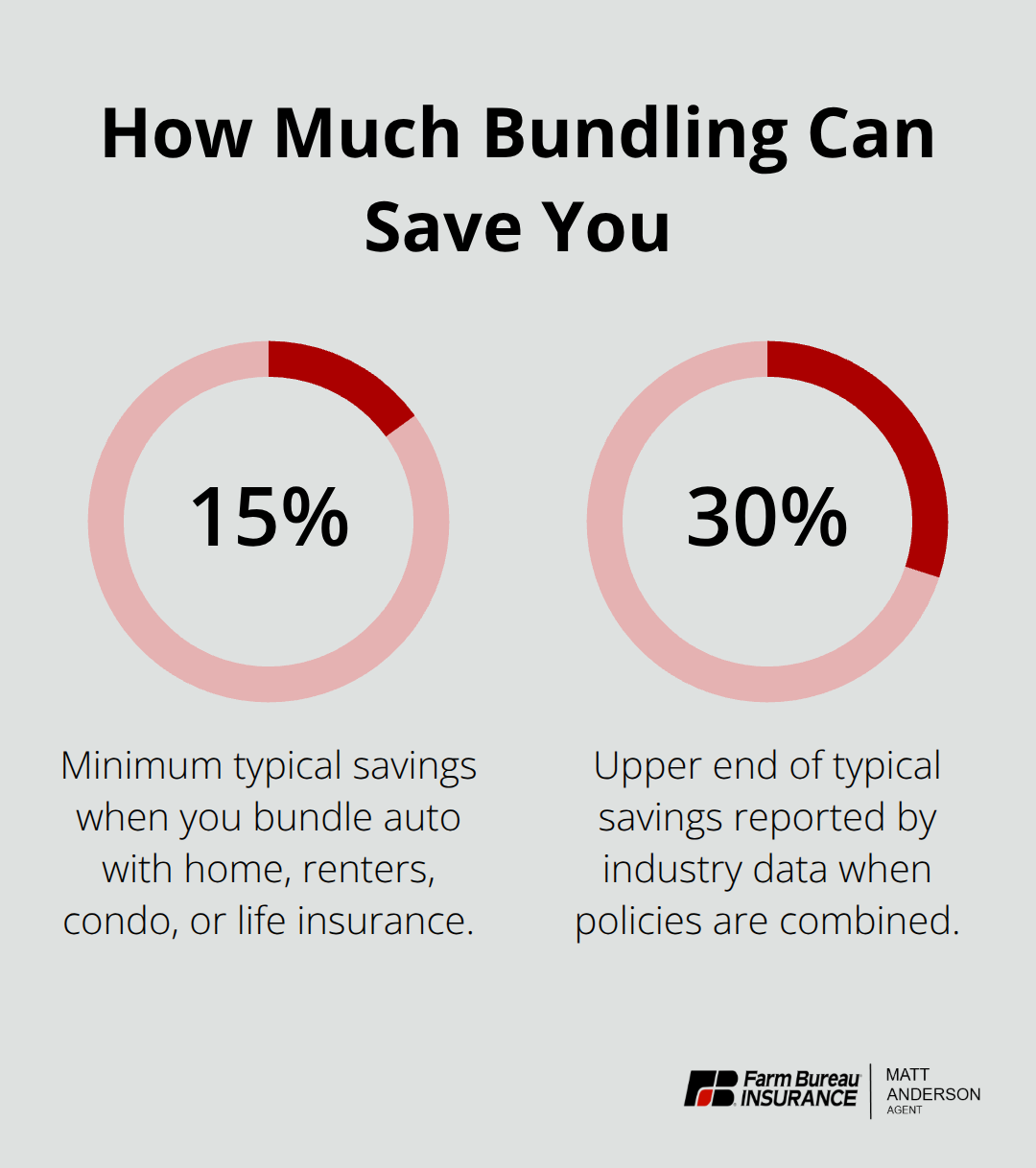
Beyond safe driving, bundling multiple policies with the same insurer delivers substantial savings. When you combine auto with homeowners, renters, condo, or life insurance, you can save 15–30% according to industry data-and sometimes more depending on which carrier you choose. Bundling works because insurers reward customer loyalty and the reduced administrative cost of managing multiple policies under one roof. If you insure a home and a vehicle separately with different companies, you leave hundreds of dollars on the table each year.

Visual showing potential savings from bundling auto with other policies

Student Discounts Recognize Academic Responsibility

Good student discounts apply to drivers under a certain age (typically 25) who maintain a B average or higher, or to full-time students who leave their vehicle at home while away at school. This discount recognizes that academic responsibility correlates with safer driving behavior. The discount typically ranges from 5% to 10%, depending on the carrier and your specific situation. A young driver with good grades, a clean record, and bundled policies can stack discounts that compound into meaningful annual savings.

Vehicle Safety Features and Additional Discounts

Vehicle safety features also matter: anti-theft devices and advanced safety technology can reduce your premium, and some carriers now offer discounts for electric vehicles. You may qualify for multiple discounts simultaneously, and the key is asking your agent about every discount you might qualify for-carriers don’t automatically apply them all. Most drivers miss discounts related to affiliations, payment methods, or specific vehicle features simply because they didn’t ask. Annual policy reviews catch these opportunities and help you adjust coverage to match your actual driving patterns and life circumstances, which sets the stage for the next critical step: knowing which strategies actually maximize your savings beyond discounts alone.

Strategies To Maximize Your Savings on Auto Insurance

Increase Your Deductible to Lower Monthly Payments

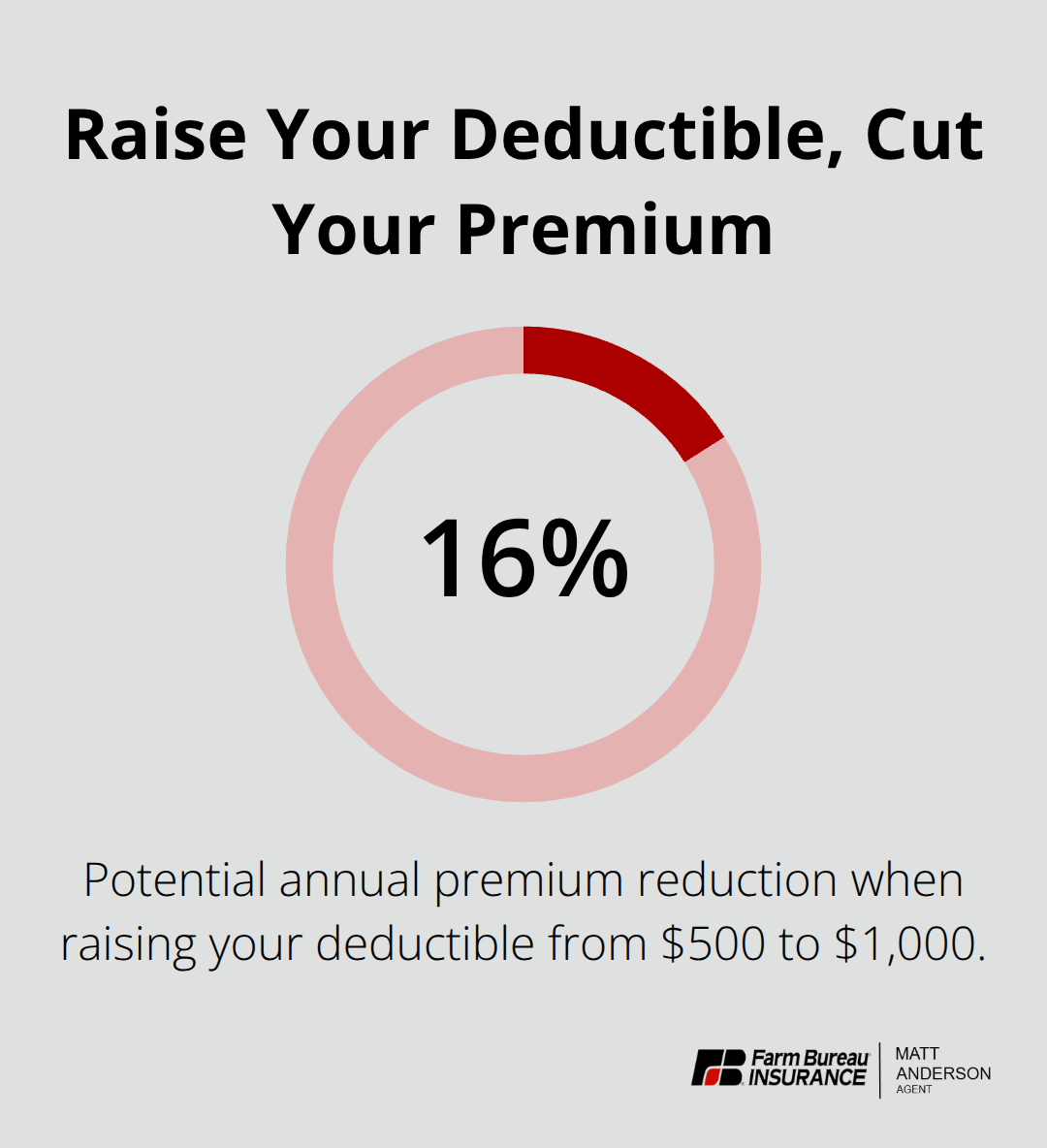
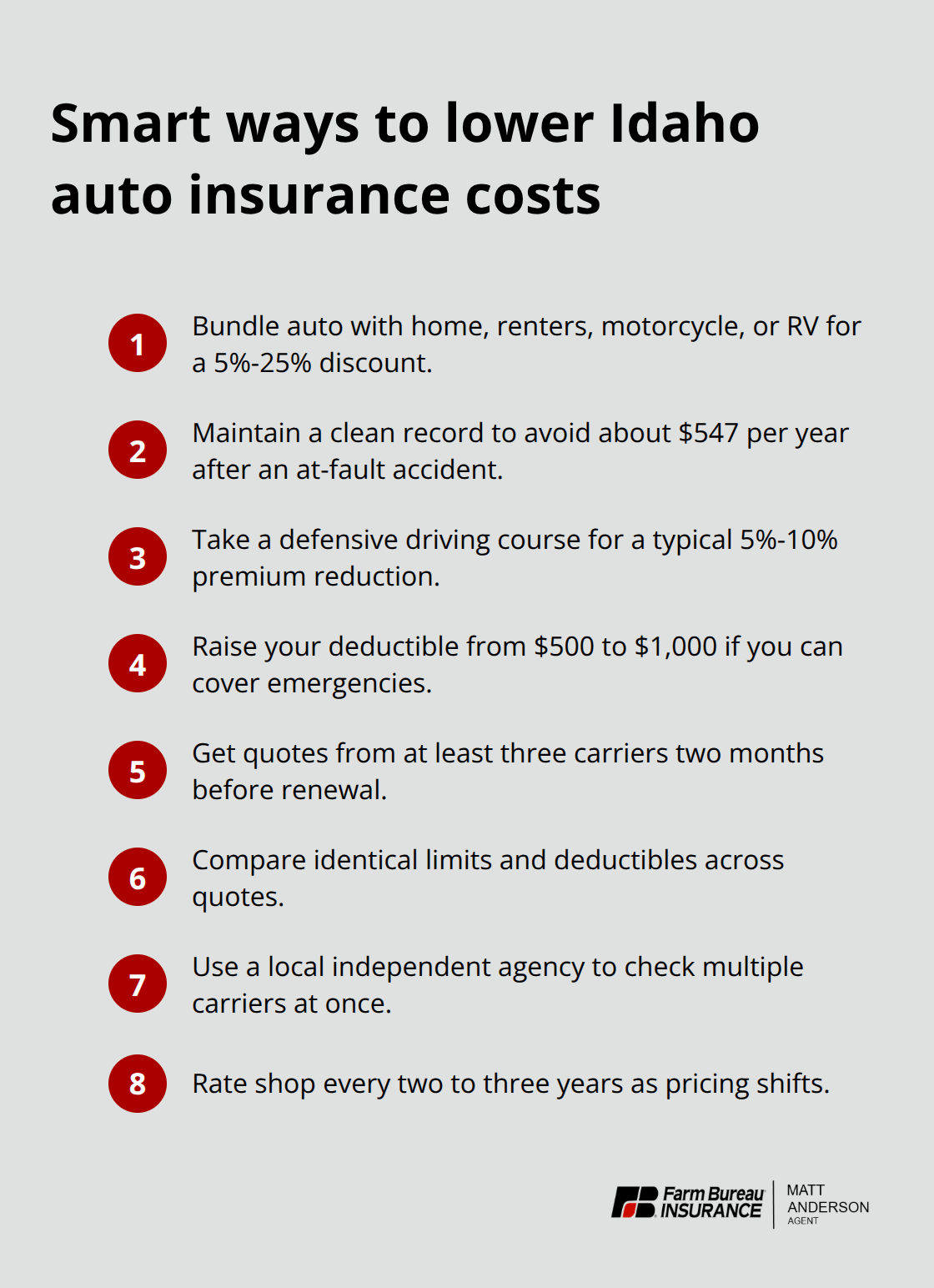
The fastest way to lower your premium starts with deductible decisions. Increase your deductible from $500 to $1,000 and you can reduce your annual premium by up to 16 percent. The math is straightforward: a $500 increase in deductible saves you real money every month, and unless you file a claim every few years, you come out ahead.

Graphic illustrating premium reduction from increasing deductible to $1,000 - Idaho auto insurance discounts

However, this strategy only works if you can actually afford to pay $1,000 out of pocket when an accident happens. If a $1,000 unexpected expense would strain your budget, stick with the lower deductible even if your premium stays higher. Make an intentional choice based on your savings capacity, not on chasing the lowest premium regardless of whether you can cover the deductible.

Match Your Coverage to Your Vehicle’s Actual Value

Your coverage mix matters more than most drivers realize. Many people carry full coverage on a vehicle worth $6,000 while paying $1,200 yearly in collision and comprehensive premiums, which means they recover their car’s entire value in five years of claims. If your vehicle is older or has low market value, dropping collision coverage saves hundreds annually and makes mathematical sense. Conversely, if you financed or leased your vehicle, your lender requires full coverage, so this decision is already made for you. Annual policy reviews catch these misalignments and help you identify what coverage actually protects you versus what you’re paying for unnecessarily.

Adjust Coverage Based on Your Driving Patterns

Your driving patterns directly affect which coverage you need. If you work from home and drive 5,000 miles yearly instead of 15,000, you may qualify for low-mileage discounts or usage-based programs that reward lighter driving. Set a calendar reminder each year to review your vehicle values, your driving patterns, and your coverage limits. This annual check ensures your policy reflects your real life, not coverage that made sense five years ago. Idaho Department of Insurance resources and local agents can help you identify which coverage actually protects you and which policies you can safely reduce.

Why Local Agents Beat Online Quotes Every Time

Online Platforms Show Only a Fraction of Available Rates

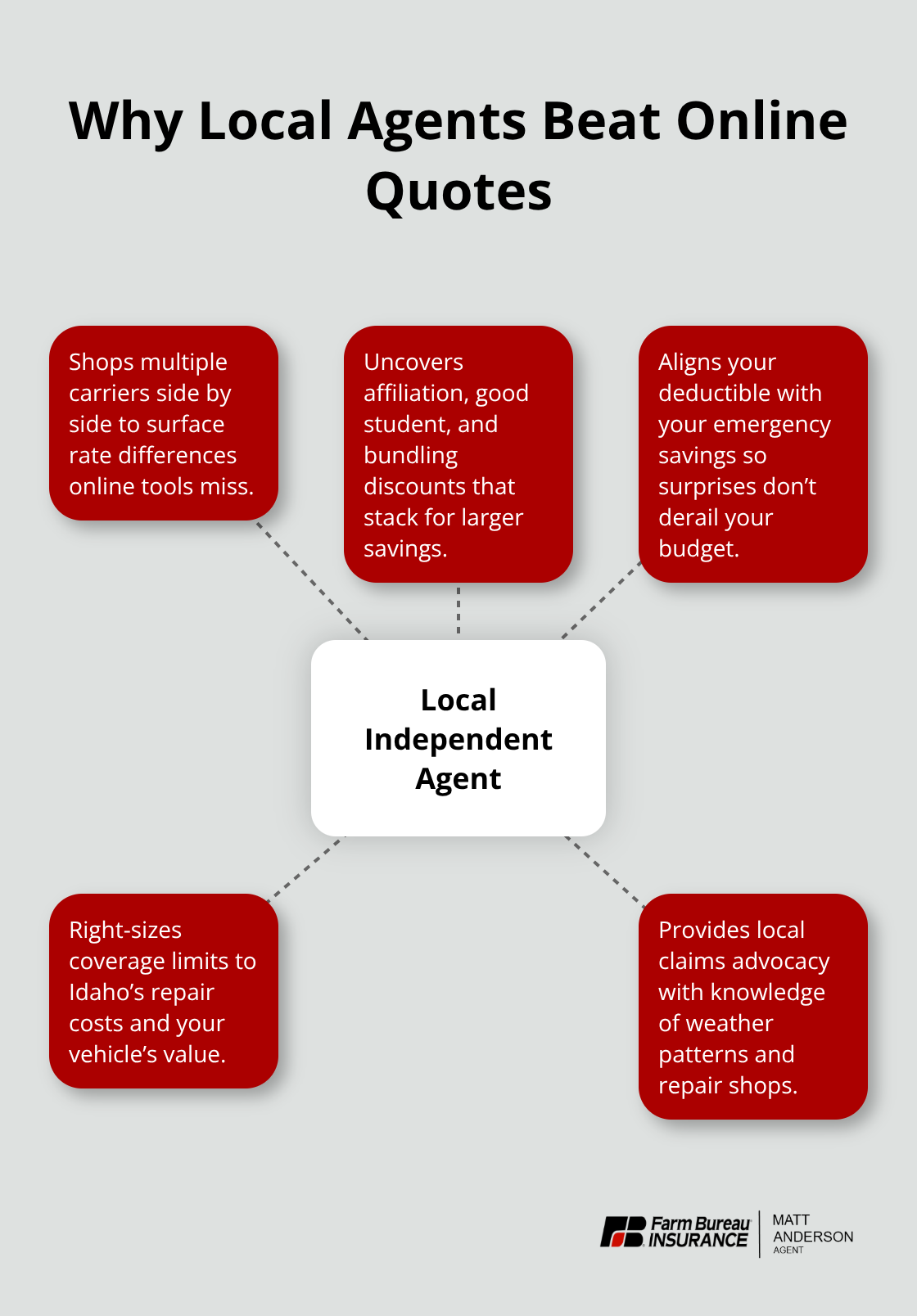
Shopping for auto insurance online feels fast, but speed costs you money. When you compare quotes on a single website, you see only carriers that pay to advertise there, not necessarily the ones offering the best rates for your specific profile. An independent agent accesses multiple carriers and runs your exact situation through each one, revealing rate differences that online tools simply miss. A driver in Boise might see a $1,200 annual quote online, but when an agent shops your profile across five carriers, one might quote $950 while another quotes $1,100-a $250 gap that compounds to thousands over a decade.

Agents Uncover Discounts You’d Never Find Alone

Agents catch discounts you would never find on your own. You might qualify for an affiliation discount through your employer, a good student discount you forgot about, or a bundling opportunity that stacks 15–30% in savings. Most online platforms ask basic questions and apply standard discounts, but they do not investigate your actual situation the way a local independent agent does. An agent reviews whether your current deductible aligns with your emergency savings, whether your coverage limits match Idaho’s rising repair costs, and whether dropping collision on that older vehicle makes sense financially.

Diagram showing how a local independent agent delivers better value than online quotes - Idaho auto insurance discounts

This personalized approach takes 30 minutes of conversation but saves hundreds annually because the agent knows the carriers, knows Idaho’s market, and knows which combinations work best for drivers in your area.

Local Support Matters When Claims Happen

Claims support matters significantly. When you file a claim with an online carrier, you talk to a call center in another state. A local independent agent handles claims with knowledge of Idaho weather patterns, local repair shops, and how claims actually work in your community. An agent advocates for you during the claims process, explains what coverage applies versus what does not, and helps you navigate the complexity. Online quotes do not include that support-you handle everything alone when something goes wrong, which is exactly when you need someone in your corner.

Final Thoughts

Idaho auto insurance discounts work best when you combine them strategically with coverage that matches your actual situation. Safe driving records, bundled policies, and student discounts form the foundation, but your real savings come from reviewing your policy annually and adjusting your deductible and coverage limits to fit your vehicle’s value and driving patterns. The gap between what you pay now and what you could pay is often substantial, and most drivers never close it because they shop online once and assume they found the best rate.

Working with a local agent changes that equation entirely. An agent accesses multiple carriers at once instead of showing you only advertised options, identifies every discount you qualify for, and structures your coverage to protect you without overpaying. This conversation reveals which Idaho auto insurance discounts apply to your profile and how much you can actually save-often hundreds of dollars annually that online quotes miss.

Contact Matt Anderson Insurance for a personalized review of your current coverage and driving situation. The process takes 20 minutes, and most drivers find savings they did not know existed.

The information provided in this blog is for general informational purposes only and does not constitute legal, financial, or insurance advice. Coverage options, terms, and availability may vary. Please consult with a licensed professional for advice specific to your situation. Artificial intelligence may have been used to generate text and images in some blog articles.
Idaho Contractor Bonding Insurance: Why Bonds Matter For Projects

Running a contracting business in Idaho means understanding what protects your work and your wallet. Idaho contractor bonding insurance isn’t optional-it’s a legal requirement for licensed contractors and a practical shield against financial risk.

At Matt Anderson Insurance, we help contractors navigate bonding requirements so you can focus on building. The right bonds give your clients confidence and keep your business compliant with state regulations.

Why Bonding Protects Your Contracting Business

Idaho’s contractor registration law, enforced by the Idaho Contractors Board, makes bonding non-negotiable for most construction work. Any project valued over $2,000 in materials and labor requires you to register, and registration demands proof of general liability insurance with a minimum of $300,000 in coverage. State-level bonding applies specifically to Plumbing, HVAC, Fire Protection Sprinkler, and Farm Labor Contractors, with bond amounts ranging from $2,000 to $30,000 depending on your specialty. Plumbing, HVAC, and Fire Protection Sprinkler contractors each need $2,000 bonds, while Farm Labor Contractors face requirements between $10,000 and $30,000. Without the correct bond in place, you cannot legally operate, obtain building permits, file liens, or enforce contracts. The penalty for working unregistered is serious-you face misdemeanor charges carrying up to $1,000 in fines or six months in jail.

How Bonds Protect Your Financial Position

Bonds function as a financial guarantee that protects both you and your clients. When a surety backs your bond, they commit to reimburse project owners for damages or unpaid claims up to the bond amount. Construction projects carry real risk-materials get damaged, timelines slip, workers get hurt, and subcontractors sometimes go unpaid. Performance bonds specifically guarantee that you will complete work as promised on time and within scope. Payment bonds ensure that workers and suppliers receive what they are owed, protecting them from your financial failure. Bid bonds prove to project owners that you will honor your bid price and take on the job if selected. These three bond types work together to shift risk away from you personally and onto the surety company backing your work. Your personal assets remain protected because claims go against the bond, not your bank account or business assets.

What Clients See When You Carry Bonds

Project owners and general contractors openly favor bonded contractors when selecting subcontractors or awarding bids. A bond signals that you have passed underwriting scrutiny based on character, capacity, and capital-the three C’s that sureties evaluate. Character assessment examines your honesty and past performance record. Capacity evaluation reviews your ability to complete similar projects using your resources and workflows. Capital analysis looks at your financial strength, net worth, profitability, and working capital to determine whether you can weather project challenges. Clients see bonding as proof that an independent third party has verified your credentials and financial stability.

Infographic showing the three C’s—Character, Capacity, and Capital—that sureties evaluate for bonded contractors. - Idaho contractor bonding insurance

Without bonds, you compete on price alone, which means lower margins and higher stress. Bonded contractors win more competitive bids and attract clients willing to pay fairly for reliable work.

Moving Forward with the Right Coverage

The bond types you need depend on your trade and the projects you pursue. Bid bonds protect you when you submit proposals for competitive work. Performance and payment bonds become essential once you win a contract and start the actual construction. Understanding which bonds apply to your situation-and maintaining them throughout your business operations-keeps you compliant and competitive. The next section covers the specific bond types that protect different phases of your contracting work.

Which Bond Types Cover Your Contracting Work

Idaho contractors operate across three distinct project phases, and each phase demands a specific bond type. When you submit proposals for competitive work, bid bonds prove to project owners that you will honor your quoted price and accept the job if selected. Most bid bonds cost between 1 and 3 percent of your bid amount, making them relatively affordable protection. Once you win the contract and work begins, performance bonds take over.

Compact list mapping project phases to bid, performance, and payment bonds for Idaho contractors.

These bonds guarantee that you will complete the project on time, within scope, and to the quality standards outlined in your agreement. Performance bonds typically cost 1 to 3 percent of the total contract value, though contractors with strong credit histories and solid track records often qualify for rates at the lower end of that range.

How Payment Bonds Protect Your Subcontractors

Payment bonds operate alongside performance bonds on most projects over $2,000. They protect your subcontractors and material suppliers by guaranteeing they receive payment even if you face cash flow problems. Payment bonds cover the same contract value as performance bonds and carry similar pricing. This protection matters because unpaid suppliers can file liens against your projects, which creates legal complications and damages your reputation with future clients.

State-Level Bond Requirements by Trade

The Idaho Division of Building Safety requires that Plumbing, HVAC, and Fire Protection Sprinkler contractors maintain a $2,000 state-level bond with their respective licensing boards. These state bonds cost as little as $100 per year or $10 per month, depending on your credit profile and the surety company you work with. Farm Labor Contractors face steeper requirements, ranging from $10,000 to $30,000, reflecting the higher risk associated with wage and labor compliance violations. Your specific trade determines which state bond applies to your license.

The Three C’s That Sureties Evaluate

The underwriting process for any bond centers on what sureties call the three C’s: Character, Capacity, and Capital. Character evaluation reviews your payment history, references from past clients, and any disciplinary actions against your license. Capacity assessment examines whether you have completed similar projects, maintain adequate equipment and crew, and demonstrate reliable workflows. Capital analysis looks at your net worth, business profitability, and working capital reserves-essentially whether you have financial cushion to handle unexpected costs.

Building Your Bonding Profile for Better Rates

Contractors with clean credit scores and documented project success typically secure bonds within 24 to 48 hours and receive the most favorable rates. Conversely, contractors with recent credit issues or limited project history may face higher premiums or stricter underwriting conditions. Your bond application should include tax returns from the past two years, bank statements showing current working capital, and a portfolio of completed projects matching the scope and value of work you plan to bid. Sureties want to see that you have successfully managed projects at or above the contract values you are bidding. If you are new to contracting or transitioning to larger projects, start with smaller bid amounts and build a documented track record of successful completions. This approach strengthens your position for future bonding at better rates and demonstrates to sureties that you can handle increased responsibility. The mistakes contractors make during this phase-underestimating costs, choosing inadequate coverage, and failing to maintain compliance-can derail your bonding approval and damage your business standing.

Mistakes That Drain Your Bonding Budget and License

Underestimating Bond Costs Across Multiple Projects

Most Idaho contractors underestimate how bonding costs stack up across multiple projects, and this miscalculation creates cash flow problems that undermine profitability. A bid bond on a $50,000 project costs between $500 and $1,500 depending on your credit score, while a performance bond on that same contract runs $500 to $1,500 again. If you bid five projects in a month and win three, you have paid for two bonds you will never use, plus three active performance and payment bonds on concurrent jobs. Your bond costs should appear as a line item in every project estimate, not as an afterthought.

The surety bond application process itself takes time-typically 24 to 48 hours for approval if your financial profile is clean-but delays happen when sureties request additional documentation or flag credit concerns. Many contractors fail to budget for this friction and miss bid deadlines because they did not account for processing time.

How Credit Scores Impact Your Bond Premiums

Contractors with poor credit scores pay significantly higher premiums because sureties view them as higher risk. A contractor with a credit score below 650 might pay $150 per month for a $2,000 state bond instead of the $10 per month rate available to contractors with scores above 750. Over a year, that difference equals $1,680-money that comes directly out of your profit margin.

Review your credit report annually and address any errors or outstanding issues before applying for bonds, since your credit profile directly impacts your cost structure. This step alone can save thousands across your bonding lifetime.

Selecting Coverage Limits That Leave You Exposed

Choosing inadequate coverage limits creates exposure that bonds are supposed to eliminate. Idaho law requires general liability insurance with a minimum $300,000 single limit, but this floor does not mean it covers all your risk. A single injury claim on a residential project can easily exceed $300,000 in medical costs and lost wages. If your liability insurance has a $300,000 limit and a claim reaches $400,000, you personally pay the $100,000 gap.

Performance bonds protect project completion but do not cover liability claims-that is what liability insurance handles. Many contractors bundle these two protections without understanding the distinction, then discover mid-project that their coverage leaves gaps. State-level bonding for HVAC, Plumbing, and Fire Protection Sprinkler contractors requires only $2,000 bonds, but this covers state compliance violations, not project liability.

Failing to Maintain Registration and Display Requirements

Failing to maintain compliance with Idaho regulations costs far more than the bond itself. The Idaho Contractors Board requires you to display your registration number at your business location and every jobsite, on all advertising, contracts, building permits, letterheads, purchase orders, and subcontracts. Contractors who skip this step face registration revocation and lose the ability to file liens, enforce contracts, or obtain permits.

Checklist highlighting Idaho registration display rules, verification of subcontractors, renewal timing, and penalties. - Idaho contractor bonding insurance

If you hire subcontractors or suppliers, you must verify they are registered-if they are not and you work with them anyway, you risk losing lien rights on that project. Renewal notices arrive six weeks before your registration expires, but contractors who ignore them lose active status and must reapply. The penalty for operating unregistered is a misdemeanor carrying up to $1,000 in fines or six months in jail.

Final Thoughts

Idaho contractor bonding insurance protects your business in three concrete ways. Bonds keep you legally compliant with state registration requirements and licensing board mandates, preventing the misdemeanor charges and lien-loss penalties that derail contractors who operate without proper coverage. They shift financial risk away from your personal assets and onto the surety company backing your work, so claims against your projects do not drain your bank account or business reserves. Project owners and general contractors gain confidence that you have passed independent financial and character verification, which helps you win competitive bids and command fair pricing instead of competing on cost alone.

We at Matt Anderson Insurance understand that bonding requirements feel overwhelming when you focus on running your contracting operation. Our licensed agents identify exactly which bonds your trade requires, calculate realistic costs for your project pipeline, and secure coverage that fits your budget and timeline. We handle the application process, coordinate with licensing boards, and manage renewals so compliance stays on your radar without consuming your time.

Contact Matt Anderson Insurance to discuss your bonding needs and explore how bundling your contractor bonds with other business coverage can lower your overall insurance costs. We will walk you through the application process, explain which bond types apply to your projects, and help you avoid the costly mistakes that drain profitability. Your registration and bonding are too important to leave to chance.

The information provided in this blog is for general informational purposes only and does not constitute legal, financial, or insurance advice. Coverage options, terms, and availability may vary. Please consult with a licensed professional for advice specific to your situation. Artificial intelligence may have been used to generate text and images in some blog articles.
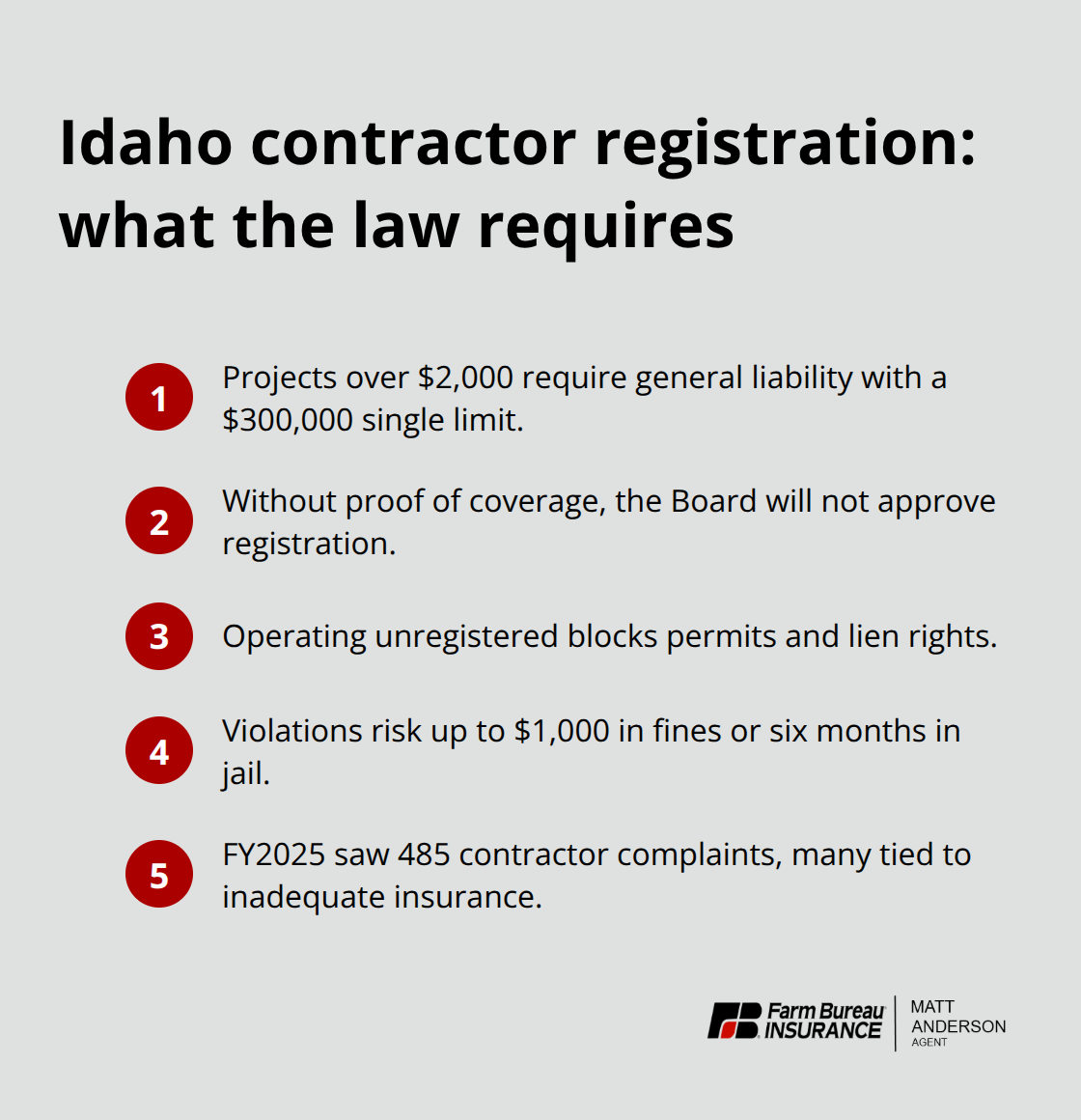
Idaho Airbnb Insurance: Peace Of Mind For Short-Term Hosts

Your standard homeowners policy won’t protect your Airbnb rental. Insurance companies exclude short-term rentals because guest turnover creates higher risks for property damage and liability claims.

At Matt Anderson Insurance, we help Idaho hosts understand their coverage options. The right Idaho Airbnb insurance policy protects your investment and gives you genuine peace of mind.

Why Your Standard Homeowners Policy Falls Short

Your homeowners insurance policy was designed for one scenario: you living in your home year-round. The moment you list your property on Airbnb or VRBO, that coverage evaporates. Insurance companies explicitly exclude short-term rentals because the risk profile changes dramatically. Constant exposure to strangers creates higher property damage claims and liability exposure that standard policies simply don’t address. According to data from Airbtics, Boise alone has 1,395 Airbnb listings that generate around $31,000 in revenue per listing annually. That income matters, but your standard homeowners policy won’t protect it if a guest causes damage or injury. Most hosts don’t realize their claim will be denied until it’s too late. We’ve seen this happen repeatedly with Idaho hosts who thought their existing coverage would apply to rental activity. It won’t.

The Real Cost of Underinsurance

Guest damage happens more frequently than most hosts expect. A broken window, damaged furniture, or stained flooring might seem minor, but repair costs add up fast. More serious incidents-a guest injury on your property or theft of valuables-create liability exposure that reaches far beyond the damage itself. Idaho law requires short-term rental properties to carry at least $1,000,000 in liability insurance coverage. Your homeowners policy typically provides $100,000 to $300,000 in liability coverage, leaving a massive gap. If a guest is injured and sues, you become personally responsible for anything above your policy limit. Additionally, standard policies don’t cover loss of rental income. If your property becomes uninhabitable due to a covered loss, you lose bookings and revenue with no compensation. A dedicated short-term rental policy covers actual loss sustained-meaning you receive compensation for the income you would have earned during the vacancy period.

What Dedicated Rental Insurance Actually Covers

Specialized short-term rental policies address the specific risks you face as a host. They include comprehensive building coverage with replacement cost for both structure and contents, general liability protection for guest-related injuries or property damage, and property entrustment coverage that protects against theft and guest-caused damage. Business revenue protection covers lost bookings and canceled reservations after a covered claim. Some policies even include bed bug and flea protection, squatter protection if a guest refuses to leave, and liquor liability coverage if alcohol is served on the property.

Checklist of specialized coverages available to Idaho short‑term rental hosts

These coverages don’t exist in homeowners policies. The cost difference matters too. Idaho homeowners insurance averages $1,000 to $1,499 annually according to U.S. Census Bureau data, but dedicated short-term rental policies are competitively priced and often bundle multiple protections that would cost far more to obtain separately. Working with an agent experienced in Idaho rental properties ensures you’re not overpaying for coverage you don’t need while closing gaps in areas where you do.

Finding the Right Coverage for Your Situation

The gap between what you think you’re covered for and what you actually are covered for can cost you thousands. Your next step is to explore the specific coverage options available to Idaho hosts-from platform protections to standalone policies that give you complete control over your coverage limits.

Coverage Options for Idaho Short-Term Rental Hosts

Airbnb’s Host Protection Has Serious Limits

Airbnb’s host protection program sounds appealing until you read the fine print. The platform offers up to $1 million in liability coverage, but this coverage only activates when Airbnb’s own insurance is triggered-typically after your personal policy denies a claim. That means you rely on a backup safety net rather than primary protection. More critically, Airbnb’s coverage excludes loss of income from canceled bookings, theft by guests, and damage caused by guests during their stay. You also navigate Airbnb’s claims process, which can take months to resolve. Idaho hosts cannot rely on platform protection alone.

Dedicated Short-Term Rental Policies Provide Primary Coverage

A dedicated short-term rental policy covers your property as the primary insurer from day one. These policies include comprehensive building coverage with replacement cost for both your structure and contents, general liability protection starting at $1 million (meeting Idaho’s legal requirement), and business revenue protection that compensates you for actual income lost during vacancy. Specialized insurers offer bed bug and flea protection, squatter protection if a guest refuses to leave, and amenities liability coverage for bikes, kayaks, pools, and hot tubs. This specialized approach means you own complete protection tailored to your rental operation rather than gambling on a platform’s secondary coverage. The cost remains competitive with standard homeowners policies, often between $1,200 and $2,000 annually depending on your property type and coverage limits-reasonable given the scope of protection.

Umbrella Coverage Protects Your Personal Assets

Umbrella coverage acts as your final safety layer, and it’s not optional if you’re serious about asset protection. A $1 million umbrella policy costs roughly $150 to $300 annually and covers liability claims that exceed your primary policy limits. If a guest suffers a serious injury on your property and wins a $2 million lawsuit, your dedicated rental policy covers the first $1 million and your umbrella covers the remaining $1 million, protecting your personal assets.

Compact list comparing Idaho homeowners, dedicated STR, and umbrella policy costs - Idaho Airbnb insurance

Idaho hosts who own their properties outright should absolutely carry umbrella coverage; those with mortgages face lender requirements for liability protection anyway.

Structuring Your Complete Protection Strategy

Work with a local agent who understands Idaho rental risks and can bind coverage quickly. The right combination of dedicated short-term rental coverage and umbrella protection means you’re genuinely protected when claims happen. Your agent helps you evaluate property type, guest volume, and local regulations to select appropriate coverage limits. Once you understand what protection looks like, the next step involves comparing specific policies and deductibles to find the right fit for your situation.

How to Choose the Right Insurance for Your Idaho Rental

Match Coverage to Your Property and Guest Patterns

Start with the specifics of your property, not general insurance talk. A cabin in McCall that hosts families during ski season faces different risks than a downtown Boise apartment renting to business travelers year-round. Your property type, occupancy patterns, and guest demographics directly determine the coverage limits you actually need. A 2-bedroom apartment generating around $31,000 annually according to Airbtics data requires different protection than a luxury vacation home. High-turnover properties with 70% occupancy like many Boise listings need robust guest damage coverage and frequent replacement cost assessments. Properties with lower occupancy can sometimes reduce coverage limits without sacrificing protection.

Chart showing 70% occupancy as a tipping point for higher-risk, high-turnover Boise listings - Idaho Airbnb insurance

Your guest volume matters because frequent turnover increases the statistical likelihood of property damage, theft, and liability claims. Ask yourself: Do you host families or solo travelers? Are guests primarily local or international? Do you allow pets? Do you serve alcohol? These answers shape which coverage options actually protect you. A property that allows pets needs animal liability coverage with no breed restrictions-a standard homeowners policy won’t touch this. A property where guests consume alcohol needs liquor liability protection, another exclusion in traditional policies.

Calculate your annual revenue realistically using data from your listings or platforms like Airbtics, then ensure your business revenue coverage matches that income. If you generate $30,000 annually, your loss-of-income coverage should reflect that threshold. Idaho hosts commonly underestimate this number and end up with coverage limits that don’t match actual revenue.

Select Deductibles and Liability Limits Based on Your Financial Reality

Coverage limits and deductibles require honest assessment of your financial position, not wishful thinking. Idaho law mandates $1,000,000 in liability coverage for short-term rentals, so that’s your floor, not your ceiling. If a guest suffers a serious injury and sues for $2 million, a $1 million policy leaves you personally liable for the difference. Dedicated short-term rental policies typically offer $1 million to $2 million in liability; choosing the higher limit costs roughly $200 to $400 more annually but protects your assets substantially.

Your deductible directly impacts your out-of-pocket costs when claims happen. A $500 deductible means you pay $500 for each claim; a $2,500 deductible reduces your premium but increases your financial exposure. High-volume hosts with frequent minor claims benefit from lower deductibles; hosts with minimal claims history can absorb higher deductibles and lower premiums. Building and contents coverage should reflect replacement cost, not actual cash value. If your furnishings cost $15,000 to replace and a guest damages them, replacement cost coverage pays the full amount; actual cash value accounts for depreciation and leaves you short.

Work with Local Idaho Agents Who Understand Rental Risks

Work with a local Idaho agent who handles short-term rental properties regularly. These agents understand Idaho’s specific risks-wildfire exposure in forested areas, seasonal rental patterns in resort communities, and local regulatory requirements that changed significantly after House Bill 583 took effect July 1, 2026. A local agent binds coverage quickly, answers claims questions directly, and helps you select the right insurance policy as your rental operation grows.

Compare quotes from multiple insurers; prices and coverage terms vary substantially. Some insurers specialize in short-term rentals while others treat them as afterthoughts. An agent experienced with properties like yours identifies gaps that generalist insurers miss and explains trade-offs between coverage options in plain language.

Final Thoughts

Your Idaho Airbnb insurance protects your income, your assets, and your ability to operate without constant financial anxiety. Standard homeowners policies leave you exposed to thousands in potential losses, while dedicated short-term rental coverage closes those gaps with comprehensive protection designed specifically for hosts. Airbnb’s host protection provides a secondary safety net, but a primary policy gives you control from day one, and adding umbrella protection creates a complete defense against liability claims that exceed your primary limits.

Idaho’s regulatory environment supports responsible hosts, and House Bill 583 eliminated many local restrictions on short-term rentals while keeping the $1 million liability requirement firm. Wildfire risk in Idaho’s forested regions continues to rise, making comprehensive property coverage essential for hosts in affected areas. The cost of proper coverage remains competitive with standard homeowners insurance, typically between $1,200 and $2,000 annually depending on your property and coverage selections.

Contact a local Idaho agent who understands short-term rental risks and can match your specific situation to the right coverage. At Matt Anderson Insurance, our licensed agents specialize in protecting Idaho hosts with comprehensive short-term rental coverage and umbrella policies that reduce your overall insurance costs. Get a quote today and stop gambling with inadequate coverage.

The information provided in this blog is for general informational purposes only and does not constitute legal, financial, or insurance advice. Coverage options, terms, and availability may vary. Please consult with a licensed professional for advice specific to your situation. Artificial intelligence may have been used to generate text and images in some blog articles.
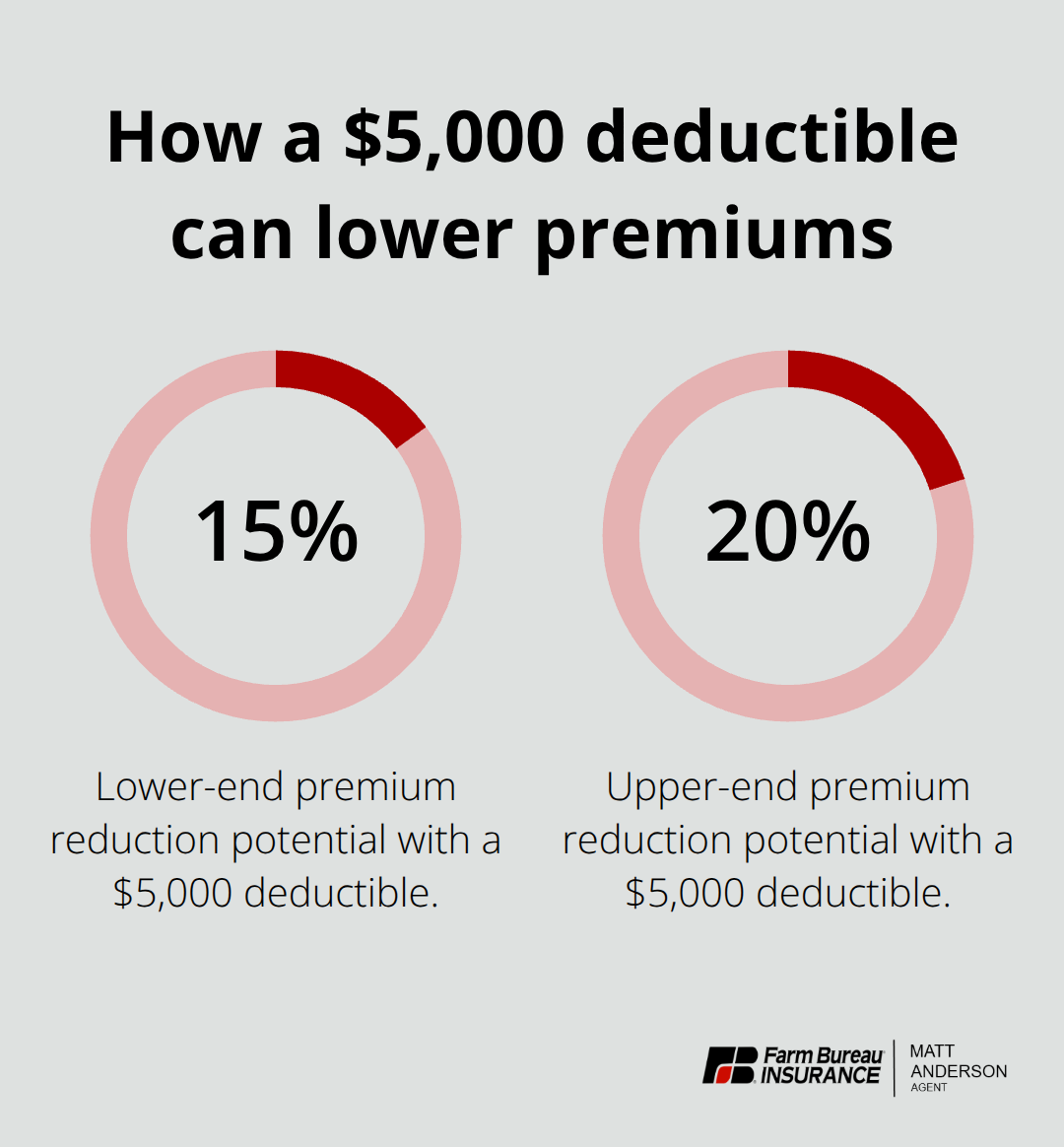
Idaho Auto Insurance Rates: What Factors Drive Your Premium

Your Idaho auto insurance rates depend on more than just luck. Insurance companies use specific factors-your driving history, age, vehicle type, and location-to calculate what you pay each month.

At Matt Anderson Insurance, we help Idaho drivers understand these factors so they can make smarter choices about their coverage and find real ways to save money.

What Really Drives Your Idaho Auto Insurance Premium

Your Driving Record Sets the Foundation

Your driving record is the single biggest factor insurers examine when calculating your rate, and the data backs this up. A clean record keeps you around the Idaho average of roughly $1,476 per year for full coverage, according to Bankrate’s analysis of Quadrant Information Services data from November 2025. One at-fault accident raises that to about $2,023 per year-a 37 percent jump. A speeding ticket alone pushes you to around $1,731 per year, roughly 17 percent higher. A DUI conviction is far worse, landing you at approximately $2,423 per year, about 64 percent above average.

Percentage increases for common violations in Idaho auto insurance

Claims history matters just as much as individual incidents. Frequent claims signal higher risk and keep your premiums elevated for three to five years after each incident. This means avoiding small claims is often smarter than filing them-you pay a few hundred dollars out of pocket for minor damage and protect your rate from climbing significantly.

Age and Experience Shape Your Cost

An 18-year-old on their own policy pays around $4,580 for full coverage, roughly 76 percent more than the state average, while a 20-year-old pays about $3,278, still 46 percent above average. These costs drop steadily as you age; by 25, premiums fall to around $1,951, and by 60, they settle near $1,313. Insurers view younger drivers as higher risk because they lack experience behind the wheel and statistically cause more accidents.

Vehicle Type and Safety Features Impact Your Premium

Your vehicle choice directly affects your bill. A Toyota Camry costs about $1,476 per year to insure, while a BMW 330i runs approximately $1,878, and a Honda Odyssey comes in around $1,277. Luxury and high-performance vehicles cost significantly more because repair parts and labor are expensive. A vehicle’s safety rating also influences your premium-cars with higher ratings qualify for discounts that lower your annual cost. When you choose a vehicle with excellent safety features and reasonable repair costs, you save money over the life of ownership.

These three factors-your driving record, age, and vehicle-form the core of how insurers price your policy. But location within Idaho and your personal financial profile add another layer of complexity to your final rate.

Where You Live and Your Money Matter More Than You Think

Location Within Idaho Creates Real Price Differences

Where you live in Idaho fundamentally shapes what you pay for auto insurance, and the differences are substantial. Boise drivers pay around $1,354 per year for full coverage, while Caldwell residents pay approximately $1,493 and Nampa drivers around $1,454, according to Bankrate’s November 2025 analysis. These variations stem from local crime rates, traffic density, and accident frequency in each area. Rural Idaho generally offers lower premiums than urban centers because fewer cars on the road means fewer collisions and theft incidents.

Hub-and-spoke showing location-driven factors behind Idaho auto insurance price differences - Idaho auto insurance rates

If you live in a high-risk ZIP code, you cannot negotiate your way out of that geographic penalty, but you can control other factors to offset it.

Your Credit Score Carries Surprising Weight

Your credit score directly influences your rate in Idaho, and the impact is severe. Drivers with poor credit pay roughly 49 percent more than the state average, while those with excellent credit save about 11 percent compared with average rates. This means a driver with poor credit might pay $2,200 annually while an excellent-credit driver in the same location pays around $1,310. Improving your credit takes time, but even modest increases over six to twelve months can lower your next renewal quote. Payment history matters as much as your overall score-consistently paying bills on time signals financial responsibility to insurers, and they reward that stability with lower rates.

Deductibles and Coverage Limits Control Your Out-of-Pocket Costs

How you structure your coverage directly controls your premium. Raising your deductible from $500 to $1,000 typically reduces your annual premium by 10 to 25 percent, which translates to $150 to $370 in savings depending on your base rate. Higher deductibles work well if you have emergency savings and drive carefully; lower deductibles suit drivers who cannot absorb unexpected out-of-pocket costs.

Idaho requires minimum liability coverage of $25,000 per person and $50,000 per accident for bodily injury, plus $15,000 for property damage, but these minimums leave you exposed to serious financial risk. If you cause an accident and someone’s medical bills exceed your coverage limits, you become personally liable for the remainder. Upgrading to $50,000 per person and $100,000 per accident costs more monthly but protects your assets far better. Most drivers renew on autopilot without adjusting anything, yet your financial situation and driving patterns change annually-a review of your coverage limits each year makes real sense.

These location, credit, and coverage decisions set the stage for the final piece of the puzzle: the concrete actions you can take to lower your costs without sacrificing protection.

How to Actually Lower Your Idaho Auto Insurance Costs

Bundle Policies for Immediate Savings

Combining insurance policies cuts your premium without sacrificing coverage. Clients who combine auto with homeowners, renters, motorcycle, or RV coverage under one policy save 5%-25% discount on their total costs. If you own a home and a car, bundling those two alone typically saves hundreds annually. The discount applies immediately at renewal, so consolidating separate policies through different companies with a single agency that offers multiple lines creates instant savings. Many Idaho drivers overlook this because they never ask their current insurer about bundling options, yet it remains one of the most straightforward ways to reduce what you owe each month.

Maintain a Clean Driving Record

Your driving record cannot change overnight, but maintaining a clean record going forward is the single most powerful lever you control. Each year without an accident or ticket keeps your rate stable or allows it to drop as you age and build experience. A single at-fault accident costs you roughly $547 more per year compared to the state average, and that premium penalty sticks around for three to five years. Defensive driving courses offered through organizations like the Idaho Transportation Department can qualify you for discounts with most carriers, typically saving 5 to 10 percent on your annual premium. The investment in a course costs $30 to $50 but pays for itself many times over if it prevents even one minor incident that would have triggered a claim. Committing to habits that reduce risk-avoiding phone use while driving, leaving extra space between vehicles, and adjusting your speed for weather conditions-all lower your accident likelihood and protect your rate.

Shop Multiple Carriers Before Renewal

Rates for identical coverage vary dramatically across insurance companies, sometimes by hundreds of dollars annually for the same driver profile. According to Bankrate’s November 2025 analysis, some carriers price 9 percent below the Idaho state average while others charge well above it for the same risk level. Waiting until your renewal notice arrives and paying the quoted amount is expensive. Instead, get quotes from at least three carriers two months before your renewal date, providing identical coverage limits and deductibles to each one. This comparison takes roughly 30 minutes online or by phone and frequently uncovers $200 to $400 in annual savings.

Compact list of actionable tips to reduce auto insurance premiums in Idaho - Idaho auto insurance rates

Local independent agencies compare multiple carriers at once rather than forcing you to contact each company separately, which saves time and often reveals discounts you would miss shopping alone. Rate shopping every two to three years, not just once, matters because carrier pricing shifts constantly as they adjust for local claims experience and market conditions.

Final Thoughts

Idaho auto insurance rates reflect your driving habits, age, vehicle choice, location, credit profile, and coverage decisions. You now control where you save money and where you accept higher costs based on your priorities. Your driving record remains the foundation-one accident or ticket costs hundreds more annually for years, while bundling policies, raising deductibles, and shopping multiple carriers offset geographic penalties that location creates.

Review your current coverage without waiting for renewal and check whether your deductibles and liability limits still match your financial situation. Many Idaho drivers carry outdated coverage that no longer fits their lives, paying for protection they do not need while leaving gaps where they do. Raising a deductible from $500 to $1,000 typically saves 10 to 25 percent annually, and upgrading liability limits from state minimums to $50,000 per person and $100,000 per accident costs more but protects your assets if you cause a serious accident.

Contact Matt Anderson Insurance for a free review of your current coverage and a comparison of rates from multiple carriers. A few minutes of conversation often uncovers hundreds in annual savings while ensuring you have the protection your family actually needs.

The information provided in this blog is for general informational purposes only and does not constitute legal, financial, or insurance advice. Coverage options, terms, and availability may vary. Please consult with a licensed professional for advice specific to your situation. Artificial intelligence may have been used to generate text and images in some blog articles.