
Idaho Home Insurance Discounts: How Much Can You Save?

Idaho homeowners typically leave money on the table when it comes to their insurance premiums. Most policies qualify for multiple discounts that can significantly reduce what you pay each month.

At Matt Anderson Insurance, we’ve helped countless Idaho residents find substantial savings by understanding which discounts apply to their specific situation. This guide walks you through the discounts available and shows you exactly how to claim them.

What Discounts Actually Reduce Your Idaho Home Insurance Bill

Idaho homeowners can cut their premiums significantly through discounts, but most people only know about bundling. Insurers offer far more savings opportunities than most realize. Discounts can reduce your premiums, and when you combine multiple discounts, the total savings compound. The key is understanding which discounts you actually qualify for and which ones matter most for your situation.

Bundling Delivers the Biggest Savings

Bundling home and auto policies stands out as the single most valuable move you can make. If you pay for home and auto separately, you overpay. This strategy simplifies your billing and renewals by consolidating policies with one carrier, which also makes managing your coverage easier.

Security Devices and Smart Home Technology

Beyond bundling, security devices make a real difference. Monitored alarm systems, fire detectors, and smoke alarms reduce your premium according to industry standards. Smart home technology like water leak detectors and remote video surveillance also qualifies for discounts. A deadbolt lock or reinforced doors trigger additional savings. These aren’t theoretical reductions-they reflect actual risk reduction that insurers reward with lower rates.
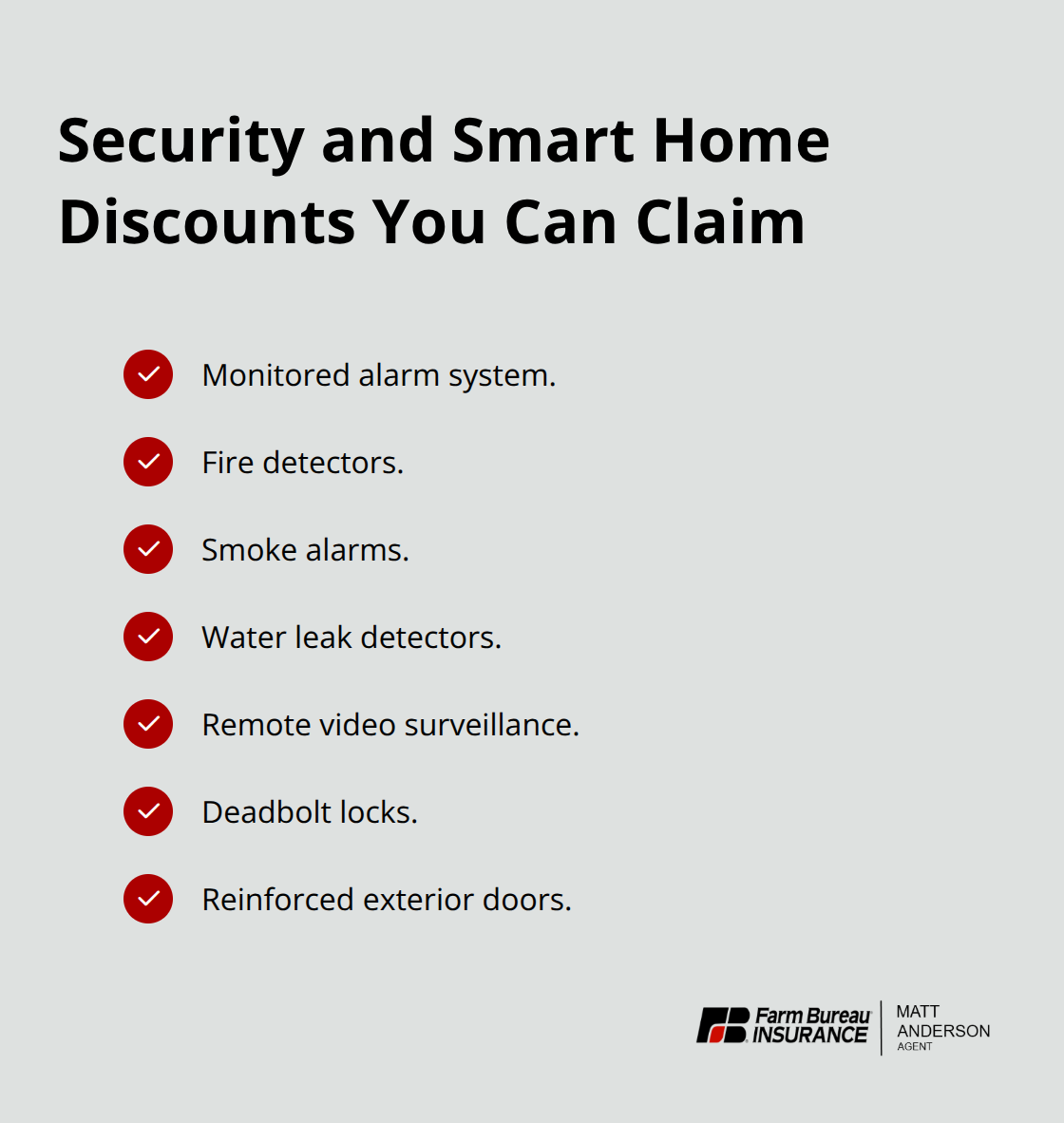
List of security and smart home devices that commonly qualify for Idaho home insurance discounts

Home Improvements That Pay Back

New roofs and upgraded electrical or plumbing systems lower your premiums because they reduce the likelihood of costly claims. A new roof, especially with impact-resistant materials, delivers measurable savings by cutting storm damage risk. Upgrading your electrical system to modern standards reduces fire risk and qualifies for discounts. Modern plumbing systems prevent water damage claims that can cost thousands. Roof age matters significantly; if your roof approaches the end of its lifespan, replacement cuts your rates going forward. Storm shutters or reinforced windows also reduce risk and lower your rates.

Discounts Most Homeowners Miss

Loyalty discounts apply if you stay with the same insurer for several years, yet many customers never ask about them. Claims-free discounts reward you for not filing claims over a set period. New home construction discounts apply if your home was recently built or substantially renovated. If you’ve recently made improvements, contact your agent and ask about rate reductions. Your credit score influences your rate in Idaho, so improving your credit score lowers premiums at renewal.

The discounts available to you depend on your specific home, location, and personal profile. Understanding which ones apply to your situation requires a closer look at your current coverage and what protections you actually need.

How Bundling and Claims History Shape Your Savings

Bundling Delivers Immediate Savings

Combining your auto and home insurance with one carrier cuts your annual premiums by 13 percent, saving about $468 per year compared to purchasing separate policies. If you pay separate policies to different insurers, you lose hundreds each year. Insurers reward bundling because they manage your entire relationship, so they reduce rates substantially in exchange for your loyalty. Beyond the premium reduction, consolidating policies simplifies your life. You get one renewal date, one agent to contact, and one bill to track instead of juggling multiple carriers and payment schedules. This efficiency matters when you need to file a claim or update your coverage. Many Idaho homeowners see reductions of 300 to 950 dollars annually depending on their specific coverage and location.

Small Claims Cost More Than You Think

Your claims history directly impacts what you pay going forward, and this is where many homeowners make costly mistakes. Filing small claims for minor damage increases your premiums significantly, sometimes more than the claim payout itself. If your roof sustains wind damage costing 800 dollars and your deductible is 1000 dollars, filing a claim makes no financial sense and will raise your rates at renewal. Instead, pay out of pocket for minor incidents and reserve claims for major losses that truly warrant insurance intervention.

Building a Claims-Free Record

Homeowners who maintain a claims-free record for three to five years qualify for specific discounts that compound your savings. These discounts reward your restraint and demonstrate to insurers that you manage risk responsibly. The longer you go without filing a claim, the more valuable your discount becomes at renewal time.

Credit Score Matters More Than Most Realize

Your credit score in Idaho directly influences your rates through credit-based insurance scoring, so paying bills on time and reducing credit card balances at renewal time can lower your premiums without changing your coverage. These behavioral factors cost nothing to address but deliver measurable financial rewards when you stay disciplined about your finances. Improving your credit before renewal gives you leverage to negotiate better rates with your current insurer or shop for better quotes elsewhere.
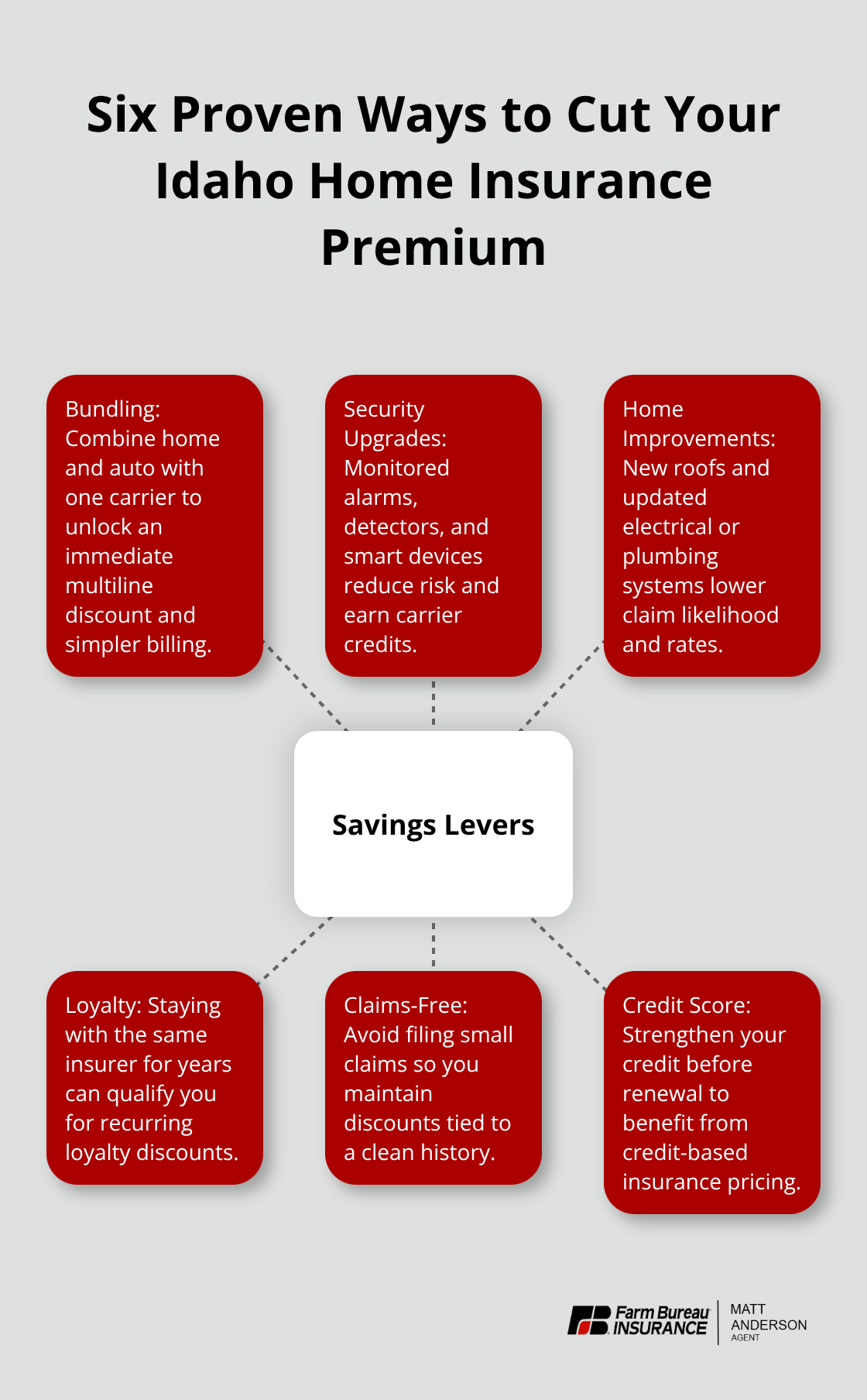
Hub-and-spoke chart showing six savings levers for Idaho homeowners - Idaho home insurance discounts

Discounts You’re Probably Overlooking

Loyalty Rewards for Long-Term Customers

Most Idaho homeowners focus on bundling and miss three substantial discounts that can shave hundreds off annual premiums. Loyalty matters more than you think, and insurers actively reward customers who stay with them for years. If you’ve held your policy for three or more years without switching carriers, ask your agent directly whether you qualify for a loyalty discount. Some insurers apply this automatically, but many require you to request it at renewal. The discount typically ranges from ten to eighteen percent depending on your carrier and how long you’ve been a customer. This is free money you leave on the table if you don’t ask.

New Construction and Renovation Discounts

If your home was built or substantially renovated within the past five years, you qualify for a new construction discount that recognizes lower rebuild costs and modern building standards. Newer homes have updated electrical systems, plumbing, and roofing materials that reduce fire and water damage risk significantly. Homes built in 2015 or later typically qualify for these discounts automatically, but if you recently completed major renovations like a new roof, rewired electrical system, or upgraded plumbing, contact your agent and request a rate review. Renovation discounts can meaningfully lower your premiums when major systems are updated, so the investment in home improvements pays back through insurance savings.

Energy-Efficient Upgrades and Green Home Features

Energy-efficient upgrades and green home features represent the third major discount category that homeowners consistently overlook. Installing a modern HVAC system, upgrading to energy-efficient windows, or adding insulation doesn’t just reduce your utility bills-it also qualifies for insurance discounts because these improvements reduce overall home risk and rebuilding costs. Smart thermostats, LED lighting upgrades, and water heaters with modern safety features all signal to insurers that you maintain your home responsibly. If you’ve made any energy-related improvements in the past year, your agent needs to know. These upgrades often go undocumented during the initial application, which means you miss the discount at every renewal. Ask your agent to conduct a full review of your home’s current condition and any improvements you’ve made since you purchased the policy. The combination of loyalty recognition, new construction or renovation discounts, and energy-efficient upgrades can easily add up to twenty or thirty percent in total savings (money that compounds year after year if you maintain your coverage with the same carrier).

Final Thoughts

Idaho homeowners typically save between $300 and $950 annually by combining multiple discounts, yet most people claim only one or two. The real savings potential emerges when you stack bundling, security upgrades, claims discipline, and loyalty recognition together. A homeowner who bundles auto and home insurance, maintains a claims-free record, installs monitored security, and qualifies for loyalty discounts can reduce their annual premium by 30 percent or more.
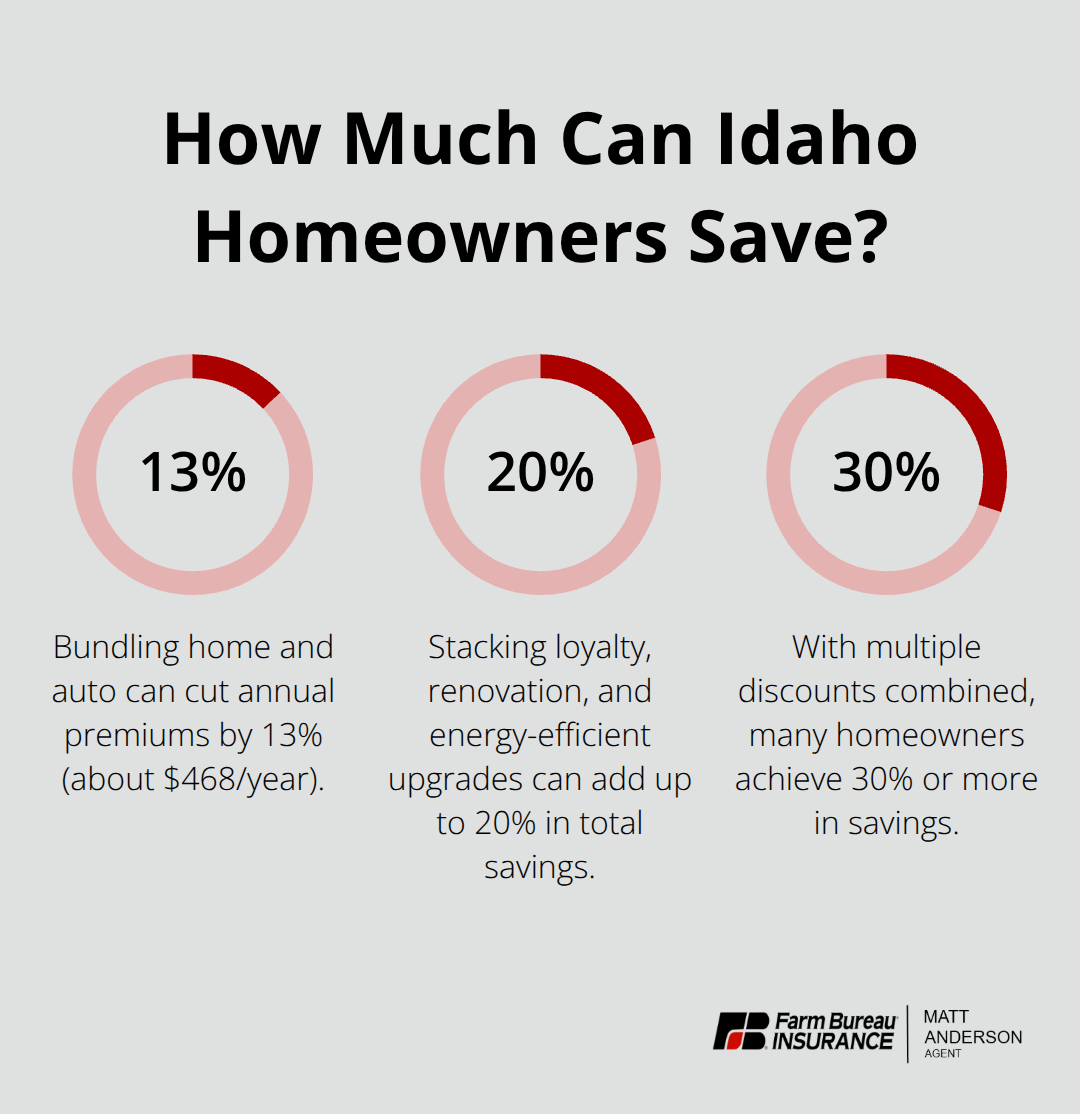
Percentage savings benchmarks from bundling and stacked discounts for Idaho home insurance

Review your current policy and identify which discounts you already receive and which ones you’ve missed. Contact your agent and ask specifically about loyalty discounts, new construction or renovation credits, and energy-efficient upgrades you’ve made since purchasing your policy. Many homeowners discover they qualify for Idaho home insurance discounts they never claimed simply by asking, and if you haven’t bundled your auto and home insurance, that single move delivers immediate savings without changing your coverage.

We at Matt Anderson Insurance help Idaho families and businesses identify every discount available to them. Our licensed agents understand the specific discounts that apply in Idaho and work to maximize your savings while protecting what matters most. Reach out to Matt Anderson Insurance today to review your coverage and discover how much you can actually save.

The information provided in this blog is for general informational purposes only and does not constitute legal, financial, or insurance advice. Coverage options, terms, and availability may vary. Please consult with a licensed professional for advice specific to your situation. Artificial intelligence may have been used to generate text and images in some blog articles.

Contractor Liability Insurance Idaho: Guarding Your Business From Claims

One accident on a job site can cost your business thousands of dollars in medical bills, legal fees, and settlements. Contractor liability insurance in Idaho protects you from these financial disasters.

At Matt Anderson Insurance, we’ve seen too many contractors operate without proper coverage and face devastating consequences. The right policy stands between your business and bankruptcy.

What Contractor Liability Insurance Actually Covers

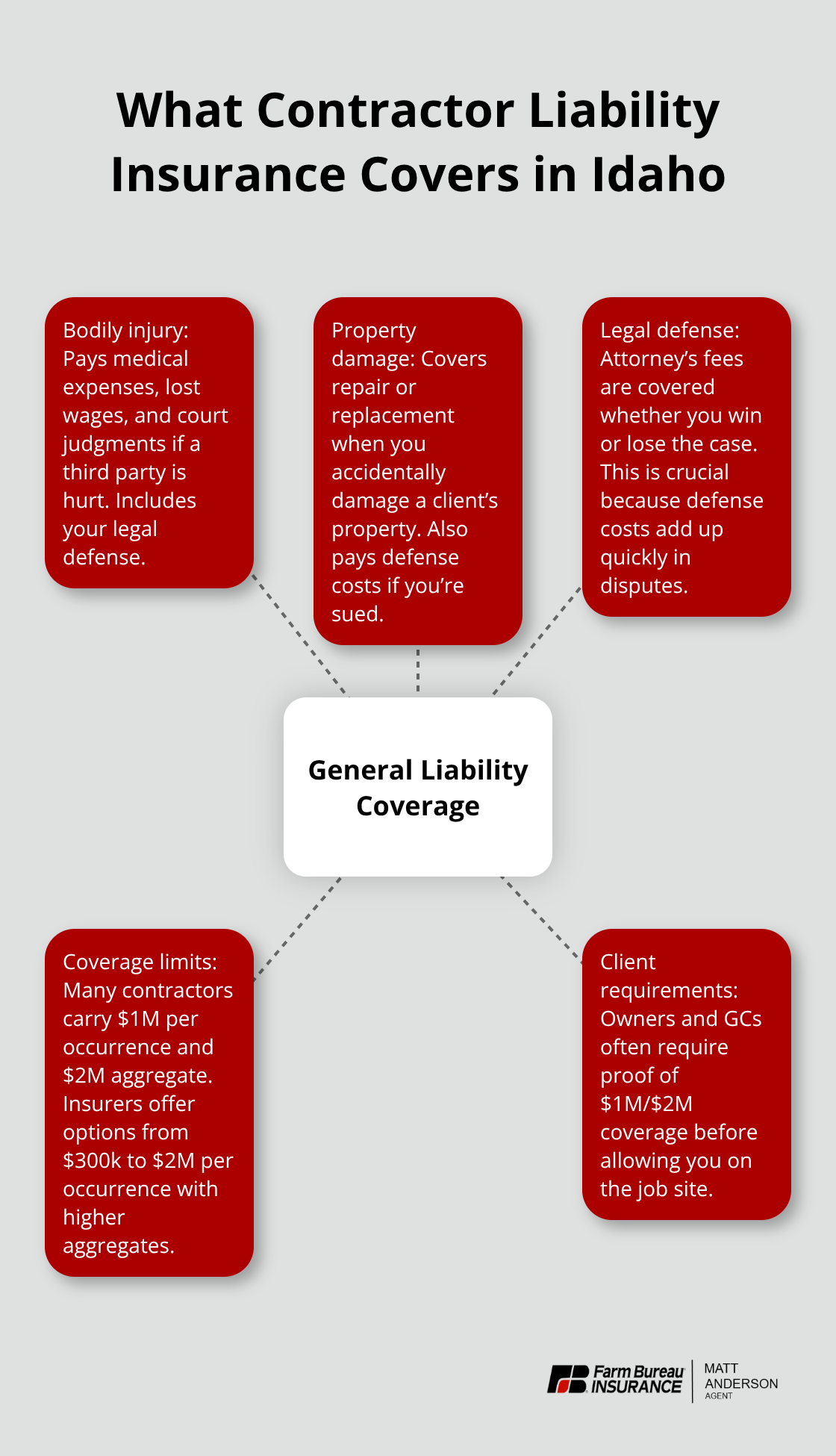
Contractor liability insurance protects you when someone gets hurt or property gets damaged because of your work. General liability policies in Idaho typically cover bodily injury claims when a third party is injured on your job site or by your work, property damage claims when you accidentally damage a client’s building or belongings, and the legal defense costs if someone sues you. The Hartford, which MoneyGeek identified as the best general liability insurer in Idaho with rates starting around $77 per month, offers coverage limits ranging from $300,000 to $2 million per occurrence, with aggregate limits up to $4 million. Most Idaho contractors carry policies with $1 million per occurrence and $2 million aggregate limits because clients and contract requirements demand it.

Diagram showing core protections of contractor general liability insurance in Idaho.

When Bodily Injury Coverage Kicks In

Someone slips on your wet concrete pour and breaks their arm. Your worker gets hit by a falling tool at a client’s property. A homeowner’s child suffers injury from equipment you left unattended. These scenarios trigger bodily injury coverage, which pays for medical expenses, lost wages, and court judgments if the injured party sues. The policy also covers your legal defense, which means the insurer pays your attorney’s fees regardless of whether you win or lose the case. This distinction matters because legal defense costs can add up quickly in construction disputes. Idaho law requires contractors to register with the Idaho Contractors Board and carry general liability insurance of at least $300,000 single limit, but this minimum is dangerously low for most jobs.

Property Damage Claims and What They Include

You accidentally damage a client’s roof while working on their home. Your equipment punctures their water line during excavation. You knock over an expensive piece of furniture during installation. Property damage coverage pays for repairs or replacement of the damaged property, plus the cost to defend yourself if the property owner sues. ERGO NEXT, another top Idaho provider according to MoneyGeek, offers up to $2 million per occurrence with strong coverage for contractor-related risks. The difference between $300,000 and $1 million coverage becomes critical when you damage expensive residential or commercial property. A single mistake on a high-value project can wipe out your annual profit without adequate limits.

Why Legal Defense Costs Matter

Construction disputes often lead to lawsuits, and your attorney’s fees add up fast. Your insurer covers these defense costs as part of your policy (whether you’re found liable or not). This protection prevents you from paying thousands out of pocket while your case moves through the court system. Many contractors underestimate how quickly legal bills accumulate-depositions, expert witnesses, and court appearances consume time and money. Without this coverage built into your policy, you face a choice between paying for defense yourself or risking an undefended judgment against your business.

Coverage Limits That Match Your Risk

Idaho contractors operate across residential, commercial, and industrial projects, each carrying different exposure levels. A $300,000 limit might cover a small residential repair job, but it leaves you exposed on larger projects. Most clients now require $1 million per occurrence and $2 million aggregate as a condition of contract, making these limits the practical standard in the market. Your specific risk depends on the scope of work you perform, the value of projects you handle, and the types of properties you work on. The next section explains how to assess your actual exposure and select limits that protect your business without overpaying for unnecessary coverage.

Why Idaho Contractors Actually Need This Coverage

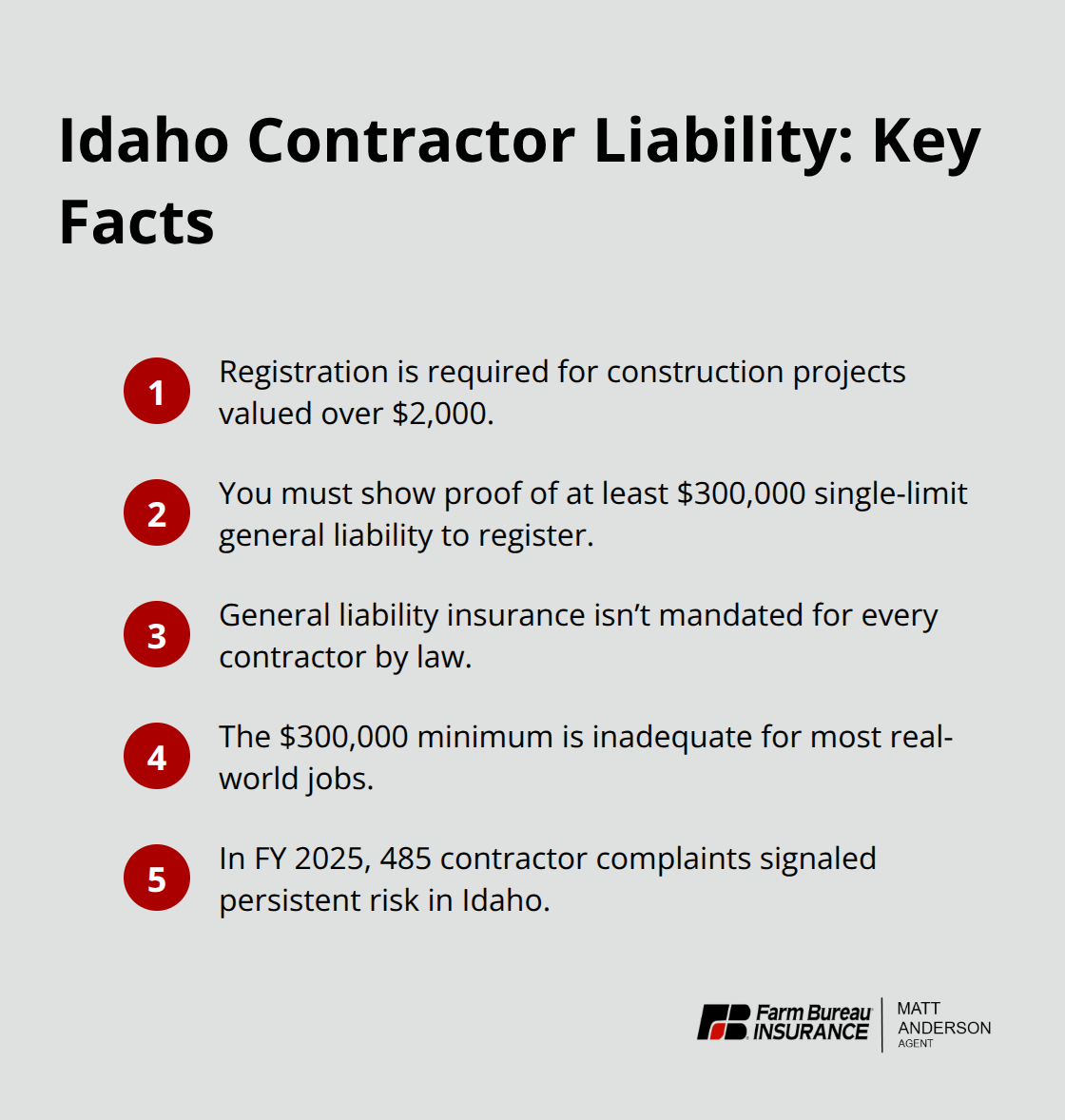
Idaho law doesn’t require general liability insurance for all contractors, but the state does require registration with the Idaho Contractors Board for any construction project valued over $2,000. That registration demands proof of general liability insurance of at least $300,000 single limit. This minimum requirement exists because the state recognizes that construction work creates real financial exposure for property owners and injured parties. However, that $300,000 floor is inadequate for most real-world situations. In fiscal year 2025, the Idaho Department of Professional and Licensing received 485 contractor complaints-the highest among all boards and commissions-signaling that registration alone doesn’t protect clients or contractors from financial disaster.

Compact list of Idaho contractor liability requirements and complaint data. - Contractor liability insurance Idaho

What Happens When You Skip Coverage

Without proper liability coverage, you face penalties ranging up to $1,000 in fines or six months in jail if you operate without current registration. More practically, practicing without valid coverage prevents you from obtaining building permits and forfeits your lien rights on projects, which means you lose your legal claim to payment if disputes arise. A single serious injury or property damage claim can exceed $100,000 in medical bills, legal fees, and settlements. Your personal assets-your home, savings, vehicles-become vulnerable if you lack adequate insurance and face a judgment that exceeds your business’s financial reserves.

Client Expectations Set the Real Standard

Most property owners, developers, and general contractors now require proof of $1 million per occurrence and $2 million aggregate liability coverage before they’ll sign a contract or allow you on their job site. This expectation has become the practical standard across Idaho’s construction market, and contractors who carry only the state minimum find themselves unable to bid on larger residential and commercial projects. The North Idaho Building Contractors Association has reported a dramatic uptick in contractor complaints in recent years, which has intensified scrutiny on contractor qualifications and financial protection.

How Insurance Affects Your Competitive Position

Clients increasingly request certificates of insurance listing them as additional insured parties, which means they need documented proof that you carry adequate coverage. Without this documentation readily available, you lose contract opportunities to competitors who can provide it instantly. Insurance also demonstrates to potential clients that you operate professionally and take your legal obligations seriously, which builds trust and justifies higher pricing for quality work. Contractors who invest in proper coverage position themselves as the safer choice in a market where clients have legitimate concerns about hiring uninsured or underinsured workers.

The next section walks you through the process of selecting the right coverage limits and deductibles for your specific business model.

Selecting Coverage Limits That Match Your Actual Work

Choosing the right liability coverage starts with understanding what you actually do on job sites and what financial exposure that work creates. A residential kitchen remodel carries different risk than commercial foundation work or industrial equipment installation. The state minimum of $300,000 single limit satisfies legal registration requirements, but it falls dangerously short of what clients demand and what real claims cost. Most Idaho contractors operate with $1 million per occurrence and $2 million aggregate because that’s what general contractors, property managers, and developers now require before signing contracts. The difference between these limits matters enormously-a single serious injury claim can reach $150,000 to $500,000 in medical expenses and legal costs, which means the state minimum leaves you personally liable for the excess.

Match Coverage to Your Project Value

Your project value drives coverage decisions directly. If you handle jobs consistently under $50,000, you might operate with $500,000 limits and still meet most client requirements. If you bid on projects exceeding $500,000 or work on commercial properties, $1 million per occurrence becomes the practical floor. ERGO NEXT and The Hartford both offer flexible limit combinations that let you match coverage to your actual risk profile rather than overpaying for unnecessary limits. The Hartford provides coverage limits from $300,000 to $2 million per occurrence, with aggregate limits up to $4 million, giving you options across different project scales.

Select Deductibles That Protect Your Cash Flow

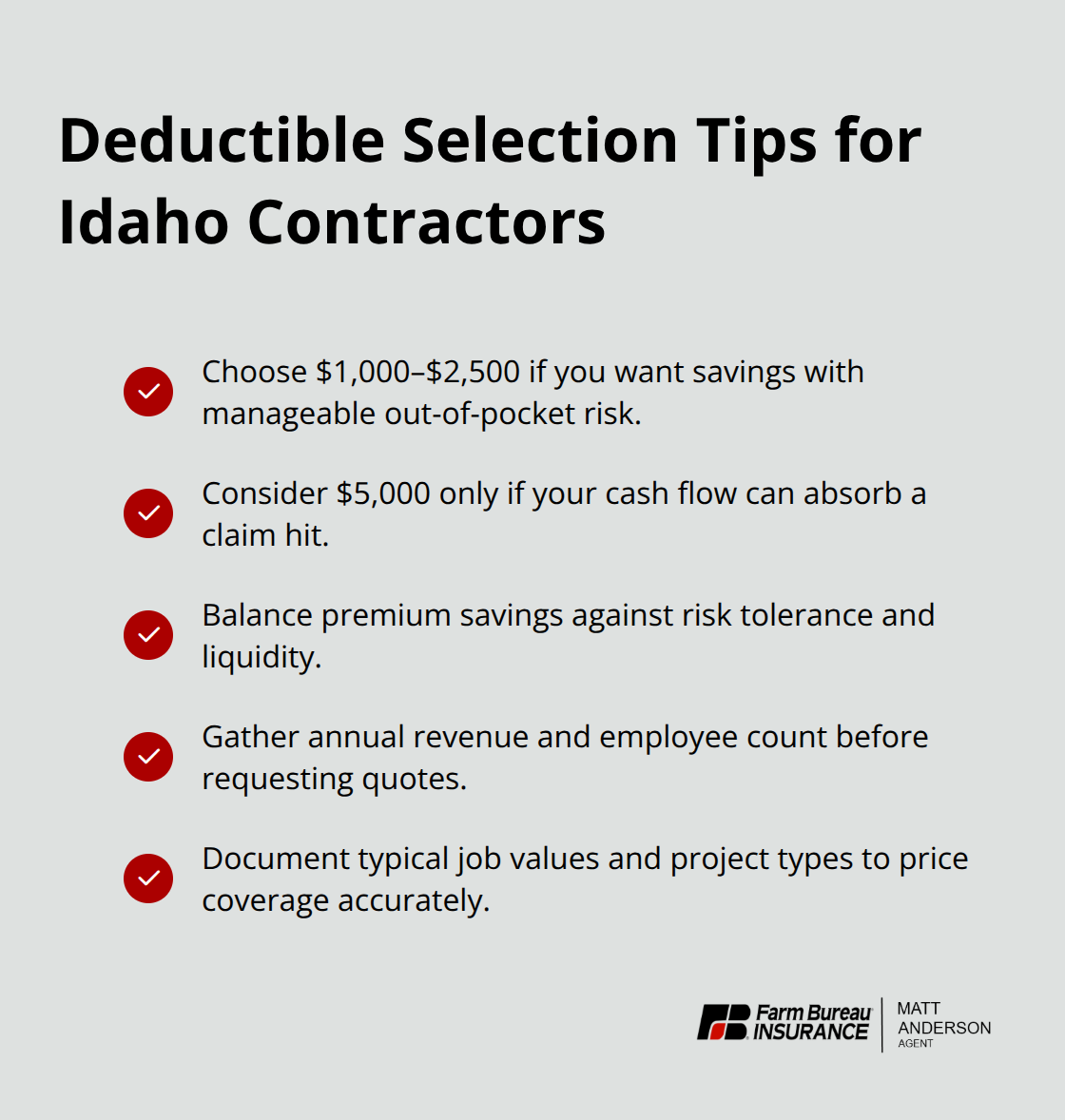
Deductibles operate as your out-of-pocket cost before insurance kicks in, and selecting the right deductible saves money without exposing you to catastrophic loss. Most Idaho contractors choose $1,000 or $2,500 deductibles because these levels reduce premiums meaningfully while remaining manageable if a claim occurs. A $5,000 deductible might save 15 to 20 percent on annual premiums, but only if you can absorb that cost without financial strain when a claim happens. The best approach involves gathering specific details about your business before requesting quotes-your annual revenue, number of employees, business classification, and the types of projects you typically handle.

Checklist of practical tips for choosing contractor liability deductibles in Idaho. - Contractor liability insurance Idaho

Compare Quotes From Multiple Idaho Insurers

Identical coverage from different Idaho insurers can vary significantly, which means comparing quotes from at least three licensed providers makes financial sense before purchasing. When comparing quotes, verify whether defense costs are included inside your policy limits or paid separately by the insurer, because this distinction affects how much coverage actually remains available for settlement or judgment. This comparison process takes time but protects your bottom line significantly.

Review Coverage Annually and After Major Changes

You should review your coverage annually and especially after hiring employees, expanding into new service areas, or moving into different Idaho counties where local requirements might differ. A local Idaho insurance agent who understands construction risk can identify endorsements specific to your trade-such as contractual liability coverage or products completed operations coverage-that protect against gaps in your standard policy. These endorsements address real exposures that standard policies often exclude, making them worth the additional cost for most contractors.

Final Thoughts

Contractor liability insurance in Idaho protects your business from financial ruin when accidents happen on job sites. The state minimum of $300,000 satisfies registration requirements, but real-world claims and client expectations demand $1 million per occurrence and $2 million aggregate limits. Without adequate coverage, you face personal liability, lost lien rights, and inability to bid on projects that require proof of insurance.

Your next step involves gathering basic business information-annual revenue, employee count, project types, and typical job values-then requesting quotes from at least three Idaho-licensed insurers. Compare not just price but also whether defense costs are included inside your limits or paid separately, and verify that endorsements match your specific trade risks. The 485 contractor complaints filed with Idaho’s Department of Professional and Licensing in fiscal year 2025 demonstrate that registration alone doesn’t protect you or your clients from costly disputes.

We at Matt Anderson Insurance understand Idaho’s construction environment and the real exposures contractors face daily. Contact us today for a quote on contractor liability insurance in Idaho that protects your business without overpaying for unnecessary coverage. Our team can help you select coverage limits that match your actual risk and identify cost-saving endorsements specific to your trade.

The information provided in this blog is for general informational purposes only and does not constitute legal, financial, or insurance advice. Coverage options, terms, and availability may vary. Please consult with a licensed professional for advice specific to your situation. Artificial intelligence may have been used to generate text and images in some blog articles.
Idaho Vacation Rental Coverage: Insurance For Hosts And Properties

Renting out your Idaho property can generate steady income, but standard homeowners insurance won’t protect you. Your guests, their belongings, and liability risks require specialized coverage that most policies simply don’t include.

At Matt Anderson Insurance, we’ve seen too many vacation rental hosts face unexpected gaps in their protection. Idaho vacation rental coverage is designed specifically for short-term rentals-and it’s the difference between a profitable venture and a financial disaster.

Why Your Standard Homeowners Policy Falls Short

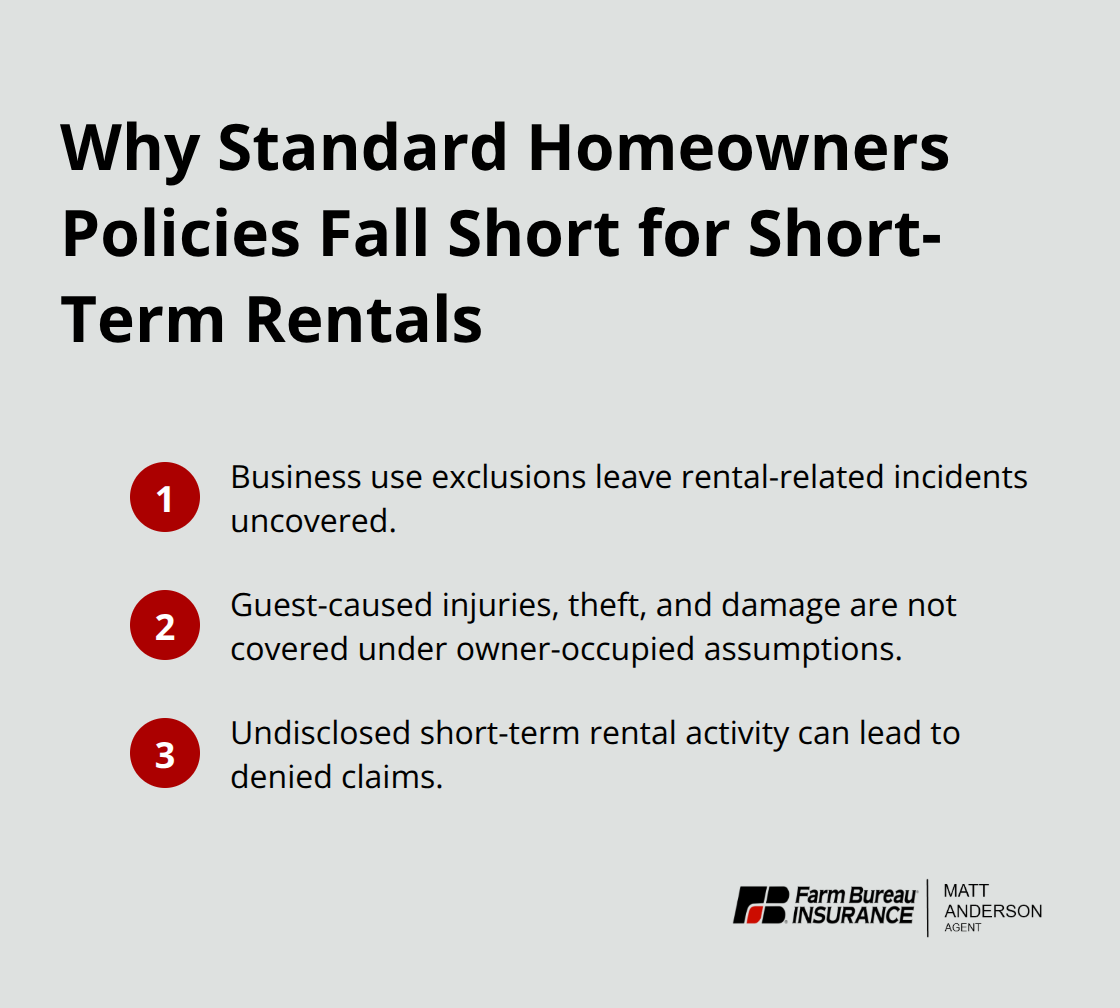
Standard homeowners insurance explicitly excludes business activity, and renting your property to guests crosses that line. Your policy was written for owner-occupied homes where you live year-round. The moment you list on Airbnb or Vrbo, you fundamentally change how your property operates-and your insurer won’t cover losses tied to that rental activity. A guest slip-and-fall on an icy deck, theft of their belongings, or damage they cause to your kitchen won’t be covered. Your insurer can even deny claims if they discover you operate a short-term rental without disclosure. This isn’t a gray area; it’s a direct violation of your policy terms.

Three key reasons standard homeowners insurance doesnt cover Idaho short-term rentals - Idaho vacation rental coverage

The liability gap that catches hosts off guard

Liability exposure from short-term rentals differs categorically from owning a vacant property or renting long-term. You invite strangers into your home multiple times per month, each with their own risk profile. A guest injures themselves on your property and sues for medical bills and lost wages. Another guest’s friend gets hurt using your hot tub or kayaks you provide. Standard homeowners policies cap guest medical payments at $1,000 to $5,000-nowhere near adequate if someone requires hospitalization. Short-term rental insurance covers commercial general liability starting at $1 million, protecting you against the actual costs of guest injuries and third-party claims. Without this coverage, a single incident can wipe out your rental income for years.

Property damage and theft accelerate with constant turnover

Long-term tenants stay for months or years, so damage accumulates slowly and patterns emerge. Short-term guests come and go weekly or daily, creating rapid-fire exposure to theft, vandalism, and deliberate damage. A guest steals your artwork, damages appliances, or punches a hole in drywall before checkout. Standard homeowners policies don’t cover theft or damage caused by guests because those policies assume you live there and control access. Short-term rental insurance includes property entrustment coverage-protection against guest theft and malicious damage that standard policies explicitly exclude. You also receive replacement cost coverage with no depreciation, meaning your belongings and building receive full value protection, not reduced for age. This matters when a guest damages a five-year-old refrigerator; you receive replacement cost, not depreciated value.

Income loss from cancellations leaves owners vulnerable

When a covered incident makes your property unrentable, your income stops immediately. A fire, water damage, or bed bug infestation forces you to cancel bookings and lose revenue while repairs happen. Standard homeowners policies don’t reimburse lost rental income because they don’t recognize your property as a business asset. Short-term rental insurance includes business revenue protection that reimburses actual loss sustained if a covered claim prevents you from renting. This coverage bridges the gap between when damage occurs and when you can welcome guests again. Without it, you absorb months of lost bookings while your property sits idle.

What Your Vacation Rental Coverage Actually Protects

Commercial Liability Protection for Guest Injuries

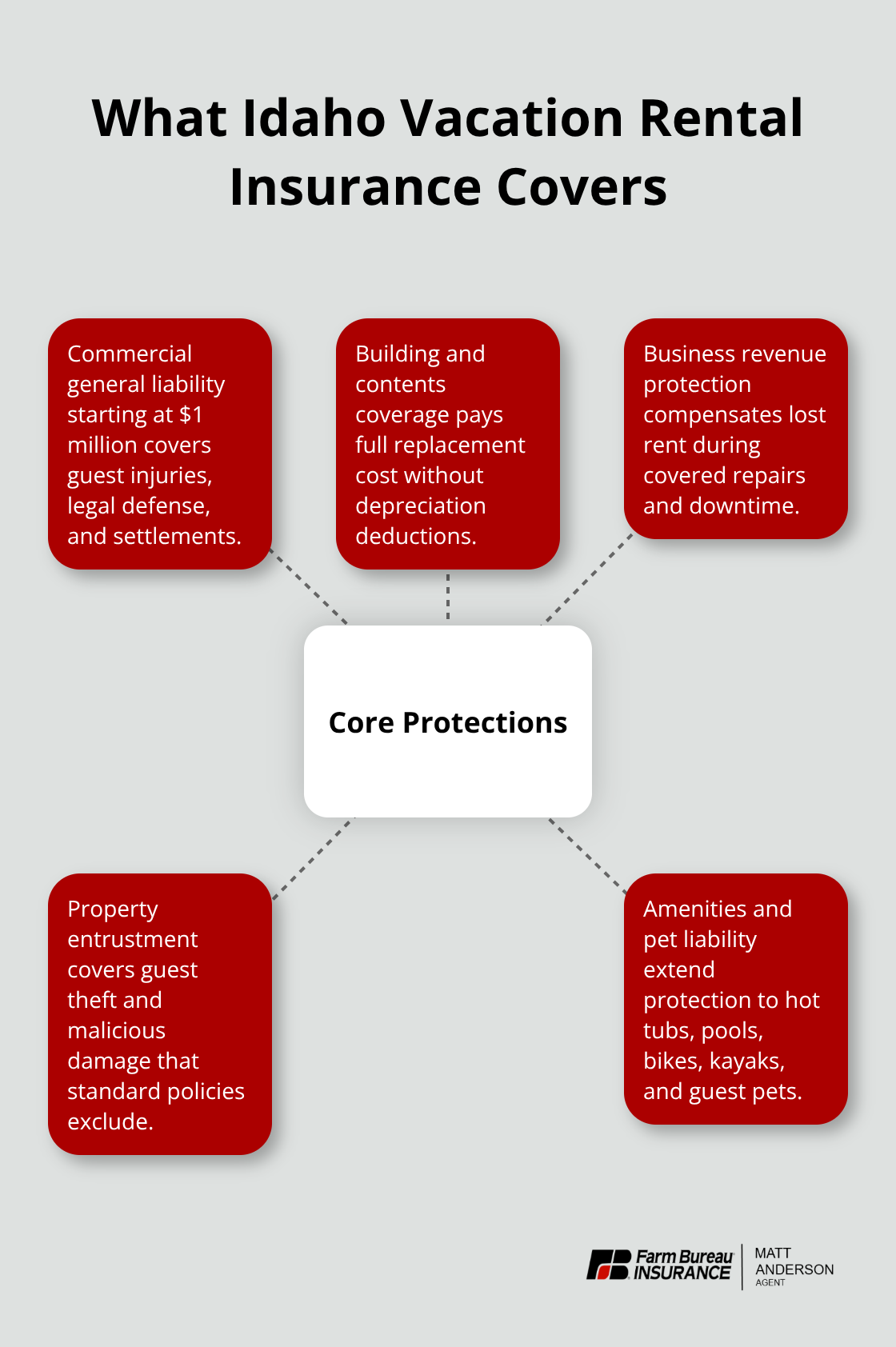
Idaho vacation rental insurance covers three distinct areas that standard homeowners policies treat as exclusions. First, commercial general liability protection starts at $1 million and shields you when a guest or their visitor gets injured on your property or by amenities you provide. A guest slips on your deck and breaks their leg, or their friend drowns in your hot tub-your liability coverage pays their medical bills, lost wages, and legal fees up to your chosen limit. Standard homeowners policies cap guest medical payments at $1,000 to $5,000, leaving you personally liable for the remainder. With $1 million in commercial liability, you’re protected against the actual costs of hospitalization, surgery, and litigation that a single serious injury can trigger.

Building and Contents Protection With Full Replacement Value

Second, your coverage includes building and contents protection with replacement cost, meaning your property and belongings receive full value without depreciation deductions. If a guest damages your kitchen cabinets, appliances, or furniture, you receive what it costs to replace them today, not their reduced value after years of use. Property entrustment coverage specifically protects against theft and vandalism by guests-the exact scenario standard policies exclude.

Core protections provided by Idaho vacation rental insurance for short-term rentals - Idaho vacation rental coverage

A guest steals your artwork, electronics, or outdoor equipment and your coverage reimburses the loss.

Business Revenue Protection During Property Downtime

Third, business revenue protection during property downtime compensates you for rental revenue lost when a covered event like fire or water damage makes your property uninhabitable during repairs. Unlike standard policies that ignore rental income entirely, this protection bridges the gap between when damage occurs and when you reopen to guests.

Specialized Coverage for Unique Short-Term Rental Risks

Beyond these core protections, Idaho vacation rental insurance addresses exposures that catch hosts off guard. Liquor liability coverage protects you if a guest gets drunk at your property and causes injury or property damage afterward-a risk standard homeowners policies explicitly exclude. Bed bug and flea protection covers both extermination costs and lost revenue from booking cancellations due to pest infestations, a growing concern for Idaho hosts. Amenities coverage extends liability protection to equipment guests use off-premises (like bikes, kayaks, and paddleboards you provide) plus hot tubs and pools on your property. Pet and animal liability is included with no breed restrictions, protecting you if a guest’s dog bites someone or if your pet injures a visitor. Squatter protection provides legal support and lost revenue compensation if a guest refuses to leave after their booking ends-a rare but devastating scenario that standard policies don’t address.

These additions exist because short-term rental risks differ fundamentally from homeownership or long-term tenancy. Your property transforms into a commercial operation the moment you accept guests, and your insurance must reflect that shift. The coverage gaps that plague unprepared hosts stem from this mismatch between how standard policies work and how vacation rentals actually operate. Understanding what protection you need is only half the battle-selecting the right limits and options for your specific property requires careful assessment of your guest volume, property type, and local Idaho risks.

Selecting Coverage That Matches Your Idaho Rental Operation

Your property’s risk profile determines which coverage limits you actually need, and most hosts either overinsure or leave dangerous gaps. Start by counting your annual guest nights and tracking property incidents over the past year. A mountain cabin in McCall that hosts 40 weekends annually faces different exposure than a Boise condo rented 300 nights per year to international tourists. High-turnover properties with frequent guests justify higher liability limits because each booking introduces new people into your space. Idaho hosts renting near ski resorts or lake communities see seasonal spikes that concentrate risk into winter and summer months, requiring coverage that reflects peak occupancy periods.

Assess Your Property’s Specific Risk Factors

Document whether guests bring pets, how many people typically occupy your property, and what amenities you provide. A hot tub or swimming pool dramatically increases liability exposure compared to a basic cabin. If you offer equipment like kayaks, mountain bikes, or jet skis, your liability extends to injuries occurring off-premises while guests use those items. Insurance carriers weight these factors heavily when calculating your premium and determining appropriate limits. A $1 million liability limit works for most Idaho hosts, but properties with pools, multiple amenities, or high guest volume should consider $2 million coverage.

Match Building Coverage to Replacement Cost

Building coverage should equal your property’s replacement cost, not its market value-a critical distinction that catches many hosts off guard. Market value includes land; replacement cost covers only the structure and contents. Get a contractor’s estimate for what it would cost to rebuild your property from scratch, then match that figure in your policy. Contents coverage should account for furnishings, appliances, linens, and equipment you provide to guests. Many Idaho hosts underestimate contents value because they forget about kitchen equipment, outdoor furniture, and seasonal décor.

Calculate Loss of Income Protection Accurately

Loss of income protection should reflect your average monthly rental revenue. Calculate your typical booking rate and nightly rate, then multiply by 30 days. This becomes your monthly protection amount. Some carriers cap business revenue coverage at 12 months; verify whether your policy includes this limit before purchasing.

Compare Deductibles and Premium Costs

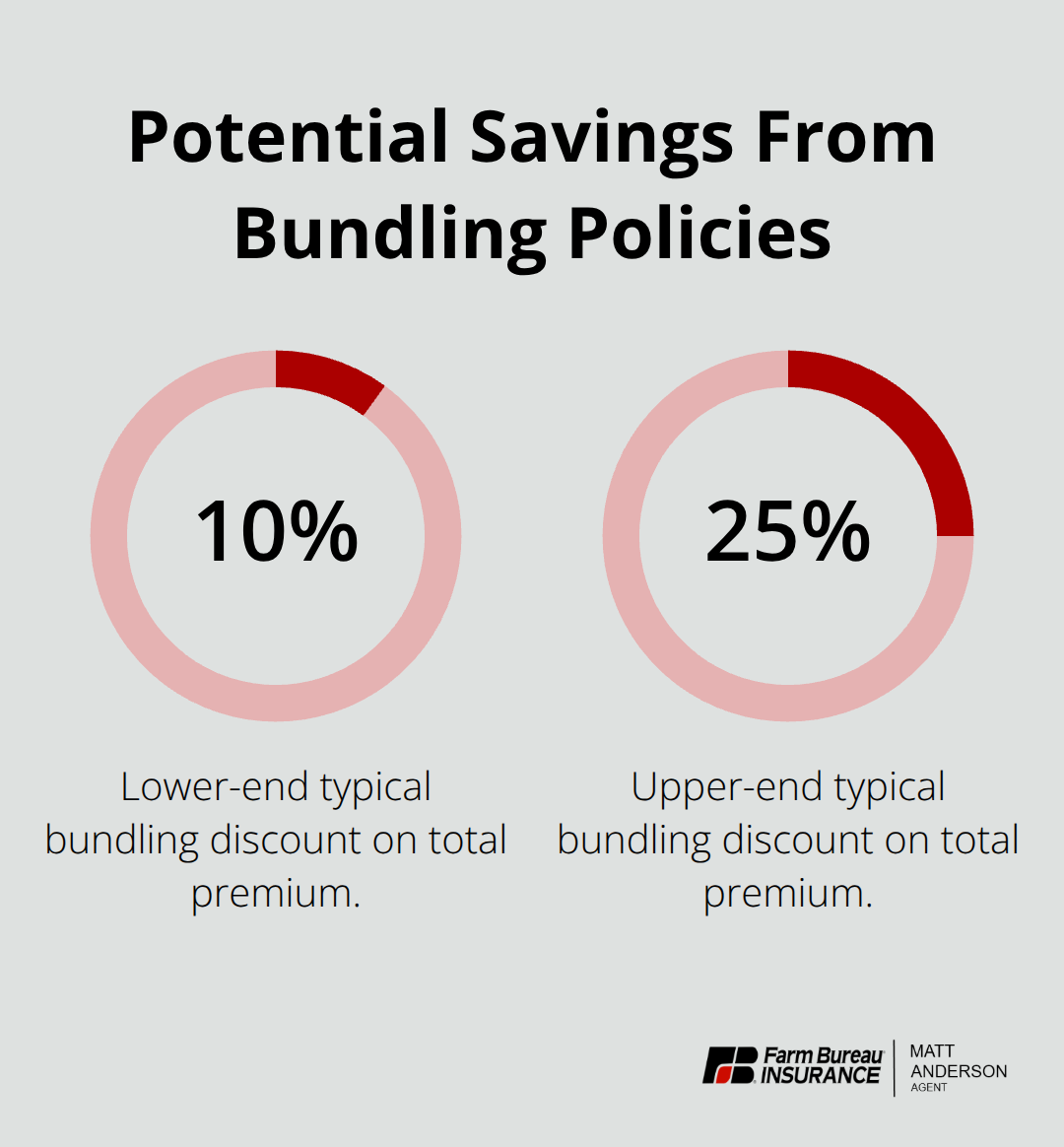
Deductibles require understanding how they affect your actual out-of-pocket costs versus premium savings. A $500 deductible costs less monthly than a $1,000 deductible, but you pay $500 from your pocket for every claim. Idaho hosts filing claims for guest damage or theft often face multiple incidents per year, making high deductibles expensive in practice. Most short-term rental hosts benefit from $500 to $750 deductibles that balance reasonable monthly premiums with manageable claim costs. Bundling your vacation rental coverage with auto, home, or other policies typically generates 10-25% savings on your total premium, though discounts vary by carrier and coverage type.

Typical bundling discounts available when combining vacation rental coverage with other policies in the U.S.

Request quotes from multiple carriers rather than accepting the first offer, since short-term rental insurance pricing varies significantly based on how each company rates property type, location, guest volume, and claims history. An independent agency can quote carriers that a captive agent cannot access, potentially saving you hundreds annually. Ask specifically about occupancy discounts if your property sits vacant during off-season months-some carriers reduce premiums when you’re not actively renting. Review your coverage annually as your guest volume changes, property improvements increase replacement value, or you add amenities like hot tubs. A policy purchased when you rented 100 nights per year may inadequately protect you after you increase to 250 nights. Idaho’s short-term rental market continues expanding, particularly in North Idaho mountain communities, and rates may shift as carriers adjust their underwriting.

Final Thoughts

Your Idaho vacation rental coverage requires active maintenance as your business evolves. Review your policy annually, especially if you’ve increased guest bookings, added amenities like hot tubs or fire pits, or upgraded your property. What protected you adequately at 100 annual guest nights may leave gaps when you reach 250 nights, and carriers often adjust rates based on claims history and market conditions.

Document your property’s condition before each guest arrives through photos and videos of the building, contents, and amenities. Time-stamped photos establish what condition your property was in, protecting you against false damage claims and strengthening legitimate claims when incidents occur. Many hosts use simple smartphone photos stored in cloud storage, making this process quick and free.

At Matt Anderson Insurance, we specialize in protecting Idaho hosts with comprehensive short-term rental coverage tailored to your property type, guest volume, and local risks. Our licensed agents understand Idaho’s unique rental landscape and can bundle your vacation rental coverage with auto and home policies for significant savings. Contact us to review your current protection and ensure your Idaho vacation rental coverage matches your actual business needs.

The information provided in this blog is for general informational purposes only and does not constitute legal, financial, or insurance advice. Coverage options, terms, and availability may vary. Please consult with a licensed professional for advice specific to your situation. Artificial intelligence may have been used to generate text and images in some blog articles.
What type of insurance do I need for my boat?

Boat Insurance Agent Driggs, IDWhen it comes to insuring your boat, it can be hard to know where to start. Most new boat owners start by wondering how much coverage will be provided by an existing home insurance policy. But it’s often best to separate your boat insurance from your homeowner’s policy or any other policies that you might have. The majority of home insurance policies either offer very limited marine specific coverage or don’t cover boats at all.


If your home insurance does provide marine insurance, it’s important to ask what type of coverage is included. Most home insurance policies that have some type of marine insurance included only offer coverage when operating the boat on inland waterways, small lakes, and rivers. Coverage rarely reaches to a coastal inlet or along the beach.  Additionally, the liability limits can be restrictive. Oftentimes a home insurance policy won’t provide coverage for costs that you might be liable for such as salvage work, wreckage removal, and environmental damages.

What are the variables involved in most boat insurance policies?

There are many variables which insurance companies will consider when determining your boat insurance premiums. Some of the most common of these variables include:

  • Length of the boat
  • Age of the boat
  • Overall value of the boat
  • Condition (Does it meet US Coast Guard Standards?)
  • Horsepower of the motor(s)
  • Where it will be kept and operated

What types of boat coverage are there?

There are two basic types of boat insurance —“agreed value” and “actual cash value.” Applying deprecation at the time of a loss is what sets these policy types apart.

An “agreed value” policy insures the boat based on its value when the policy was initially written. While it can cost more upfront, there is no depreciation for a total loss of the boat.

“Actual cash value” policies cost less upfront but factor in depreciation. The policy will only pay the boat’s actual value at the time of loss. Over time, as your boat ages, your insurer will likely insist on an actual cash value policy—and your premiums will likely decrease over time as a result.

What coverages are often available on a stand-alone boat policy?

The availability of specialized coverages is the advantage of purchasing a stand-alone boat policy rather than relying on your home insurance. Some of these coverages include:

  • Accessories Coverage: Coverage for a specific high-value piece of equipment on your boat, such as an expensive prop or navigation equipment.
  • Wreckage Removal: Covers the cost of removing and transporting your boat in the case of severe damage or sinking.
  • Towing: In the event that your boat breaks down, this coverage will reimburse you for the costs associated with getting back to shore.
  • Cruising Extension: You can get temporary, additional coverage for areas outside the USA such as Mexico or the Bahamas.

The best way to get more information on boat insurance is to ask a licensed agent in our office. We can assist you with assessing your insurance needs and provide you with some quotes from several of the top insurance companies.

Get A Quote For Your Boat Insurance Today

Our licensed staff is ready to help you get multiple boat insurance quotes. Because we’re an independent insurance agent we can shop from multiple insurance companies to help you find the right coverage at the right price.

April is Distracted Driving Awareness Month – Tips to Be a Safer Driver

Distracted Driving Awareness MonthApril is Distracted Driving Awareness Month. According to National Highway Traffic Safety Administration, 3,142 lives were lost from distracted driving accidents. This increased 10% from 2018.

What is considered distracted driving? Any time you cannot have 100% full attention to driving your vehicle is considered distracted driving. Behaviors can range from talking on the phone, texting, talking to a passenger in your vehicle, eating, brushing your hair, adjusting settings in your vehicle or playing with your vehicle’s GPS while driving your vehicle. Unfortunately, distracted driving is more common than it should be.

Take this month to practice safe driving by eliminating any of the previously mentioned behaviors while driving. This will not only make you a safer driver, but keeps other vehicles on the road safer too.

Cell Phone Use

Cell phone use can be one of the most dangerous behaviors while driving a vehicle. Sending a text message while driving can take your eyes off the road for several seconds. Talking on the phone also creates enough distraction while driving. Here are some things to consider practicing this month –

  • Keep your phone in the back seat when driving to avoid looking at it, texting or talking. You could also consider other areas of your car like your trunk or glove box. If the glove box is tempting, place farther away from you like the back seat or trunk.
  • There are options to put a do not disturb setting on your phone while driving. This can help eliminate the distraction.
  • Make phone calls or texts before or after driving your vehicle.
  • If you are riding with a passenger, let the passenger be in charge of your phone for calls or texts.

Be Aware of Other Distracted Driving Behaviors

Do you find yourself eating in the car often? Grooming? Frequently fiddling with your entertainment system? Reaching in the back seat dealing with children? If you are guilty of these behaviors, how can you work to eliminate them?

Be a Good Role Model

Especially if you are a parent to children, you should demonstrate how to be a safe driver. Children see what you do and can easily follow in your footsteps. Cell phone use can be one of the most dangerous behaviors so practice never using your cell phone while driving. If you do not have kids, keep others you love accountable. Not only demonstrate safe driving practices while you are behind the wheel, but call out any of their behaviors you feel are unsafe while in the passenger seat.

While our agents cannot teach out how to practice safe driving, we can shop to find you the best rate for your auto insurance. Call our office for a free auto insurance quote. We’ll shop our carriers and provide you with several quotes to choose from. We’ll explain your coverage options too.