
Idaho Contractor Bonding Insurance: Why Bonds Matter For Projects

Running a contracting business in Idaho means understanding what protects your work and your wallet. Idaho contractor bonding insurance isn’t optional-it’s a legal requirement for licensed contractors and a practical shield against financial risk.

At Matt Anderson Insurance, we help contractors navigate bonding requirements so you can focus on building. The right bonds give your clients confidence and keep your business compliant with state regulations.

Why Bonding Protects Your Contracting Business

Idaho’s contractor registration law, enforced by the Idaho Contractors Board, makes bonding non-negotiable for most construction work. Any project valued over $2,000 in materials and labor requires you to register, and registration demands proof of general liability insurance with a minimum of $300,000 in coverage. State-level bonding applies specifically to Plumbing, HVAC, Fire Protection Sprinkler, and Farm Labor Contractors, with bond amounts ranging from $2,000 to $30,000 depending on your specialty. Plumbing, HVAC, and Fire Protection Sprinkler contractors each need $2,000 bonds, while Farm Labor Contractors face requirements between $10,000 and $30,000. Without the correct bond in place, you cannot legally operate, obtain building permits, file liens, or enforce contracts. The penalty for working unregistered is serious-you face misdemeanor charges carrying up to $1,000 in fines or six months in jail.

How Bonds Protect Your Financial Position

Bonds function as a financial guarantee that protects both you and your clients. When a surety backs your bond, they commit to reimburse project owners for damages or unpaid claims up to the bond amount. Construction projects carry real risk-materials get damaged, timelines slip, workers get hurt, and subcontractors sometimes go unpaid. Performance bonds specifically guarantee that you will complete work as promised on time and within scope. Payment bonds ensure that workers and suppliers receive what they are owed, protecting them from your financial failure. Bid bonds prove to project owners that you will honor your bid price and take on the job if selected. These three bond types work together to shift risk away from you personally and onto the surety company backing your work. Your personal assets remain protected because claims go against the bond, not your bank account or business assets.

What Clients See When You Carry Bonds

Project owners and general contractors openly favor bonded contractors when selecting subcontractors or awarding bids. A bond signals that you have passed underwriting scrutiny based on character, capacity, and capital-the three C’s that sureties evaluate. Character assessment examines your honesty and past performance record. Capacity evaluation reviews your ability to complete similar projects using your resources and workflows. Capital analysis looks at your financial strength, net worth, profitability, and working capital to determine whether you can weather project challenges. Clients see bonding as proof that an independent third party has verified your credentials and financial stability.
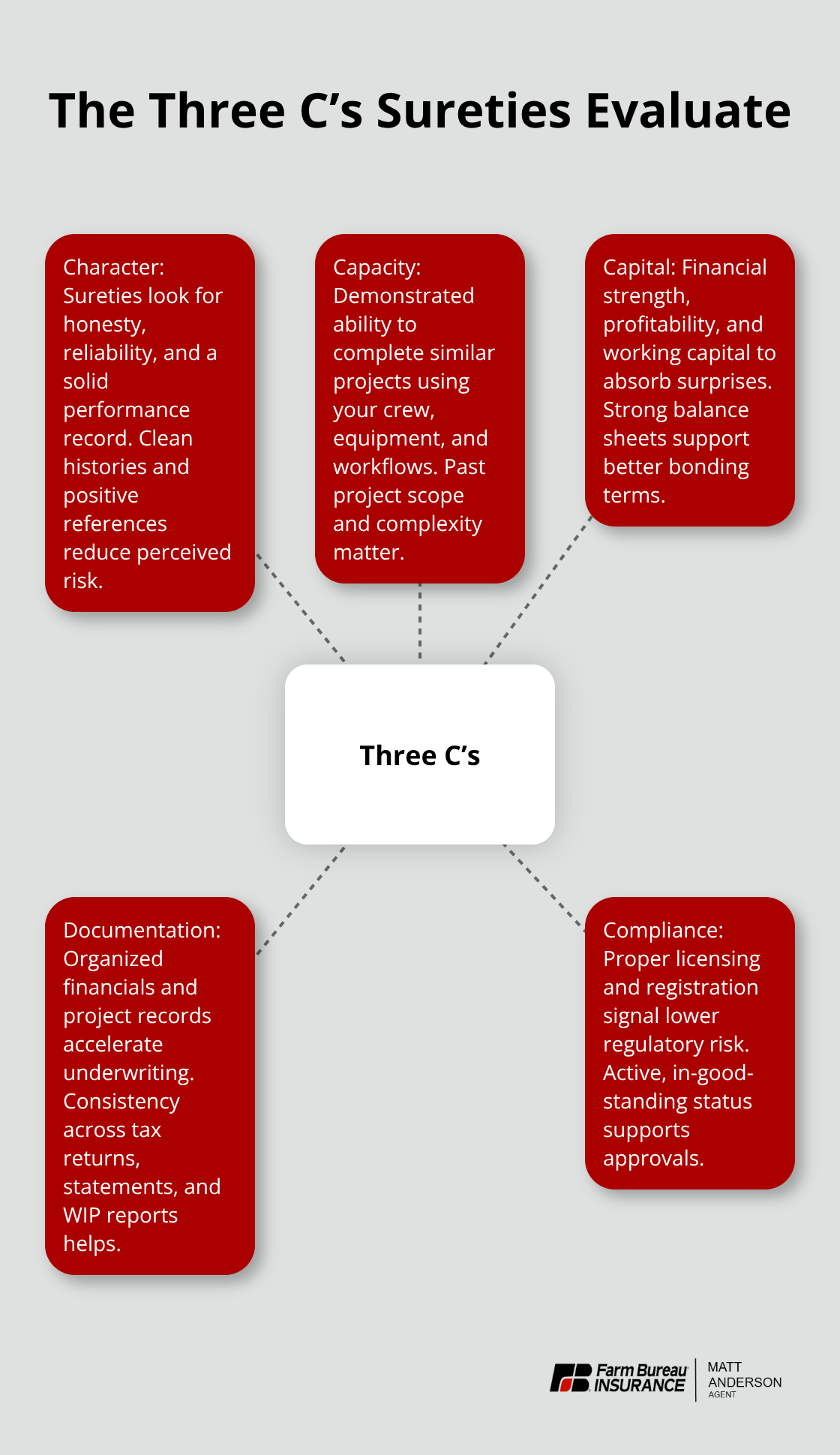
Infographic showing the three C’s—Character, Capacity, and Capital—that sureties evaluate for bonded contractors. - Idaho contractor bonding insurance

Without bonds, you compete on price alone, which means lower margins and higher stress. Bonded contractors win more competitive bids and attract clients willing to pay fairly for reliable work.

Moving Forward with the Right Coverage

The bond types you need depend on your trade and the projects you pursue. Bid bonds protect you when you submit proposals for competitive work. Performance and payment bonds become essential once you win a contract and start the actual construction. Understanding which bonds apply to your situation-and maintaining them throughout your business operations-keeps you compliant and competitive. The next section covers the specific bond types that protect different phases of your contracting work.

Which Bond Types Cover Your Contracting Work

Idaho contractors operate across three distinct project phases, and each phase demands a specific bond type. When you submit proposals for competitive work, bid bonds prove to project owners that you will honor your quoted price and accept the job if selected. Most bid bonds cost between 1 and 3 percent of your bid amount, making them relatively affordable protection. Once you win the contract and work begins, performance bonds take over.
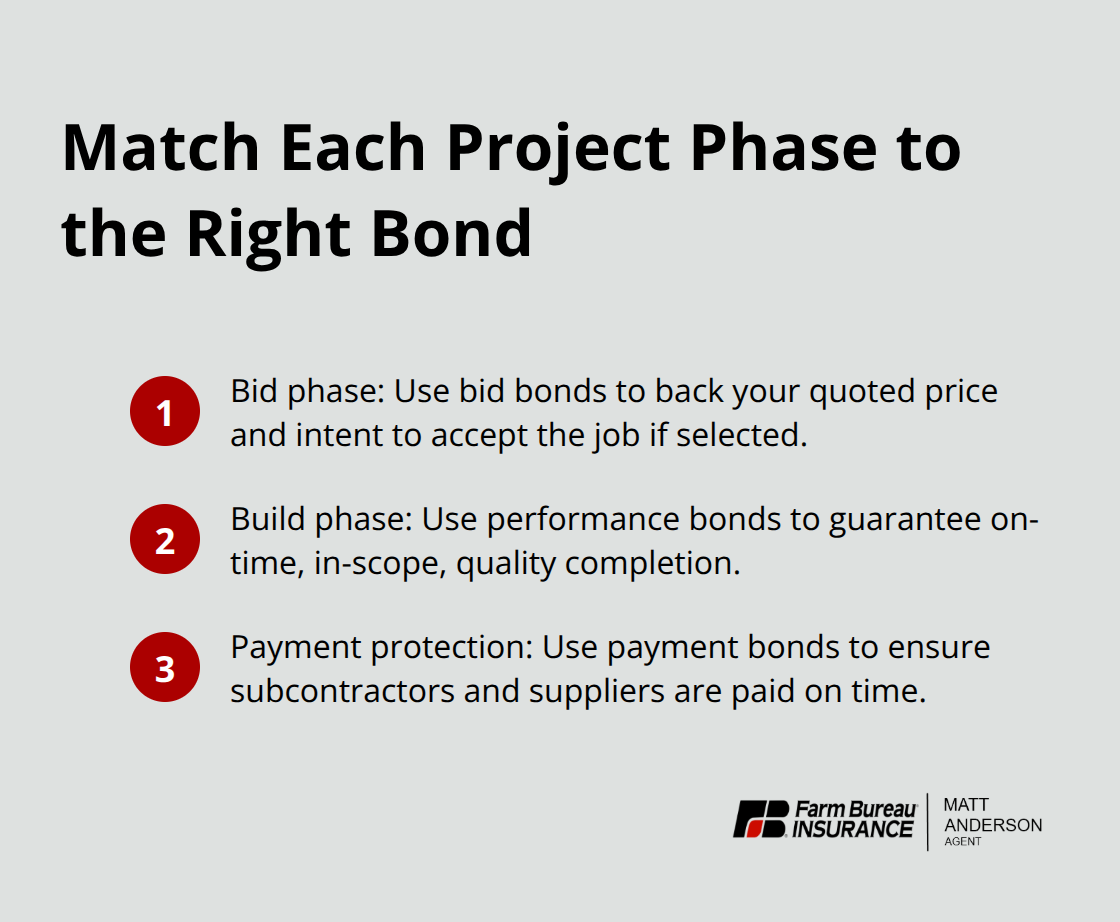
Compact list mapping project phases to bid, performance, and payment bonds for Idaho contractors.

These bonds guarantee that you will complete the project on time, within scope, and to the quality standards outlined in your agreement. Performance bonds typically cost 1 to 3 percent of the total contract value, though contractors with strong credit histories and solid track records often qualify for rates at the lower end of that range.

How Payment Bonds Protect Your Subcontractors

Payment bonds operate alongside performance bonds on most projects over $2,000. They protect your subcontractors and material suppliers by guaranteeing they receive payment even if you face cash flow problems. Payment bonds cover the same contract value as performance bonds and carry similar pricing. This protection matters because unpaid suppliers can file liens against your projects, which creates legal complications and damages your reputation with future clients.

State-Level Bond Requirements by Trade

The Idaho Division of Building Safety requires that Plumbing, HVAC, and Fire Protection Sprinkler contractors maintain a $2,000 state-level bond with their respective licensing boards. These state bonds cost as little as $100 per year or $10 per month, depending on your credit profile and the surety company you work with. Farm Labor Contractors face steeper requirements, ranging from $10,000 to $30,000, reflecting the higher risk associated with wage and labor compliance violations. Your specific trade determines which state bond applies to your license.

The Three C’s That Sureties Evaluate

The underwriting process for any bond centers on what sureties call the three C’s: Character, Capacity, and Capital. Character evaluation reviews your payment history, references from past clients, and any disciplinary actions against your license. Capacity assessment examines whether you have completed similar projects, maintain adequate equipment and crew, and demonstrate reliable workflows. Capital analysis looks at your net worth, business profitability, and working capital reserves-essentially whether you have financial cushion to handle unexpected costs.

Building Your Bonding Profile for Better Rates

Contractors with clean credit scores and documented project success typically secure bonds within 24 to 48 hours and receive the most favorable rates. Conversely, contractors with recent credit issues or limited project history may face higher premiums or stricter underwriting conditions. Your bond application should include tax returns from the past two years, bank statements showing current working capital, and a portfolio of completed projects matching the scope and value of work you plan to bid. Sureties want to see that you have successfully managed projects at or above the contract values you are bidding. If you are new to contracting or transitioning to larger projects, start with smaller bid amounts and build a documented track record of successful completions. This approach strengthens your position for future bonding at better rates and demonstrates to sureties that you can handle increased responsibility. The mistakes contractors make during this phase-underestimating costs, choosing inadequate coverage, and failing to maintain compliance-can derail your bonding approval and damage your business standing.

Mistakes That Drain Your Bonding Budget and License

Underestimating Bond Costs Across Multiple Projects

Most Idaho contractors underestimate how bonding costs stack up across multiple projects, and this miscalculation creates cash flow problems that undermine profitability. A bid bond on a $50,000 project costs between $500 and $1,500 depending on your credit score, while a performance bond on that same contract runs $500 to $1,500 again. If you bid five projects in a month and win three, you have paid for two bonds you will never use, plus three active performance and payment bonds on concurrent jobs. Your bond costs should appear as a line item in every project estimate, not as an afterthought.

The surety bond application process itself takes time-typically 24 to 48 hours for approval if your financial profile is clean-but delays happen when sureties request additional documentation or flag credit concerns. Many contractors fail to budget for this friction and miss bid deadlines because they did not account for processing time.

How Credit Scores Impact Your Bond Premiums

Contractors with poor credit scores pay significantly higher premiums because sureties view them as higher risk. A contractor with a credit score below 650 might pay $150 per month for a $2,000 state bond instead of the $10 per month rate available to contractors with scores above 750. Over a year, that difference equals $1,680-money that comes directly out of your profit margin.

Review your credit report annually and address any errors or outstanding issues before applying for bonds, since your credit profile directly impacts your cost structure. This step alone can save thousands across your bonding lifetime.

Selecting Coverage Limits That Leave You Exposed

Choosing inadequate coverage limits creates exposure that bonds are supposed to eliminate. Idaho law requires general liability insurance with a minimum $300,000 single limit, but this floor does not mean it covers all your risk. A single injury claim on a residential project can easily exceed $300,000 in medical costs and lost wages. If your liability insurance has a $300,000 limit and a claim reaches $400,000, you personally pay the $100,000 gap.

Performance bonds protect project completion but do not cover liability claims-that is what liability insurance handles. Many contractors bundle these two protections without understanding the distinction, then discover mid-project that their coverage leaves gaps. State-level bonding for HVAC, Plumbing, and Fire Protection Sprinkler contractors requires only $2,000 bonds, but this covers state compliance violations, not project liability.

Failing to Maintain Registration and Display Requirements

Failing to maintain compliance with Idaho regulations costs far more than the bond itself. The Idaho Contractors Board requires you to display your registration number at your business location and every jobsite, on all advertising, contracts, building permits, letterheads, purchase orders, and subcontracts. Contractors who skip this step face registration revocation and lose the ability to file liens, enforce contracts, or obtain permits.
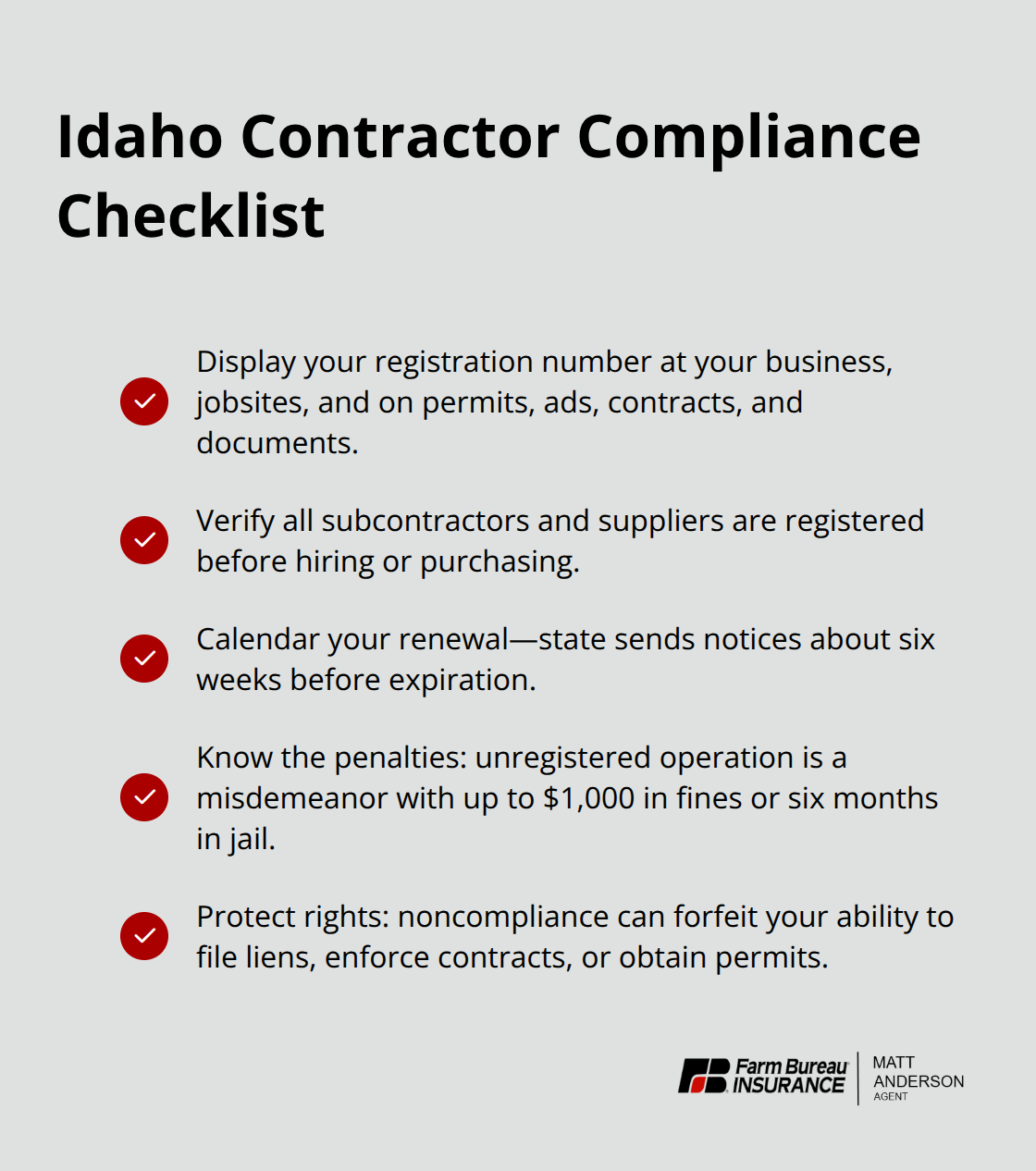
Checklist highlighting Idaho registration display rules, verification of subcontractors, renewal timing, and penalties. - Idaho contractor bonding insurance

If you hire subcontractors or suppliers, you must verify they are registered-if they are not and you work with them anyway, you risk losing lien rights on that project. Renewal notices arrive six weeks before your registration expires, but contractors who ignore them lose active status and must reapply. The penalty for operating unregistered is a misdemeanor carrying up to $1,000 in fines or six months in jail.

Final Thoughts

Idaho contractor bonding insurance protects your business in three concrete ways. Bonds keep you legally compliant with state registration requirements and licensing board mandates, preventing the misdemeanor charges and lien-loss penalties that derail contractors who operate without proper coverage. They shift financial risk away from your personal assets and onto the surety company backing your work, so claims against your projects do not drain your bank account or business reserves. Project owners and general contractors gain confidence that you have passed independent financial and character verification, which helps you win competitive bids and command fair pricing instead of competing on cost alone.

We at Matt Anderson Insurance understand that bonding requirements feel overwhelming when you focus on running your contracting operation. Our licensed agents identify exactly which bonds your trade requires, calculate realistic costs for your project pipeline, and secure coverage that fits your budget and timeline. We handle the application process, coordinate with licensing boards, and manage renewals so compliance stays on your radar without consuming your time.

Contact Matt Anderson Insurance to discuss your bonding needs and explore how bundling your contractor bonds with other business coverage can lower your overall insurance costs. We will walk you through the application process, explain which bond types apply to your projects, and help you avoid the costly mistakes that drain profitability. Your registration and bonding are too important to leave to chance.

The information provided in this blog is for general informational purposes only and does not constitute legal, financial, or insurance advice. Coverage options, terms, and availability may vary. Please consult with a licensed professional for advice specific to your situation. Artificial intelligence may have been used to generate text and images in some blog articles.

Idaho Airbnb Insurance: Peace Of Mind For Short-Term Hosts

Your standard homeowners policy won’t protect your Airbnb rental. Insurance companies exclude short-term rentals because guest turnover creates higher risks for property damage and liability claims.

At Matt Anderson Insurance, we help Idaho hosts understand their coverage options. The right Idaho Airbnb insurance policy protects your investment and gives you genuine peace of mind.

Why Your Standard Homeowners Policy Falls Short

Your homeowners insurance policy was designed for one scenario: you living in your home year-round. The moment you list your property on Airbnb or VRBO, that coverage evaporates. Insurance companies explicitly exclude short-term rentals because the risk profile changes dramatically. Constant exposure to strangers creates higher property damage claims and liability exposure that standard policies simply don’t address. According to data from Airbtics, Boise alone has 1,395 Airbnb listings that generate around $31,000 in revenue per listing annually. That income matters, but your standard homeowners policy won’t protect it if a guest causes damage or injury. Most hosts don’t realize their claim will be denied until it’s too late. We’ve seen this happen repeatedly with Idaho hosts who thought their existing coverage would apply to rental activity. It won’t.

The Real Cost of Underinsurance

Guest damage happens more frequently than most hosts expect. A broken window, damaged furniture, or stained flooring might seem minor, but repair costs add up fast. More serious incidents-a guest injury on your property or theft of valuables-create liability exposure that reaches far beyond the damage itself. Idaho law requires short-term rental properties to carry at least $1,000,000 in liability insurance coverage. Your homeowners policy typically provides $100,000 to $300,000 in liability coverage, leaving a massive gap. If a guest is injured and sues, you become personally responsible for anything above your policy limit. Additionally, standard policies don’t cover loss of rental income. If your property becomes uninhabitable due to a covered loss, you lose bookings and revenue with no compensation. A dedicated short-term rental policy covers actual loss sustained-meaning you receive compensation for the income you would have earned during the vacancy period.

What Dedicated Rental Insurance Actually Covers

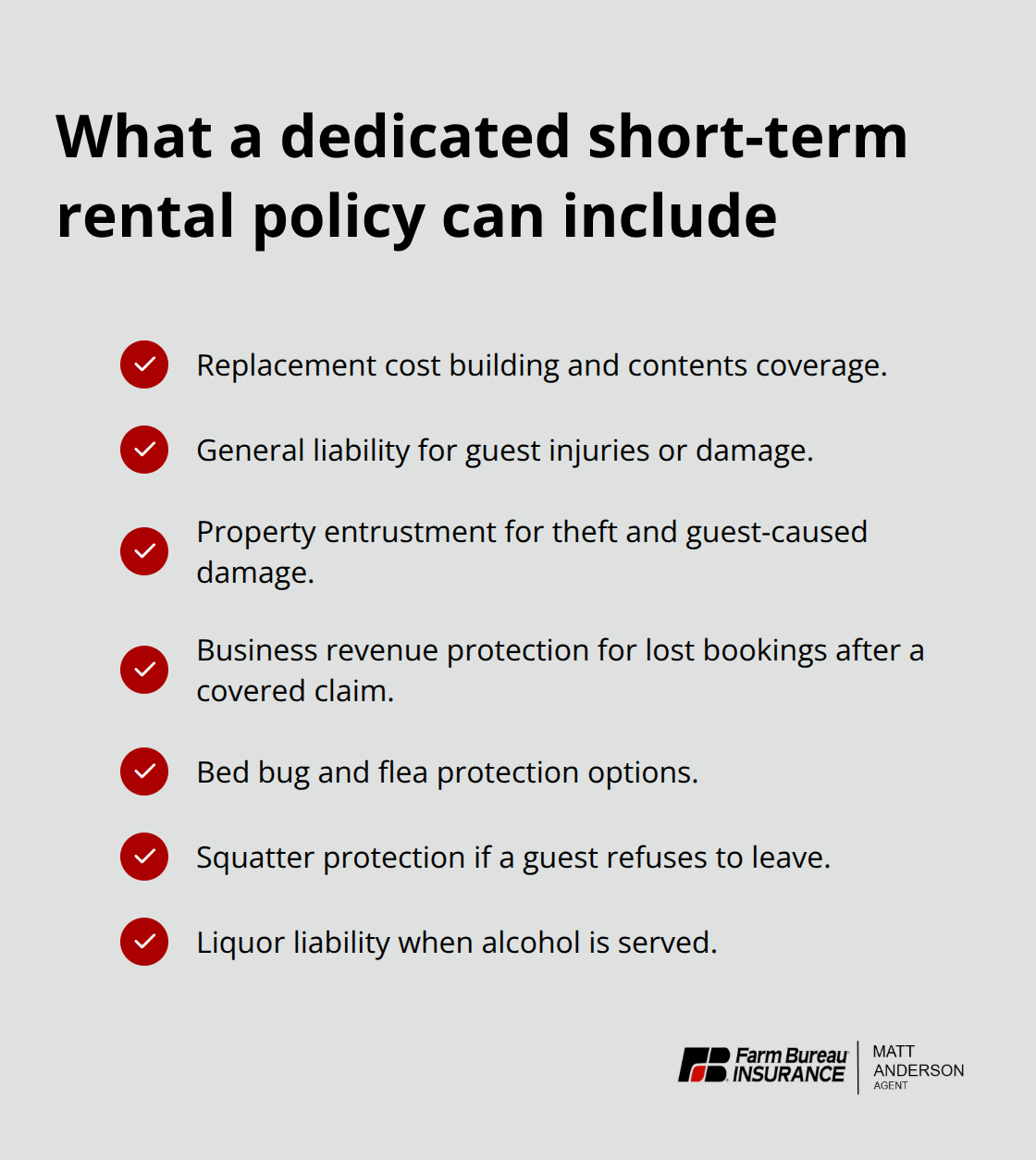
Specialized short-term rental policies address the specific risks you face as a host. They include comprehensive building coverage with replacement cost for both structure and contents, general liability protection for guest-related injuries or property damage, and property entrustment coverage that protects against theft and guest-caused damage. Business revenue protection covers lost bookings and canceled reservations after a covered claim. Some policies even include bed bug and flea protection, squatter protection if a guest refuses to leave, and liquor liability coverage if alcohol is served on the property.

Checklist of specialized coverages available to Idaho short‑term rental hosts

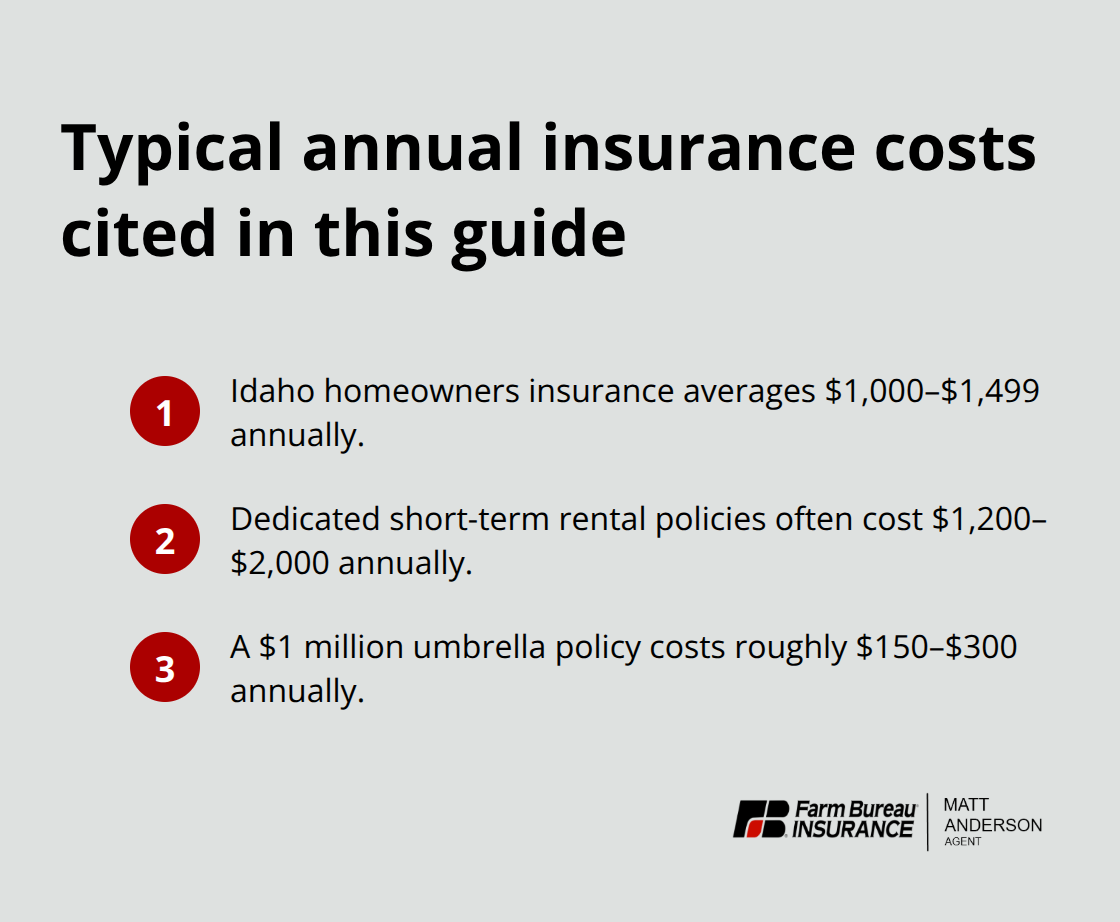
These coverages don’t exist in homeowners policies. The cost difference matters too. Idaho homeowners insurance averages $1,000 to $1,499 annually according to U.S. Census Bureau data, but dedicated short-term rental policies are competitively priced and often bundle multiple protections that would cost far more to obtain separately. Working with an agent experienced in Idaho rental properties ensures you’re not overpaying for coverage you don’t need while closing gaps in areas where you do.

Finding the Right Coverage for Your Situation

The gap between what you think you’re covered for and what you actually are covered for can cost you thousands. Your next step is to explore the specific coverage options available to Idaho hosts-from platform protections to standalone policies that give you complete control over your coverage limits.

Coverage Options for Idaho Short-Term Rental Hosts

Airbnb’s Host Protection Has Serious Limits

Airbnb’s host protection program sounds appealing until you read the fine print. The platform offers up to $1 million in liability coverage, but this coverage only activates when Airbnb’s own insurance is triggered-typically after your personal policy denies a claim. That means you rely on a backup safety net rather than primary protection. More critically, Airbnb’s coverage excludes loss of income from canceled bookings, theft by guests, and damage caused by guests during their stay. You also navigate Airbnb’s claims process, which can take months to resolve. Idaho hosts cannot rely on platform protection alone.

Dedicated Short-Term Rental Policies Provide Primary Coverage

A dedicated short-term rental policy covers your property as the primary insurer from day one. These policies include comprehensive building coverage with replacement cost for both your structure and contents, general liability protection starting at $1 million (meeting Idaho’s legal requirement), and business revenue protection that compensates you for actual income lost during vacancy. Specialized insurers offer bed bug and flea protection, squatter protection if a guest refuses to leave, and amenities liability coverage for bikes, kayaks, pools, and hot tubs. This specialized approach means you own complete protection tailored to your rental operation rather than gambling on a platform’s secondary coverage. The cost remains competitive with standard homeowners policies, often between $1,200 and $2,000 annually depending on your property type and coverage limits-reasonable given the scope of protection.

Umbrella Coverage Protects Your Personal Assets

Umbrella coverage acts as your final safety layer, and it’s not optional if you’re serious about asset protection. A $1 million umbrella policy costs roughly $150 to $300 annually and covers liability claims that exceed your primary policy limits. If a guest suffers a serious injury on your property and wins a $2 million lawsuit, your dedicated rental policy covers the first $1 million and your umbrella covers the remaining $1 million, protecting your personal assets.

Compact list comparing Idaho homeowners, dedicated STR, and umbrella policy costs - Idaho Airbnb insurance

Idaho hosts who own their properties outright should absolutely carry umbrella coverage; those with mortgages face lender requirements for liability protection anyway.

Structuring Your Complete Protection Strategy

Work with a local agent who understands Idaho rental risks and can bind coverage quickly. The right combination of dedicated short-term rental coverage and umbrella protection means you’re genuinely protected when claims happen. Your agent helps you evaluate property type, guest volume, and local regulations to select appropriate coverage limits. Once you understand what protection looks like, the next step involves comparing specific policies and deductibles to find the right fit for your situation.

How to Choose the Right Insurance for Your Idaho Rental

Match Coverage to Your Property and Guest Patterns

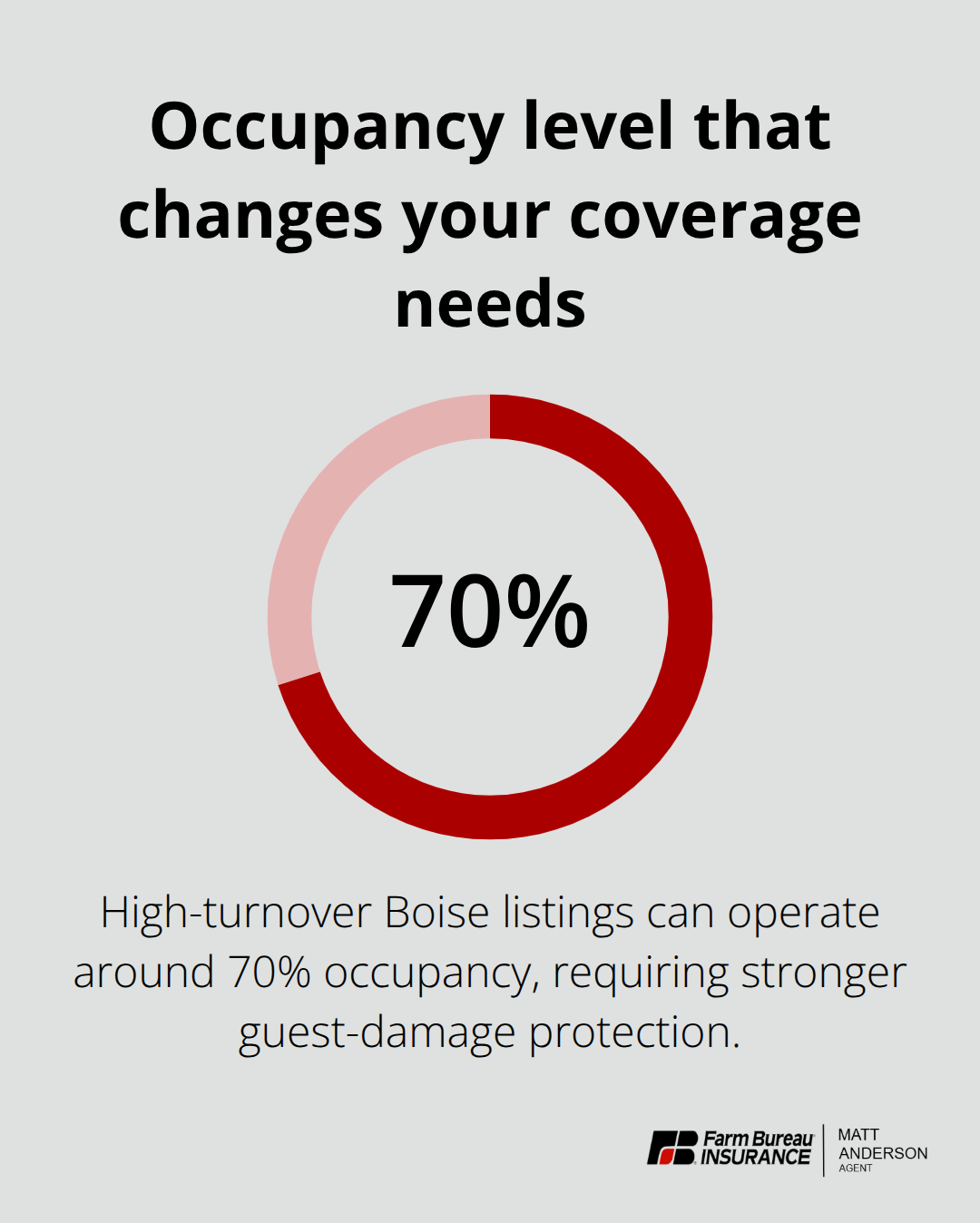
Start with the specifics of your property, not general insurance talk. A cabin in McCall that hosts families during ski season faces different risks than a downtown Boise apartment renting to business travelers year-round. Your property type, occupancy patterns, and guest demographics directly determine the coverage limits you actually need. A 2-bedroom apartment generating around $31,000 annually according to Airbtics data requires different protection than a luxury vacation home. High-turnover properties with 70% occupancy like many Boise listings need robust guest damage coverage and frequent replacement cost assessments. Properties with lower occupancy can sometimes reduce coverage limits without sacrificing protection.

Chart showing 70% occupancy as a tipping point for higher-risk, high-turnover Boise listings - Idaho Airbnb insurance

Your guest volume matters because frequent turnover increases the statistical likelihood of property damage, theft, and liability claims. Ask yourself: Do you host families or solo travelers? Are guests primarily local or international? Do you allow pets? Do you serve alcohol? These answers shape which coverage options actually protect you. A property that allows pets needs animal liability coverage with no breed restrictions-a standard homeowners policy won’t touch this. A property where guests consume alcohol needs liquor liability protection, another exclusion in traditional policies.

Calculate your annual revenue realistically using data from your listings or platforms like Airbtics, then ensure your business revenue coverage matches that income. If you generate $30,000 annually, your loss-of-income coverage should reflect that threshold. Idaho hosts commonly underestimate this number and end up with coverage limits that don’t match actual revenue.

Select Deductibles and Liability Limits Based on Your Financial Reality

Coverage limits and deductibles require honest assessment of your financial position, not wishful thinking. Idaho law mandates $1,000,000 in liability coverage for short-term rentals, so that’s your floor, not your ceiling. If a guest suffers a serious injury and sues for $2 million, a $1 million policy leaves you personally liable for the difference. Dedicated short-term rental policies typically offer $1 million to $2 million in liability; choosing the higher limit costs roughly $200 to $400 more annually but protects your assets substantially.

Your deductible directly impacts your out-of-pocket costs when claims happen. A $500 deductible means you pay $500 for each claim; a $2,500 deductible reduces your premium but increases your financial exposure. High-volume hosts with frequent minor claims benefit from lower deductibles; hosts with minimal claims history can absorb higher deductibles and lower premiums. Building and contents coverage should reflect replacement cost, not actual cash value. If your furnishings cost $15,000 to replace and a guest damages them, replacement cost coverage pays the full amount; actual cash value accounts for depreciation and leaves you short.

Work with Local Idaho Agents Who Understand Rental Risks

Work with a local Idaho agent who handles short-term rental properties regularly. These agents understand Idaho’s specific risks-wildfire exposure in forested areas, seasonal rental patterns in resort communities, and local regulatory requirements that changed significantly after House Bill 583 took effect July 1, 2026. A local agent binds coverage quickly, answers claims questions directly, and helps you select the right insurance policy as your rental operation grows.

Compare quotes from multiple insurers; prices and coverage terms vary substantially. Some insurers specialize in short-term rentals while others treat them as afterthoughts. An agent experienced with properties like yours identifies gaps that generalist insurers miss and explains trade-offs between coverage options in plain language.

Final Thoughts

Your Idaho Airbnb insurance protects your income, your assets, and your ability to operate without constant financial anxiety. Standard homeowners policies leave you exposed to thousands in potential losses, while dedicated short-term rental coverage closes those gaps with comprehensive protection designed specifically for hosts. Airbnb’s host protection provides a secondary safety net, but a primary policy gives you control from day one, and adding umbrella protection creates a complete defense against liability claims that exceed your primary limits.

Idaho’s regulatory environment supports responsible hosts, and House Bill 583 eliminated many local restrictions on short-term rentals while keeping the $1 million liability requirement firm. Wildfire risk in Idaho’s forested regions continues to rise, making comprehensive property coverage essential for hosts in affected areas. The cost of proper coverage remains competitive with standard homeowners insurance, typically between $1,200 and $2,000 annually depending on your property and coverage selections.

Contact a local Idaho agent who understands short-term rental risks and can match your specific situation to the right coverage. At Matt Anderson Insurance, our licensed agents specialize in protecting Idaho hosts with comprehensive short-term rental coverage and umbrella policies that reduce your overall insurance costs. Get a quote today and stop gambling with inadequate coverage.

The information provided in this blog is for general informational purposes only and does not constitute legal, financial, or insurance advice. Coverage options, terms, and availability may vary. Please consult with a licensed professional for advice specific to your situation. Artificial intelligence may have been used to generate text and images in some blog articles.
Idaho Auto Insurance Rates: What Factors Drive Your Premium

Your Idaho auto insurance rates depend on more than just luck. Insurance companies use specific factors-your driving history, age, vehicle type, and location-to calculate what you pay each month.

At Matt Anderson Insurance, we help Idaho drivers understand these factors so they can make smarter choices about their coverage and find real ways to save money.

What Really Drives Your Idaho Auto Insurance Premium

Your Driving Record Sets the Foundation

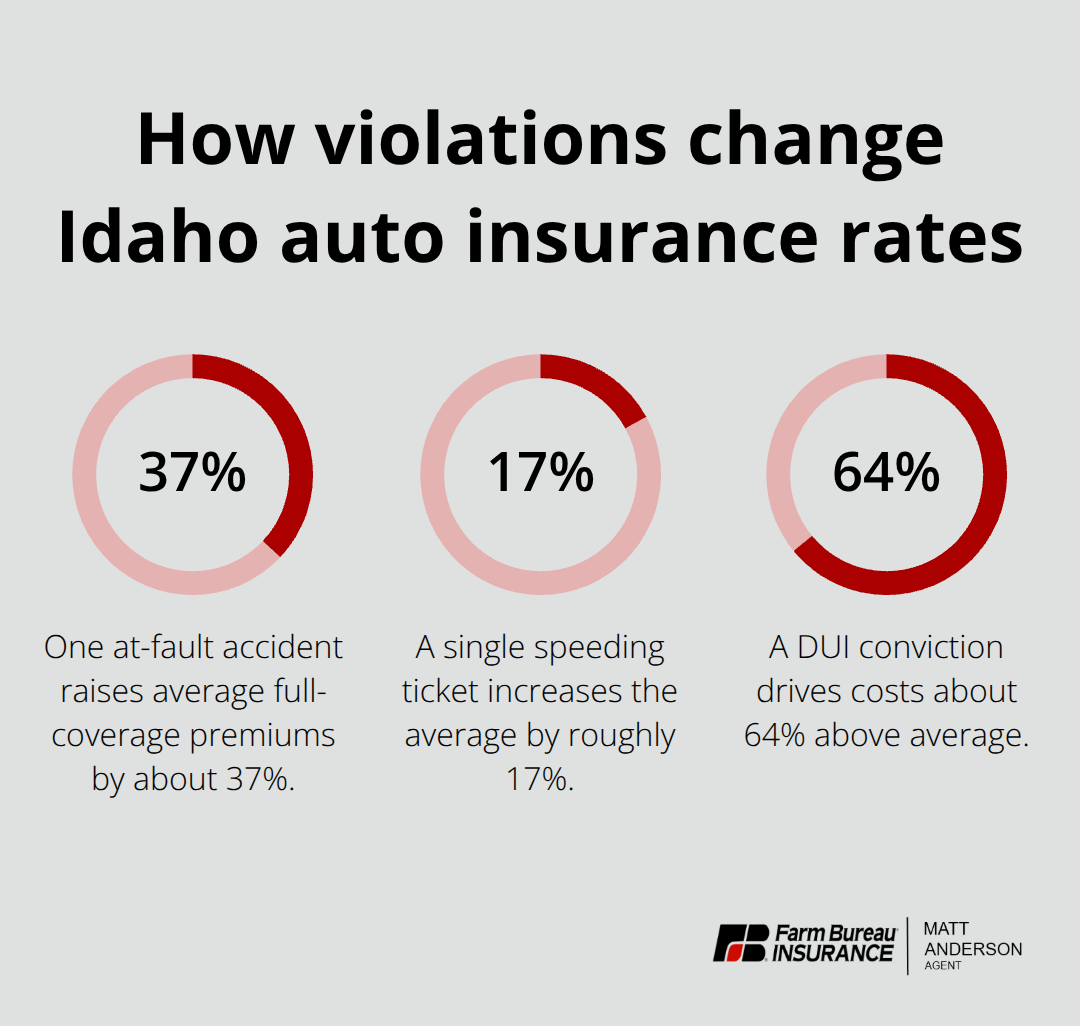
Your driving record is the single biggest factor insurers examine when calculating your rate, and the data backs this up. A clean record keeps you around the Idaho average of roughly $1,476 per year for full coverage, according to Bankrate’s analysis of Quadrant Information Services data from November 2025. One at-fault accident raises that to about $2,023 per year-a 37 percent jump. A speeding ticket alone pushes you to around $1,731 per year, roughly 17 percent higher. A DUI conviction is far worse, landing you at approximately $2,423 per year, about 64 percent above average.

Percentage increases for common violations in Idaho auto insurance

Claims history matters just as much as individual incidents. Frequent claims signal higher risk and keep your premiums elevated for three to five years after each incident. This means avoiding small claims is often smarter than filing them-you pay a few hundred dollars out of pocket for minor damage and protect your rate from climbing significantly.

Age and Experience Shape Your Cost

An 18-year-old on their own policy pays around $4,580 for full coverage, roughly 76 percent more than the state average, while a 20-year-old pays about $3,278, still 46 percent above average. These costs drop steadily as you age; by 25, premiums fall to around $1,951, and by 60, they settle near $1,313. Insurers view younger drivers as higher risk because they lack experience behind the wheel and statistically cause more accidents.

Vehicle Type and Safety Features Impact Your Premium

Your vehicle choice directly affects your bill. A Toyota Camry costs about $1,476 per year to insure, while a BMW 330i runs approximately $1,878, and a Honda Odyssey comes in around $1,277. Luxury and high-performance vehicles cost significantly more because repair parts and labor are expensive. A vehicle’s safety rating also influences your premium-cars with higher ratings qualify for discounts that lower your annual cost. When you choose a vehicle with excellent safety features and reasonable repair costs, you save money over the life of ownership.

These three factors-your driving record, age, and vehicle-form the core of how insurers price your policy. But location within Idaho and your personal financial profile add another layer of complexity to your final rate.

Where You Live and Your Money Matter More Than You Think

Location Within Idaho Creates Real Price Differences

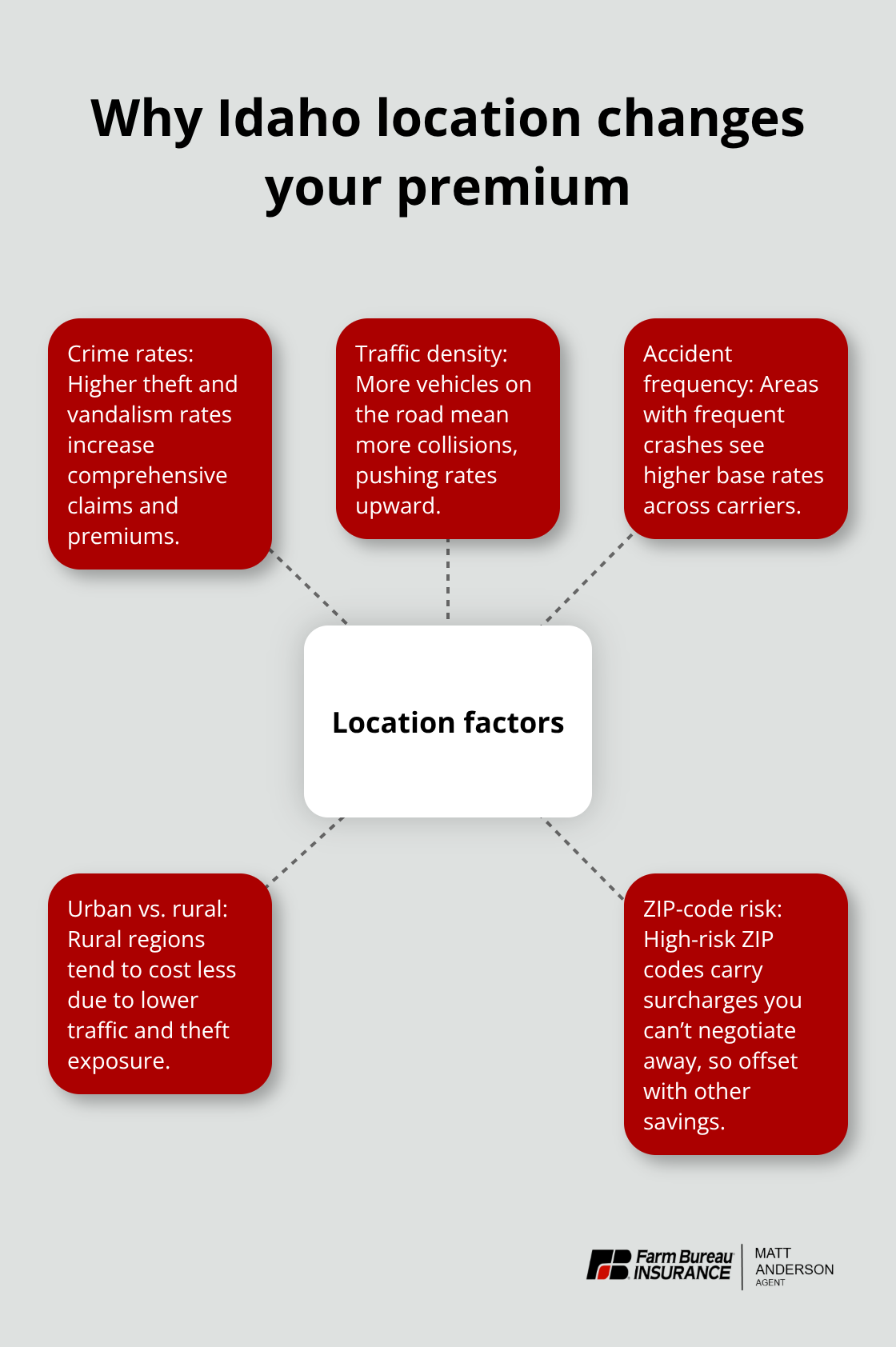
Where you live in Idaho fundamentally shapes what you pay for auto insurance, and the differences are substantial. Boise drivers pay around $1,354 per year for full coverage, while Caldwell residents pay approximately $1,493 and Nampa drivers around $1,454, according to Bankrate’s November 2025 analysis. These variations stem from local crime rates, traffic density, and accident frequency in each area. Rural Idaho generally offers lower premiums than urban centers because fewer cars on the road means fewer collisions and theft incidents.

Hub-and-spoke showing location-driven factors behind Idaho auto insurance price differences - Idaho auto insurance rates

If you live in a high-risk ZIP code, you cannot negotiate your way out of that geographic penalty, but you can control other factors to offset it.

Your Credit Score Carries Surprising Weight

Your credit score directly influences your rate in Idaho, and the impact is severe. Drivers with poor credit pay roughly 49 percent more than the state average, while those with excellent credit save about 11 percent compared with average rates. This means a driver with poor credit might pay $2,200 annually while an excellent-credit driver in the same location pays around $1,310. Improving your credit takes time, but even modest increases over six to twelve months can lower your next renewal quote. Payment history matters as much as your overall score-consistently paying bills on time signals financial responsibility to insurers, and they reward that stability with lower rates.

Deductibles and Coverage Limits Control Your Out-of-Pocket Costs

How you structure your coverage directly controls your premium. Raising your deductible from $500 to $1,000 typically reduces your annual premium by 10 to 25 percent, which translates to $150 to $370 in savings depending on your base rate. Higher deductibles work well if you have emergency savings and drive carefully; lower deductibles suit drivers who cannot absorb unexpected out-of-pocket costs.

Idaho requires minimum liability coverage of $25,000 per person and $50,000 per accident for bodily injury, plus $15,000 for property damage, but these minimums leave you exposed to serious financial risk. If you cause an accident and someone’s medical bills exceed your coverage limits, you become personally liable for the remainder. Upgrading to $50,000 per person and $100,000 per accident costs more monthly but protects your assets far better. Most drivers renew on autopilot without adjusting anything, yet your financial situation and driving patterns change annually-a review of your coverage limits each year makes real sense.

These location, credit, and coverage decisions set the stage for the final piece of the puzzle: the concrete actions you can take to lower your costs without sacrificing protection.

How to Actually Lower Your Idaho Auto Insurance Costs

Bundle Policies for Immediate Savings

Combining insurance policies cuts your premium without sacrificing coverage. Clients who combine auto with homeowners, renters, motorcycle, or RV coverage under one policy save 5%-25% discount on their total costs. If you own a home and a car, bundling those two alone typically saves hundreds annually. The discount applies immediately at renewal, so consolidating separate policies through different companies with a single agency that offers multiple lines creates instant savings. Many Idaho drivers overlook this because they never ask their current insurer about bundling options, yet it remains one of the most straightforward ways to reduce what you owe each month.

Maintain a Clean Driving Record

Your driving record cannot change overnight, but maintaining a clean record going forward is the single most powerful lever you control. Each year without an accident or ticket keeps your rate stable or allows it to drop as you age and build experience. A single at-fault accident costs you roughly $547 more per year compared to the state average, and that premium penalty sticks around for three to five years. Defensive driving courses offered through organizations like the Idaho Transportation Department can qualify you for discounts with most carriers, typically saving 5 to 10 percent on your annual premium. The investment in a course costs $30 to $50 but pays for itself many times over if it prevents even one minor incident that would have triggered a claim. Committing to habits that reduce risk-avoiding phone use while driving, leaving extra space between vehicles, and adjusting your speed for weather conditions-all lower your accident likelihood and protect your rate.

Shop Multiple Carriers Before Renewal

Rates for identical coverage vary dramatically across insurance companies, sometimes by hundreds of dollars annually for the same driver profile. According to Bankrate’s November 2025 analysis, some carriers price 9 percent below the Idaho state average while others charge well above it for the same risk level. Waiting until your renewal notice arrives and paying the quoted amount is expensive. Instead, get quotes from at least three carriers two months before your renewal date, providing identical coverage limits and deductibles to each one. This comparison takes roughly 30 minutes online or by phone and frequently uncovers $200 to $400 in annual savings.

Compact list of actionable tips to reduce auto insurance premiums in Idaho - Idaho auto insurance rates

Local independent agencies compare multiple carriers at once rather than forcing you to contact each company separately, which saves time and often reveals discounts you would miss shopping alone. Rate shopping every two to three years, not just once, matters because carrier pricing shifts constantly as they adjust for local claims experience and market conditions.

Final Thoughts

Idaho auto insurance rates reflect your driving habits, age, vehicle choice, location, credit profile, and coverage decisions. You now control where you save money and where you accept higher costs based on your priorities. Your driving record remains the foundation-one accident or ticket costs hundreds more annually for years, while bundling policies, raising deductibles, and shopping multiple carriers offset geographic penalties that location creates.

Review your current coverage without waiting for renewal and check whether your deductibles and liability limits still match your financial situation. Many Idaho drivers carry outdated coverage that no longer fits their lives, paying for protection they do not need while leaving gaps where they do. Raising a deductible from $500 to $1,000 typically saves 10 to 25 percent annually, and upgrading liability limits from state minimums to $50,000 per person and $100,000 per accident costs more but protects your assets if you cause a serious accident.

Contact Matt Anderson Insurance for a free review of your current coverage and a comparison of rates from multiple carriers. A few minutes of conversation often uncovers hundreds in annual savings while ensuring you have the protection your family actually needs.

The information provided in this blog is for general informational purposes only and does not constitute legal, financial, or insurance advice. Coverage options, terms, and availability may vary. Please consult with a licensed professional for advice specific to your situation. Artificial intelligence may have been used to generate text and images in some blog articles.
Idaho Builder Insurance: Protecting Your Projects And Profits

Construction projects in Idaho face real financial risks. Weather damage, theft, and accidents can wipe out profits faster than you’d expect.

That’s where Idaho builder insurance comes in. We at Matt Anderson Insurance know that standard business policies leave contractors exposed to gaps that can cost thousands when something goes wrong.

What Builder’s Risk Insurance Actually Covers

Builder’s risk insurance protects the physical structure, materials, and temporary installations on your job site from fire, hail, theft, and vandalism. The policy covers the building frame, walls, roofing, interior finishes, and materials stored on site-essentially everything that becomes part of the finished project. It also covers temporary structures like scaffolding, fences, and site offices that support construction operations. Many policies include debris removal costs if a covered loss occurs, which can run $10,000 to $50,000 on larger projects.

Key builder's risk coverage items for Idaho construction projects - Idaho builder insurance

What Builder’s Risk Does Not Cover

The coverage typically ends when construction is complete, so you’ll need separate business property insurance afterward to protect the finished building. Builder’s risk does not cover your personal tools, equipment, or vehicles on site-those require separate inland marine or equipment coverage. The policy also excludes land itself, vegetation, and damage caused by poor workmanship or ordinary wear and tear, so understanding these boundaries prevents costly surprises when you file a claim.

Liability Coverage During Construction

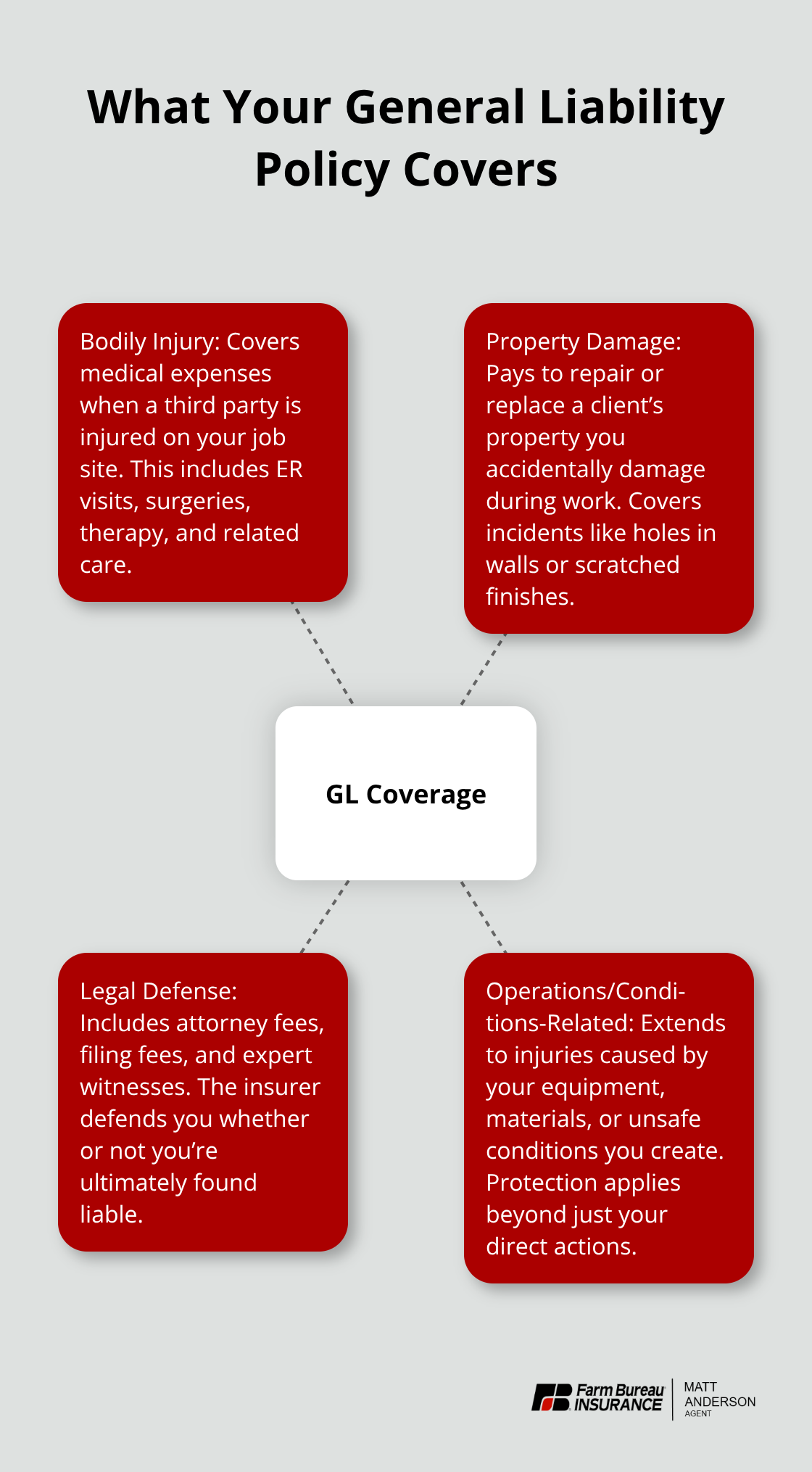
Builder’s risk policies can include liability protection for bodily injury and property damage claims that arise from your construction work, though this varies by policy and endorsement. If someone is injured on your job site or your work damages a client’s existing property, liability coverage pays medical expenses, legal defense costs, and settlement amounts. Importantly, most contractors also carry a separate general liability policy that covers these same risks, and many clients require proof of at least $1,000,000 per occurrence before awarding contracts.

Defense Costs and Policy Coordination

The Hartford and other major carriers offer policies with defense costs paid outside the coverage limits, meaning your $1,000,000 limit stays intact while the insurer pays legal fees. If you work on residential projects over $2,000, Idaho law requires you to disclose your insurance details to the homeowner in writing, so having clear documentation of your liability coverage protects both you and the client. Coordinating builder’s risk liability with your general liability policy prevents gaps and overlaps that can complicate claims or leave you underinsured on high-value projects. Understanding these coverage layers helps you select the right protection before your next bid.

Why Idaho Contractors Really Need Builder’s Risk

Idaho construction sites operate in a high-risk environment that standard business policies simply don’t address. A single hailstorm damages roofing materials worth $20,000 to $100,000, and theft from job sites costs Idaho contractors thousands annually. Weather patterns in Idaho-including spring hail, winter snow loads, and summer wind events-create specific exposures that generic commercial policies exclude or severely limit. If you rely on a standard business property policy to cover materials and structures under construction, you’re almost certainly underinsured. These policies are designed for completed buildings and established operations, not for the dynamic, exposed conditions of active construction. The gap between what you think you’re covered for and what actually pays out destroys a project’s profitability in weeks.

Coverage Gaps That Cost You Money

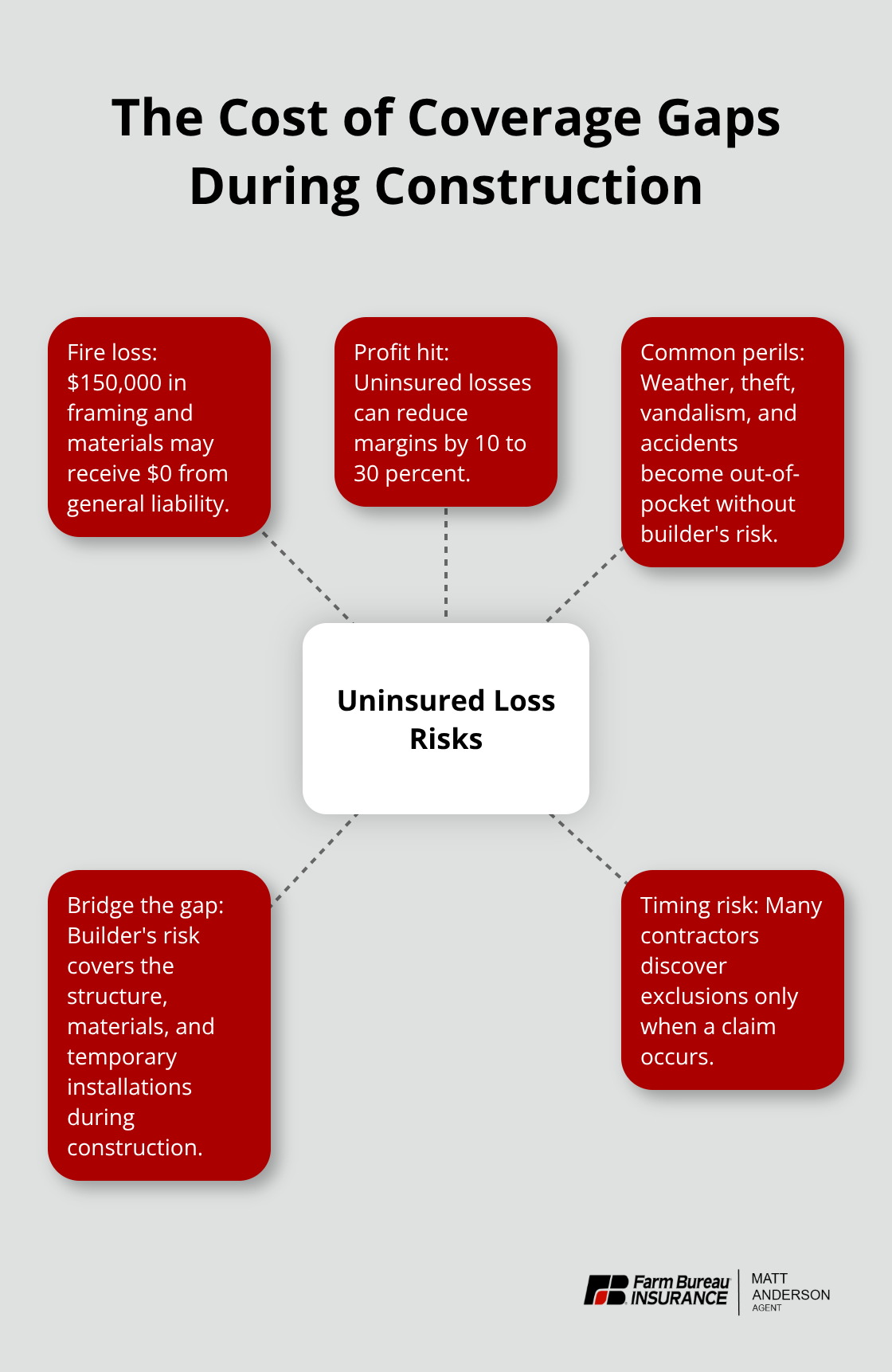
Most general contractors carry general liability insurance to meet Idaho’s registration requirements and client demands, but that policy covers only bodily injury and property damage claims-not physical loss to the building itself. If a fire damages $150,000 worth of framing and materials on your job site, your general liability policy pays nothing. That loss comes directly out of your pocket, reducing profit margins by 10 to 30 percent depending on project size. Builder’s risk fills that exact gap by covering the structure, materials, and temporary installations while construction is underway.

How uninsured losses impact contractors and how builder's risk fills the gap - Idaho builder insurance

Without it, weather damage, theft, vandalism, and accidents become uninsured losses that force you to absorb costs or negotiate with clients to cover repairs. Contractors who thought their existing policies were sufficient often discover critical exclusions only when a claim happens-and by then it’s too late to add coverage.

Protecting Your Cash Flow and Schedule

Construction projects operate on tight timelines and tight budgets. A theft of copper wiring or HVAC equipment sets your schedule back two weeks and costs $5,000 to $15,000 in replacement and labor. Builder’s risk insurance covers these losses directly, so you file a claim and move forward rather than scrambling to fund repairs from operating capital. Debris removal endorsements, which many builder’s risk policies include, cover the cost of clearing wreckage after a covered loss-expenses that reach $10,000 to $50,000 on larger projects. Without this endorsement, you pay for cleanup out of pocket while your crew sits idle and your schedule slips further. The policy also protects your financial stake in materials ordered in advance or stored on site, so if a delivery is damaged before installation, you recover the cost rather than absorbing it as a loss.

Meeting Client Requirements and Legal Obligations

For residential projects over $2,000, Idaho law requires you to disclose your insurance to homeowners in writing anyway, so having robust builder’s risk coverage demonstrates professionalism and protects the client relationship when unexpected damage occurs. Many clients now demand proof of builder’s risk coverage before awarding contracts, especially on larger residential and commercial projects. This coverage requirement has become standard in the industry because clients understand that uninsured losses often lead to disputes, delays, and cost overruns. When you present a complete insurance package-including builder’s risk-you position yourself as a professional operator who takes project protection seriously. This advantage matters when competing for bids against contractors who carry only the state minimum coverage.

How to Match Coverage to Your Actual Project Risk

Builder’s risk policies are not one-size-fits-all, and selecting the wrong coverage limits or missing critical endorsements can leave you exposed to exactly the losses you’re trying to prevent. Start by calculating your total project value, including materials, labor, and soft costs like permits and design fees. A $200,000 residential renovation needs different coverage than a $2 million commercial build, and your policy limits should reflect the actual replacement cost of everything on site at any given time.

Calculate Your Coverage Needs Accurately

Most Idaho contractors underestimate their coverage needs because they focus only on materials and miss the cost of temporary structures, stored equipment, and debris removal. The Hartford and Travelers both offer replacement-cost valuation rather than actual cash value, which means you recover the full cost to rebuild rather than a depreciated amount-this matters significantly on projects with older materials or long timelines. Request quotes from at least three insurers and compare not just the premium but also what’s included in the base policy versus what requires paid endorsements. A policy that includes $100,000 in debris removal coverage as standard saves you thousands compared to one that requires you to purchase this protection separately.

Choose Your Deductible Based on Cash Reserves

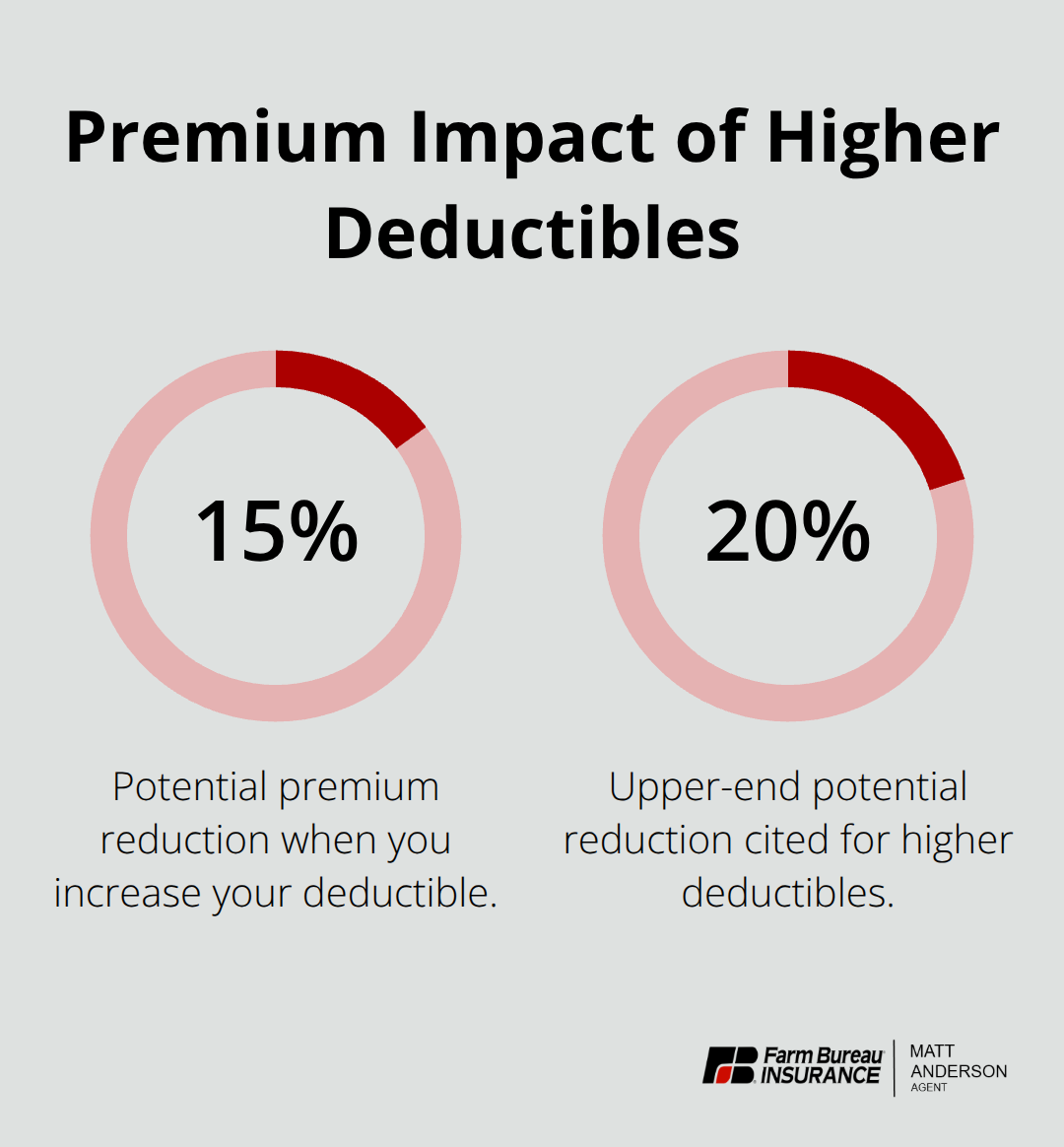
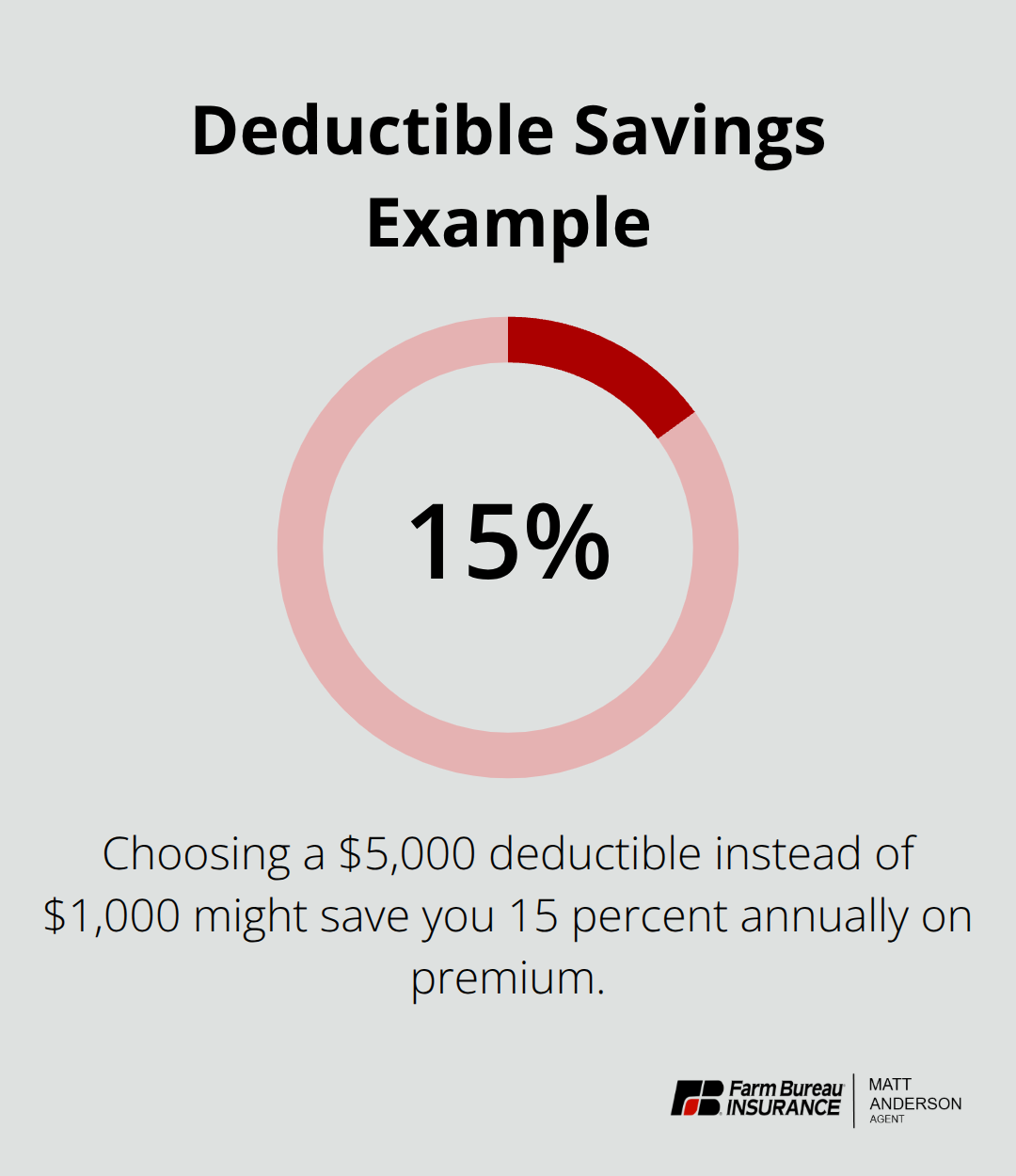
Deductibles typically range from $1,000 to $5,000, and choosing a higher deductible can reduce your annual premium by 15 to 20 percent, but only if you can afford to pay that amount out of pocket when a loss occurs. Calculate your deductible choice based on your operating capital and cash reserves-a contractor with limited liquid assets should choose a $1,000 deductible even if it costs more annually, because a $5,000 out-of-pocket loss could strain your business.

How increasing your deductible can affect your annual premium

This decision directly affects both your premium and your financial stability after a claim.

Work with a Local Idaho Agent

Idaho’s specific weather patterns and regional construction practices require an agent who understands local risks rather than someone selling a generic national template. Work with a local Idaho-based agency that knows spring hail patterns, winter snow load requirements, and the building codes that affect your projects. Ask your agent directly whether they recommend endorsements for pollutant cleanup, code-change penalties, or energy-efficiency certification costs-these add $500 to $2,000 annually but prevent catastrophic gaps when a covered loss triggers these expenses.

Verify Policy Details Before Committing

Verify whether your policy’s defense costs are paid outside your coverage limits or count toward them; Chubb and The Hartford typically pay defense costs separately, which preserves your limit for actual claim payouts. Request a sample policy document before committing and have your attorney review it if the project value exceeds $500,000. When construction finishes, coordinate with your agent to transition from builder’s risk to business property insurance for the completed building, because builder’s risk automatically expires and leaves you uninsured if you don’t arrange follow-up coverage immediately. Document your project timeline clearly when applying for quotes, because policies are priced and underwritten based on the construction schedule you provide-extensions beyond the original timeline may require policy amendments or new quotes.

Final Thoughts

Idaho builder insurance protects your profits from weather damage, theft, and accidents that standard business policies ignore. A single hailstorm destroys $50,000 in roofing materials, theft of copper wiring delays your schedule by weeks, or vandalism forces you to replace windows and doors-these losses hit your bottom line hard without proper protection. Builder’s risk covers the physical structure, materials, and temporary installations on your job site while your general liability policy handles bodily injury and property damage claims, creating a complete safety net for your projects.

Selecting the right coverage means calculating your actual project value, choosing deductibles based on your cash reserves, and working with a local agent who understands Idaho’s specific weather risks and building practices. The cost typically ranges from 1 to 5 percent of your total project budget-a small investment compared to the financial damage an uninsured loss causes. When you combine builder’s risk with your general liability policy and meet Idaho’s registration requirements, you present yourself as a contractor who takes project protection seriously.

Contact Matt Anderson Insurance today for a quote on Idaho builder insurance that matches your actual exposure. Our licensed agents help contractors select coverage that protects both projects and profits. We handle claims support efficiently so you keep your schedule on track.

The information provided in this blog is for general informational purposes only and does not constitute legal, financial, or insurance advice. Coverage options, terms, and availability may vary. Please consult with a licensed professional for advice specific to your situation. Artificial intelligence may have been used to generate text and images in some blog articles.

Bundled Auto Insurance Idaho: Save With A Combined Policy Plan

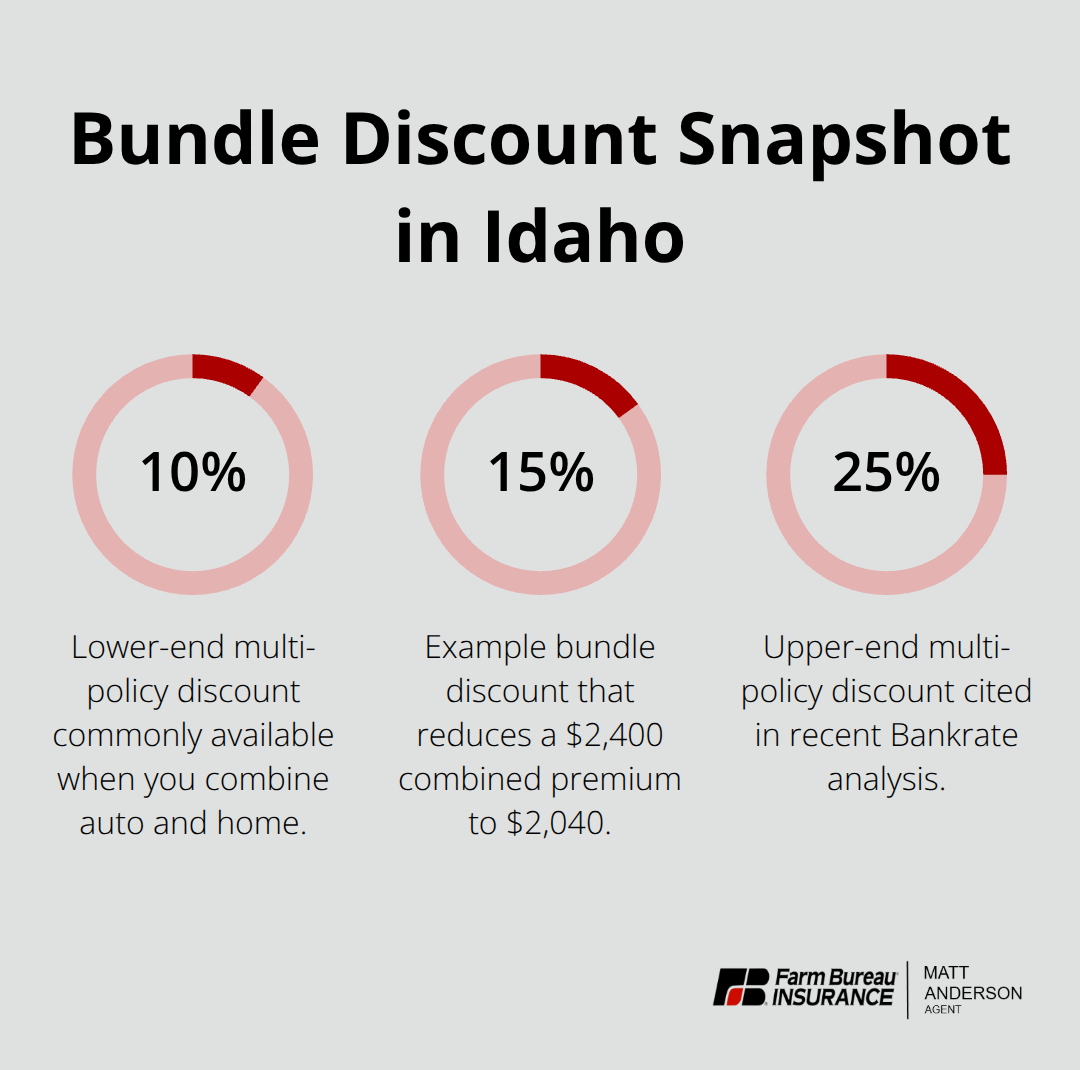
Bundling your auto insurance with other policies is one of the smartest financial moves you can make in Idaho. Most insurers offer discounts ranging from 10% to 25% when you combine auto, home, and other coverage under one plan.

At Matt Anderson Insurance, we’ve helped countless Idaho drivers reduce their premiums significantly through bundled policies. The savings add up fast, and you’ll gain the convenience of managing everything with a single agent.

How Bundling Saves Idaho Drivers Real Money

The Numbers Behind Bundle Discounts

When you bundle auto insurance with home coverage in Idaho, savings appear immediately on your bill. SelectQuote data shows that customers who combined their policies saved an average of $693 annually. Bankrate’s November 2025 analysis found that bundling discounts typically range from 10% to 25%, though the actual amount depends on your location, driving history, and the carrier you choose. The math works simply: if your separate auto and home policies cost $2,400 combined, a 15% bundle discount reduces that to $2,040.

Visualizing common Idaho bundle discounts at 10%, 15%, and 25%. - Bundled auto insurance Idaho

USAA, Geico, and American National consistently offer competitive bundled rates across Idaho, with USAA averaging around $728 annually for auto coverage alone among eligible military members and veterans. For homeowners, SelectQuote customers paid an average of $103.98 monthly, just below the national average of $104.08 according to the Insurance Information Institute. When you add multi-policy discounts on top of these base rates, the total savings compound-especially if you add renters, boat, or RV coverage to the bundle.

Why Separate Policies Cost More

Carrying auto and home policies with different insurers means you pay full price at each company with no loyalty discount. Each carrier sets rates independently based on their own underwriting criteria, and they have no reason to discount you when they’re only insuring one line of business. A driver in Boise might pay $405 annually for minimum auto coverage but then shop separately for homeowners and miss the 15–20% discount available through bundling. Managing two renewal dates, two billing cycles, and two separate agents creates friction that prevents you from optimizing your coverage. When claims happen, uncoordinated policies can leave gaps in coverage or create disputes about which policy should pay. An independent agency can help consolidate your coverage, but only if you take action to request quotes and compare bundled options against your current separate policies.

Location Drives Bundle Savings in Idaho

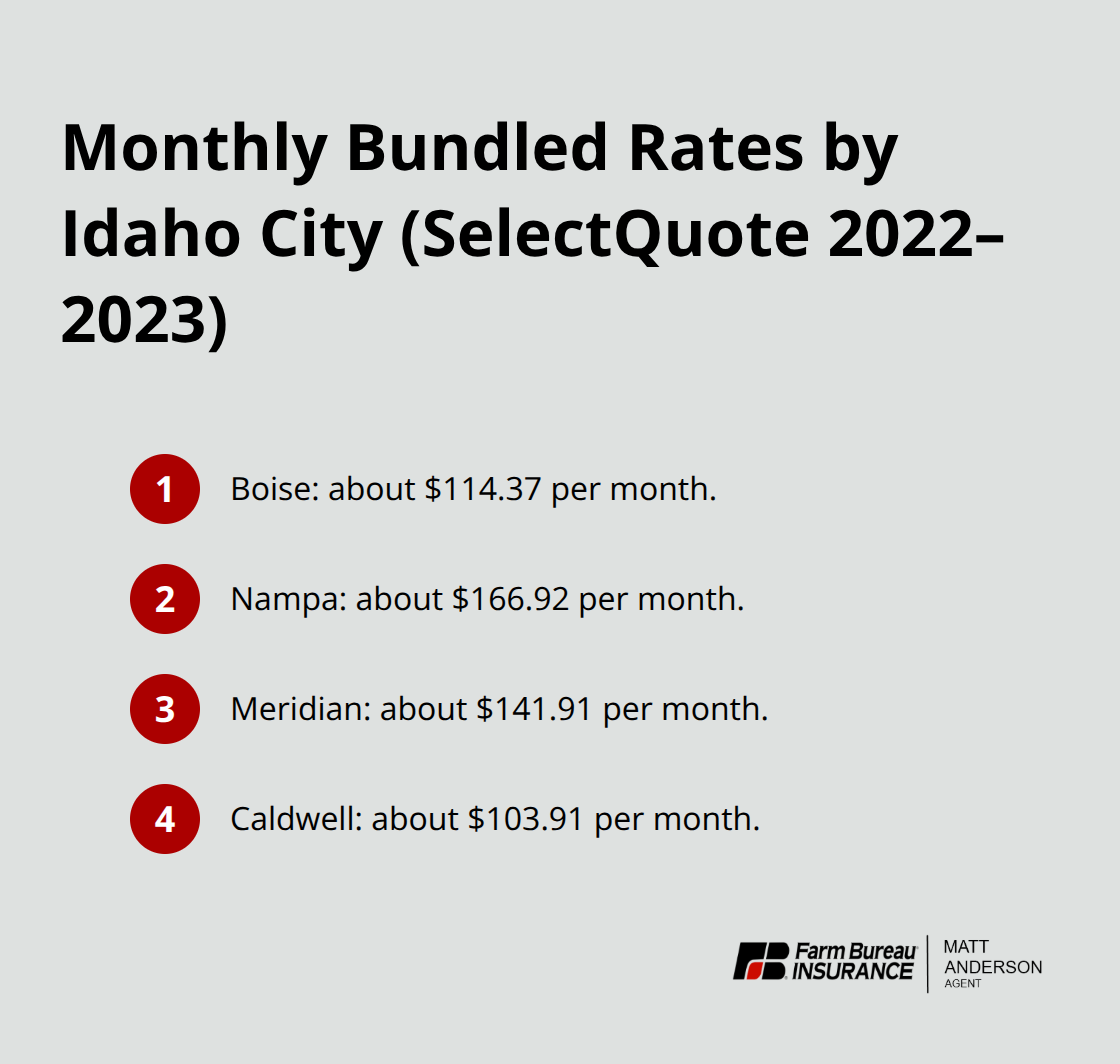
City location matters significantly for bundle savings. Boise bundled rates averaged around $114.37 monthly in SelectQuote data from 2022–2023, while Nampa customers paid $166.92 monthly for the same coverage type-a difference that compounds to over $600 annually. Meridian bundled policies cost about $141.91 monthly, and Caldwell came in lower at $103.91. These variations exist because claim frequency, property values, and theft rates differ by location.

Compact list comparing average monthly bundled rates in Boise, Nampa, Meridian, and Caldwell. - Bundled auto insurance Idaho

Rural areas generally have lower rates than densely populated urban zones, so if you live in a smaller Idaho town, your bundle savings might exceed the statewide average. Drivers with clean records who bundle also unlock additional discounts for defensive driving courses, paid-in-full payments, and safety features on their vehicles. A household with multiple drivers or vehicles gains even more from bundling because one policy covers everyone and everything under the same plan, multiplying the multi-policy discount effect. Understanding what coverage types you can actually combine with your auto policy helps you maximize these location-based advantages.

What Coverage Types Bundle Best With Auto Insurance

Homeowners Insurance Delivers the Strongest Savings

Homeowners insurance pairs naturally with auto coverage and produces the strongest savings in Idaho. When you combine these two policies, carriers apply multi-policy discounts that help reduce your monthly premiums. The reason is straightforward: homeowners and auto policies share similar underwriting processes, so bundling them costs insurers less to administer. If you own a home in Idaho, bundling auto and homeowners makes strong financial sense.

Renters and Recreational Vehicle Coverage

Renters who own vehicles can also bundle renters insurance with auto coverage for similar savings, though the discount tends to be slightly smaller than homeowners bundles because renters policies cover less property value. Boat and RV policies integrate smoothly into bundled plans, especially in Idaho where recreational vehicles remain common. Adding watercraft or RV coverage to an existing auto and home bundle typically triggers an additional discount on your total premium. This matters because boat and RV owners often carry these vehicles for only part of the year, making them ideal candidates for seasonal bundling adjustments that further reduce costs.

Umbrella and Business Insurance Options

Umbrella coverage sits on top of your existing auto and home liability limits and protects you if someone sues for damages beyond what your standard policies cover. Farm Bureau offers umbrella policies that bundle seamlessly with auto and home coverage for Idaho residents. Adding umbrella coverage to your bundle typically costs $150–$300 annually but provides $1 million or more in additional liability protection-a financial safeguard that justifies the premium. Business insurance for sole proprietors or small business owners in Idaho can also bundle with personal auto and home policies at many carriers, though availability varies by insurer.

How Multiple Policies Multiply Your Savings

Each additional policy you add to your bundle unlocks another layer of discount. A household with auto, home, boat, and umbrella coverage under one carrier pays significantly less than someone managing these policies separately across multiple insurers. When you’re ready to explore which coverage combinations work best for your specific situation and assets, understanding your current protection gaps becomes the next critical step.

What to Look for When Bundling Policies in Idaho

Align Your Coverage Limits Across Policies

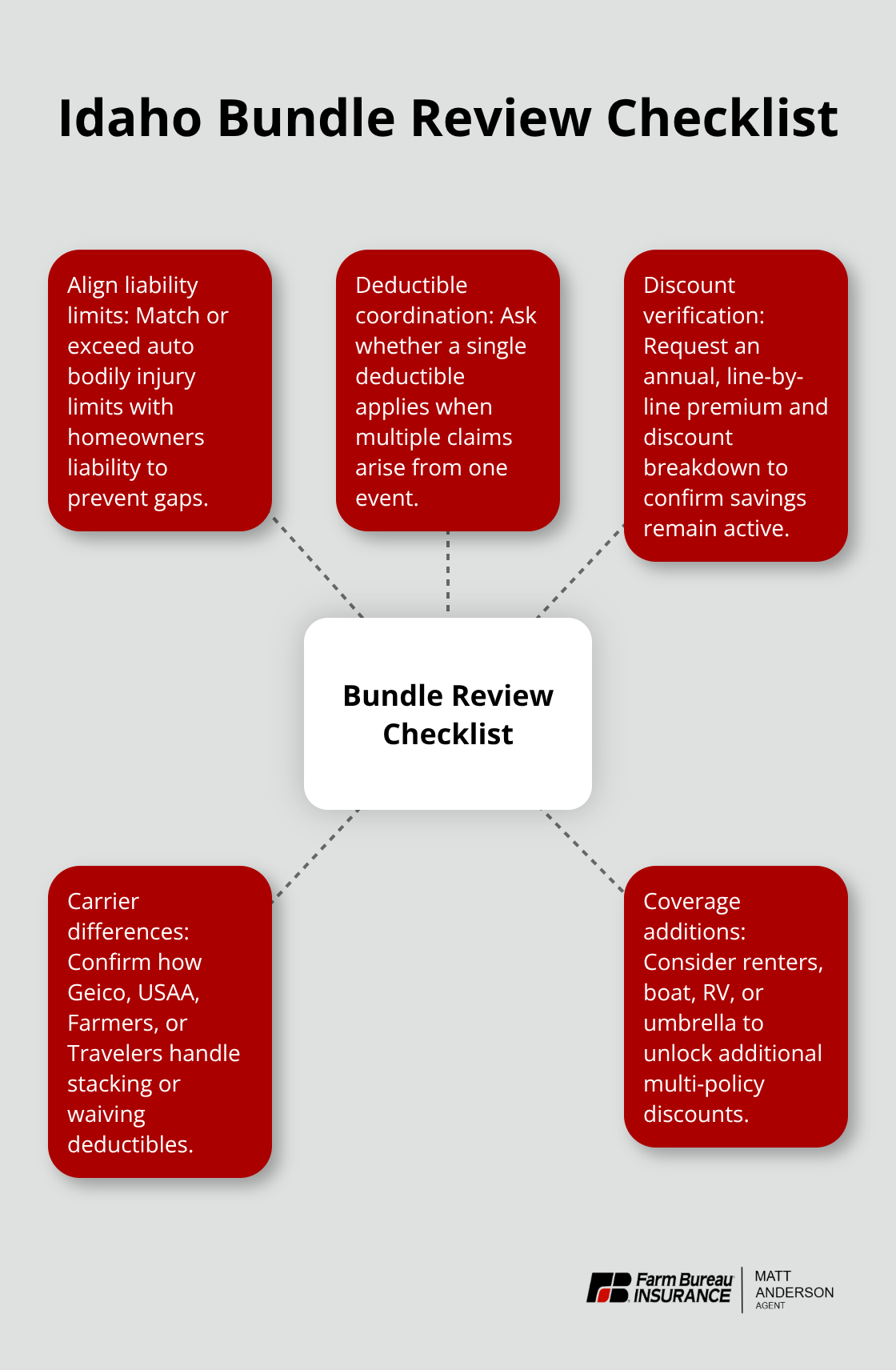
Before you commit to a bundled plan, comparing coverage limits across your policies matters far more than chasing the lowest premium. Idaho minimum auto liability is 25/50/15, but that covers only basic injuries to others-not damage to your own vehicle or adequate protection if you are sued. When bundling home and auto, many Idaho drivers overlook the fact that homeowners policies have separate liability limits (typically 100,000 to 300,000) that do not automatically increase when you add auto coverage. If someone is injured on your property and sues, your homeowners liability pays first, then your auto umbrella coverage may kick in-but only if your limits align properly.

Hub-and-spoke checklist of key steps to optimize an Idaho insurance bundle.

We recommend reviewing whether your bundled auto limits should match or exceed your homeowners liability limits to avoid gaps. A household with a home worth 350,000 and multiple vehicles should carry at least 100,000 per person in auto bodily injury liability, not the state minimum. Ask your agent directly: what happens to my liability coverage if I am sued for an accident at home versus on the road? The answer reveals whether your bundle protects you adequately or leaves exposure.

Understand How Deductibles Work in Your Bundle

Deductibles compound differently across bundled policies, and this is where many Idaho drivers make costly mistakes. Your auto policy might have a 500 deductible while your homeowners deductible is 1,000-meaning after a claim, you pay both amounts separately. Some carriers allow you to apply a single deductible across your entire bundle when multiple claims occur in the same incident, but this varies significantly by insurer. Geico and USAA handle deductible coordination differently than Farmers or Travelers, so you must ask whether your bundle includes deductible stacking or waiving. However, choosing a higher deductible to chase savings often backfires when a winter storm damages your roof and hail hits your vehicle in the same event-suddenly you owe significantly more out of pocket than expected.

Track Premium Adjustments and Discount Erosion

Premium adjustments happen annually, and bundled discounts sometimes erode if you do not actively review your policies. Request a detailed premium breakdown showing exactly what discount applies to each line of your bundle, then ask your licensed agent to review it annually to confirm discounts remain active and competitive.

Final Thoughts

Bundled auto insurance in Idaho delivers real savings and genuine convenience that separate policies cannot match. SelectQuote customers saved an average of $693 annually by combining coverage, and Bankrate’s research confirms that multi-policy discounts typically range from 10% to 25% depending on your location and carrier. Beyond the dollars, bundling simplifies your life by consolidating renewal dates, billing cycles, and claims handling into one relationship with a single agent.

The path forward starts with an honest assessment of what you currently own and what protection gaps exist. Review your home value, vehicle types, and liability exposure, then request quotes from carriers that consistently deliver competitive bundled rates in Idaho. USAA, Geico, Farmers, and Travelers all offer strong bundle options, though your eligibility and location will influence which carrier makes the most sense for your household.

When comparing quotes, focus on total bundled cost rather than individual line premiums. Ask each carrier exactly what discounts apply to your bundle, how deductibles coordinate across policies, and whether your coverage limits align properly. Contact our licensed agents to explore how bundled auto insurance in Idaho can protect your assets without overpaying, and let us show you how much you can save with a combined policy plan tailored to your home and vehicles.

The information provided in this blog is for general informational purposes only and does not constitute legal, financial, or insurance advice. Coverage options, terms, and availability may vary. Please consult with a licensed professional for advice specific to your situation. Artificial intelligence may have been used to generate text and images in some blog articles.
Idaho Farm Home Insurance: Protecting Rural Homes And Farm Assets

Farm properties face insurance challenges that standard homeowners policies simply don’t cover. Barns, equipment, livestock, and liability from farm operations require specialized protection that we at Matt Anderson Insurance understand deeply.

Idaho farm home insurance needs to account for your unique rural setup. This guide walks you through the coverage options that actually matter for your farm.

Why Farm Properties Need Different Insurance

Standard Homeowners Policies Leave Farm Operations Unprotected

Farm homes sit on land that operates as both a residence and a business, which creates coverage gaps that standard homeowners policies won’t touch. A typical homeowners policy protects your house and personal belongings inside, but it explicitly excludes farm operations, equipment, and liability from animals or farm activities. The moment you add barns, grain storage, tractors, or livestock to your property, you’ve moved beyond what a regular policy covers. Farmers often call after a barn fire or equipment theft only to discover their homeowners policy won’t pay because farm structures and machinery fall outside standard residential coverage. Your farm isn’t just a place to live; it’s an operation with distinct risks that demand specialized protection.

Physical Differences Drive Insurance Complexity

The physical differences between farm properties and suburban homes directly impact your insurance needs. Farm buildings use different materials and construction methods than residential structures-metal roofing on barns, concrete floors in equipment storage, and open-sided sheds don’t fit the standard building classifications that insurers use for houses. Your equipment inventory changes seasonally and includes high-value items like combines, tractors, and hay balers that depreciate differently than household goods.

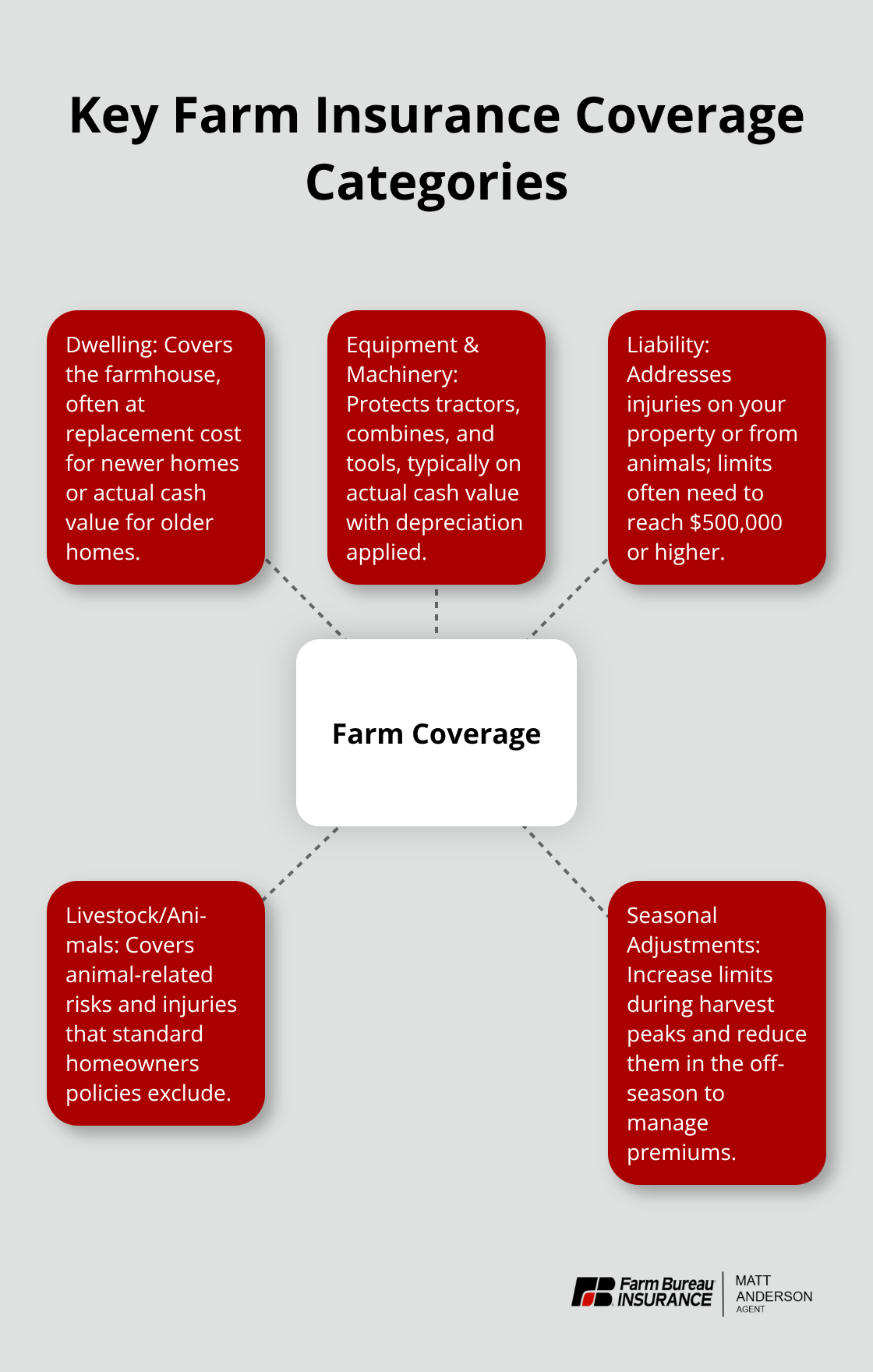
Visual map of core farm coverage areas for Idaho farm homes - Idaho farm home insurance

Farm liability exposure on rural properties is significantly higher because visitors, hired workers, and contractors move through your property regularly, and animals create injury risks that homeowners policies explicitly exclude.

Liability Costs Can Exceed Half a Million Dollars

A single incident involving a visitor injured by livestock or a neighbor’s child hurt on farm equipment can result in claims exceeding $500,000 in medical and legal costs. Farm home insurance accounts for these realities by providing separate coverage categories for structures, equipment, liability, and animals rather than lumping everything into one residential package. This specialized approach protects your operation from the ground up, addressing risks that standard policies ignore entirely.

Understanding these differences sets the stage for evaluating the specific coverage options that actually protect your farm operation.

What Your Farm Home Insurance Actually Covers

Dwelling Coverage Protects Your Main Farmhouse

Idaho farm home insurance splits protection into distinct coverage categories that work together to address your operation’s real risks. The main farmhouse receives dwelling coverage that pays to rebuild or repair the structure if fire, wind, theft, or other covered perils damage it. Dwelling coverage for your house typically starts at replacement cost for newer structures but shifts to actual cash value for homes built before the 1970s, which means you absorb depreciation on older properties. This distinction matters significantly-a farmhouse constructed in 1965 will cost less to insure under actual cash value than a newly built home, but you’ll recover less after a total loss.

Equipment and Machinery Need Accurate Inventory Values

Equipment and machinery coverage protects your tractors, combines, balers, and other farm tools-typically valued at actual cash value rather than replacement cost, which means depreciation applies. Equipment coverage requires you to provide an accurate inventory, as many farmers underestimate machinery values and end up underinsured when a combine or tractor needs replacement. Peak-season adjustments matter for grain storage and harvested crops, allowing you to increase limits during harvest months and reduce them during off-season periods, which lowers your annual premium while keeping you protected when risk is highest. Ask any potential provider specifically whether their farm policies include coverage for foreign object ingestion on equipment since rocks and debris cause expensive breakdowns, and whether they offer custom farming endorsements if you perform agricultural work for neighbors or other operations.

Liability Coverage Addresses Farm-Specific Injury Risks

Liability coverage handles medical bills and legal costs when someone gets injured on your property or by your animals, and this is where farm policies diverge sharply from homeowners coverage because farm liability limits often need to reach $500,000 or higher to reflect the actual risk. Liability protection for farm operations should include extensions for hired workers and contractors since your standard coverage may not apply when someone else works on your property. Most Idaho farm policies also include coverage for farm outbuildings like barns and storage sheds, though you’ll want to verify whether structures built before 1990 receive replacement cost or actual cash value coverage since older buildings affect premium calculations differently.

Choosing Between Replacement Cost and Actual Cash Value

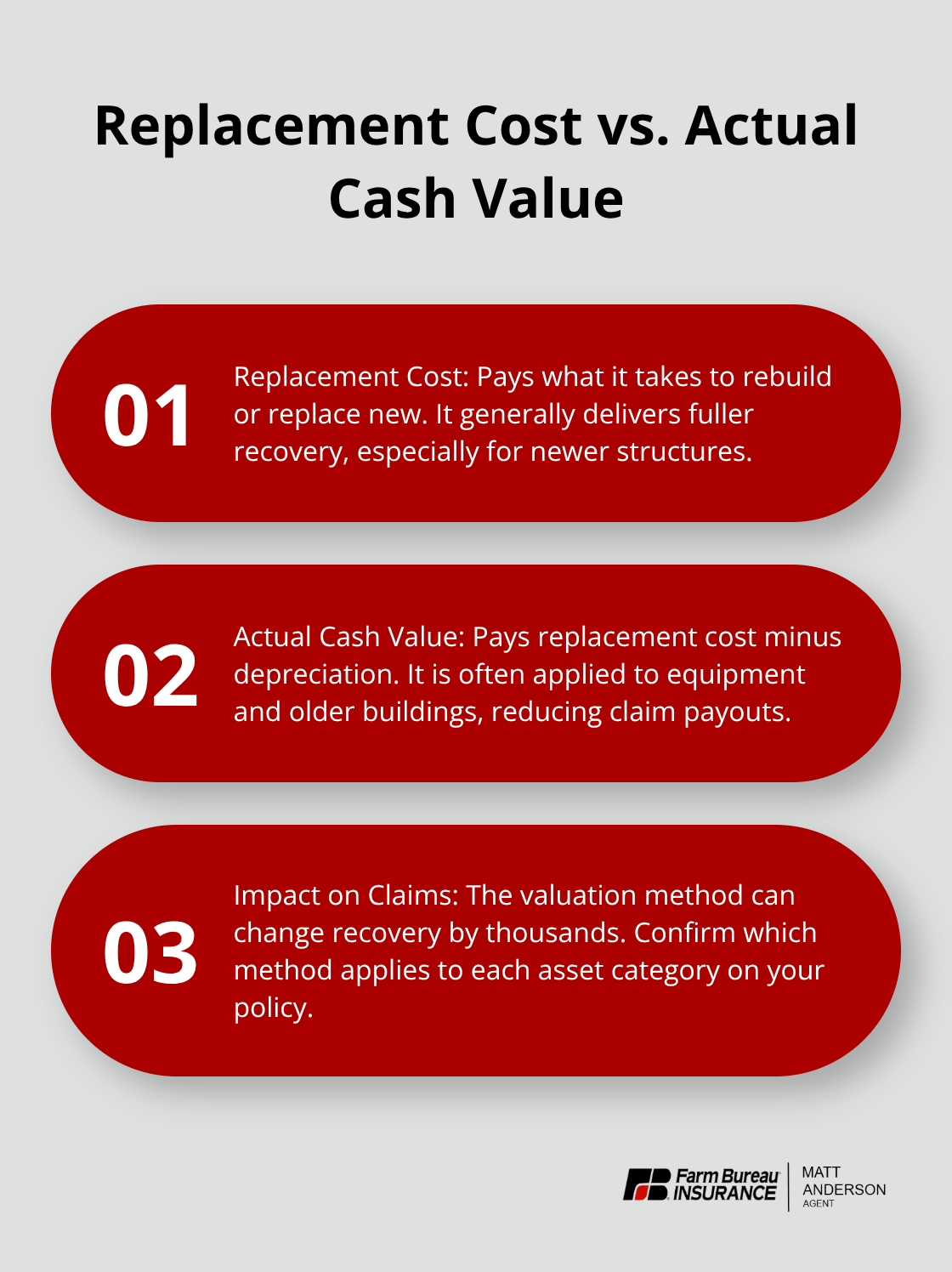
The coverage you select directly impacts what happens after a loss. Replacement cost coverage pays what it costs to rebuild or replace an item new, while actual cash value subtracts depreciation from that amount. Newer farm buildings typically qualify for replacement cost protection, but insurers often apply actual cash value to equipment and older structures.

Three key differences between replacement cost and actual cash value for farm insurance - Idaho farm home insurance

This difference can mean thousands of dollars in recovery after a significant loss, so clarify with your provider which valuation method applies to each asset category on your farm.

Tailoring Coverage to Your Seasonal Operations

Farm operations shift dramatically across seasons, and your insurance should reflect those changes. Higher grain storage during harvest months creates different risk profiles than winter months when silos sit empty. Adjusting your coverage limits seasonally prevents you from overpaying during low-risk periods while maintaining adequate protection when your assets reach peak value. Your provider can help you establish a schedule that matches your actual operational calendar rather than applying one-size-fits-all limits year-round.

Understanding these coverage categories positions you to evaluate which specific limits and endorsements your farm operation actually needs.

Selecting Farm Coverage That Matches Your Actual Operation

Inventory Every Asset on Your Property

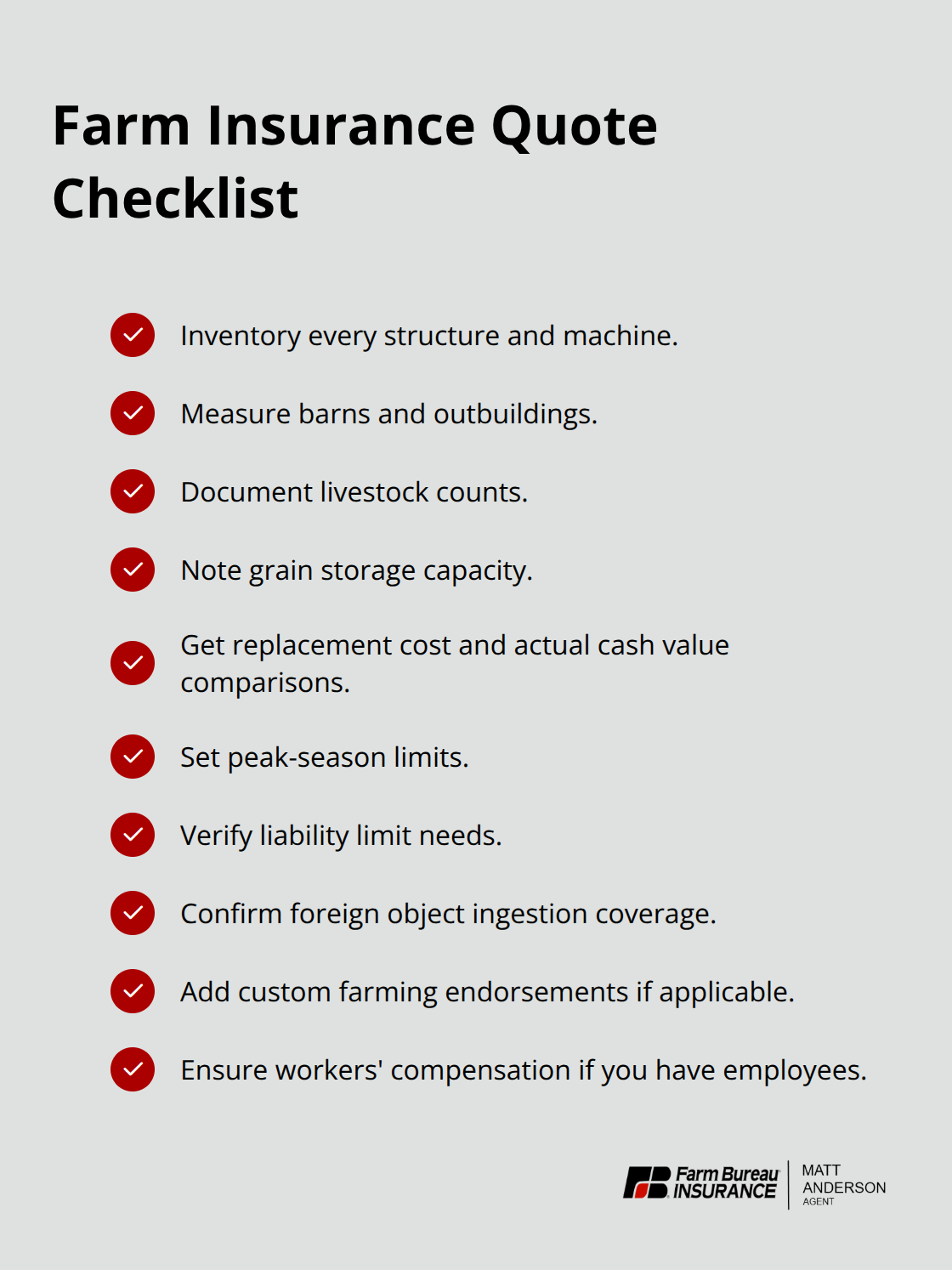
Walk through your property with a notepad and photograph every structure, piece of equipment, and asset that generates value. Most farmers significantly underestimate what they own until they physically inventory it. Measure your barns and outbuildings, list every piece of equipment with its age and condition, document livestock counts, and note any grain storage capacity. This isn’t theoretical-underinsurance on farm properties means you absorb the loss yourself after a claim. A combine purchased five years ago for $350,000 may be worth $210,000 today under actual cash value, but many farmers insure it at the original purchase price and then face a significant shortfall if it’s stolen or damaged.

Compare Replacement Cost Against Actual Cash Value

Get replacement cost quotes for new structures and equipment, then compare those figures against actual cash value estimates to understand the real difference in coverage and premium. Your farm’s seasonal nature demands specific attention: if you store 50,000 bushels of grain during harvest but hold only 5,000 bushels in winter, your peak-season coverage should reflect that higher value while your off-season limits drop accordingly. Request quotes that explicitly show how liability limits scale-$300,000 in coverage may feel adequate until you consider that a serious injury on your property can generate $500,000 or more in medical and legal expenses.

Account for Workers’ Compensation Requirements

Idaho farm operations with employees must also account for workers’ compensation, which is required by the Idaho Industrial Commission for any business with employees (including seasonal labor). This coverage protects your workers and shields your operation from liability if an employee suffers a work-related injury on your farm.

Request Detailed Quotes From Multiple Providers

When comparing providers, request detailed quotes that break down dwelling coverage, equipment and machinery protection, liability limits, and any endorsements your operation requires. Ask each provider whether their policies include foreign object ingestion coverage for equipment, whether custom farming endorsements are available if you perform work for other operations, and whether livestock coverage extends to attacks by dogs or wild animals. Some insurers apply replacement cost to barns built after 1990 but shift to actual cash value for older structures, which affects your long-term costs significantly.

Checklist of items to confirm when requesting farm insurance quotes

Verify that liability coverage includes medical payments for visitors and that it protects you if contractors work on your property-this gap leaves many farmers exposed. Request quotes for peak-season adjustments during your highest-value months rather than paying year-round rates for maximum coverage you only need four months annually.

Prioritize Coverage Fit Over Price Alone

The most common mistake farmers make is shopping primarily on price rather than on whether the policy actually covers their operation-a $200 annual savings means nothing if a claim reveals your equipment or structures fell outside your coverage.

Final Thoughts

Idaho farm home insurance protects what standard homeowners policies won’t touch, and adequate coverage makes the difference between financial recovery and catastrophic loss after a claim. Your farm operation faces distinct risks that demand specialized protection across dwelling structures, equipment, liability, and seasonal asset fluctuations. A barn fire, equipment theft, or serious injury on your property can generate costs exceeding $500,000, and underinsurance means you absorb those expenses yourself rather than your insurer covering them.

The coverage decisions you make now directly impact your financial security during Idaho’s farming cycles. Choosing replacement cost over actual cash value, adjusting limits seasonally to match your operational calendar, and including endorsements for foreign object ingestion and custom farming work all shape whether your policy actually protects your operation when you need it most. Many farmers discover coverage gaps only after a loss occurs, which is why you should walk through your property to inventory every asset and compare detailed quotes from multiple providers before you commit to a policy.

We at Matt Anderson Insurance understand the specific protection rural Idaho families and farms require. Contact us to discuss your farm’s unique insurance needs and get a quote that reflects your actual assets and seasonal operations.

The information provided in this blog is for general informational purposes only and does not constitute legal, financial, or insurance advice. Coverage options, terms, and availability may vary. Please consult with a licensed professional for advice specific to your situation. Artificial intelligence may have been used to generate text and images in some blog articles.
Idaho Vacation Rental Insurance: Peace Of Mind For Short-Term Hosts

Running a vacation rental in Idaho comes with real financial exposure. Standard homeowners insurance won’t protect your rental income or cover liability from guest injuries-leaving you vulnerable to thousands in losses.

At Matt Anderson Insurance, we help Idaho vacation rental hosts get the specialized coverage they need. The right Idaho vacation rental insurance policy shields both your property and your income stream when accidents happen.

Why Your Homeowners Policy Won’t Protect Your Rental Income

Standard Homeowners Insurance Excludes Short-Term Rentals

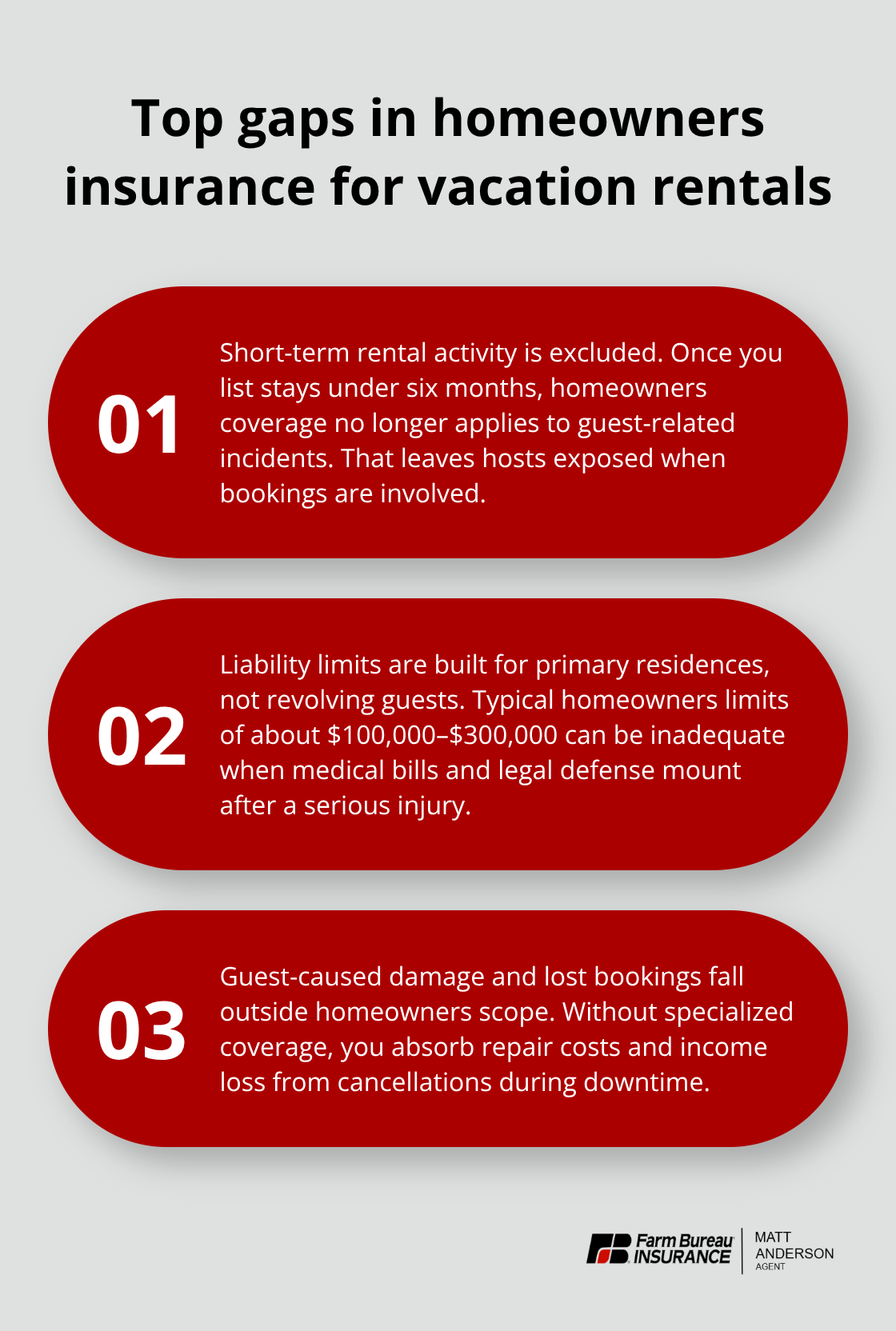
Standard homeowners insurance explicitly excludes short-term rental activity. The moment you list your Idaho property on Airbnb, VRBO, or any other platform for stays under six months, your traditional policy becomes void. Insurers will deny claims related to guest injuries, property damage caused by guests, or lost rental income if they discover your property operates as a vacation rental. This isn’t a gray area-the coverage simply doesn’t exist in a homeowners policy. You face complete financial exposure on the exact risks that matter most: a guest slipping on your deck, someone’s belongings stolen during their stay, or a guest causing damage that forces you to cancel bookings for weeks.

Three reasons homeowners insurance won't protect Idaho vacation rental income - Idaho vacation rental insurance

Guest Traffic Multiplies Your Liability Risk

Each guest who enters your property increases your liability risk significantly. Short-term rental hosts welcome dozens or hundreds of strangers annually, compared to the stable tenant relationship in long-term rentals. A delivery person slips on an icy walkway, a guest’s dog attacks another visitor, or a visitor suffers injury from faulty railings-these incidents happen regularly at vacation rentals and create substantial legal exposure. Personal liability coverage under homeowners policies typically maxes out around $100,000 to $300,000, which sounds substantial until you face medical bills, legal defense costs, and settlement demands from a serious injury. Vacation rental properties with amenities like hot tubs, pools, or fire pits attract higher liability claims because guests often use them without full understanding of risks. Idaho’s weather adds another layer: winter ice, spring flooding, and summer wildfire smoke create conditions where guests slip, fall, or suffer property damage more frequently than in stable residential settings.

Turnover Creates Damage and Loss Exposure

Turnover happens constantly in vacation rentals. You might host ten different groups in a month, each one handling your furnishings, appliances, and décor differently. Bed bug infestations spread faster when guests cycle through regularly. Broken furniture, damaged plumbing fixtures, and missing items accumulate quickly. Standard homeowners policies won’t cover any of this because guest damage falls outside the policy’s scope. Vacation rental insurance fills this gap with coverage for guest-caused damage, theft, and vandalism. When a guest damages your hot tub or steals artwork, specialized vacation rental policies respond where homeowners insurance refuses. The frequency of turnover also means your property sits vacant between bookings, creating exposure to weather damage, theft, or squatters that homeowners policies may not address during vacancy periods.

These gaps in standard coverage make specialized vacation rental insurance essential-and understanding what protection actually exists becomes your next priority.

What Coverage Actually Protects Your Vacation Rental

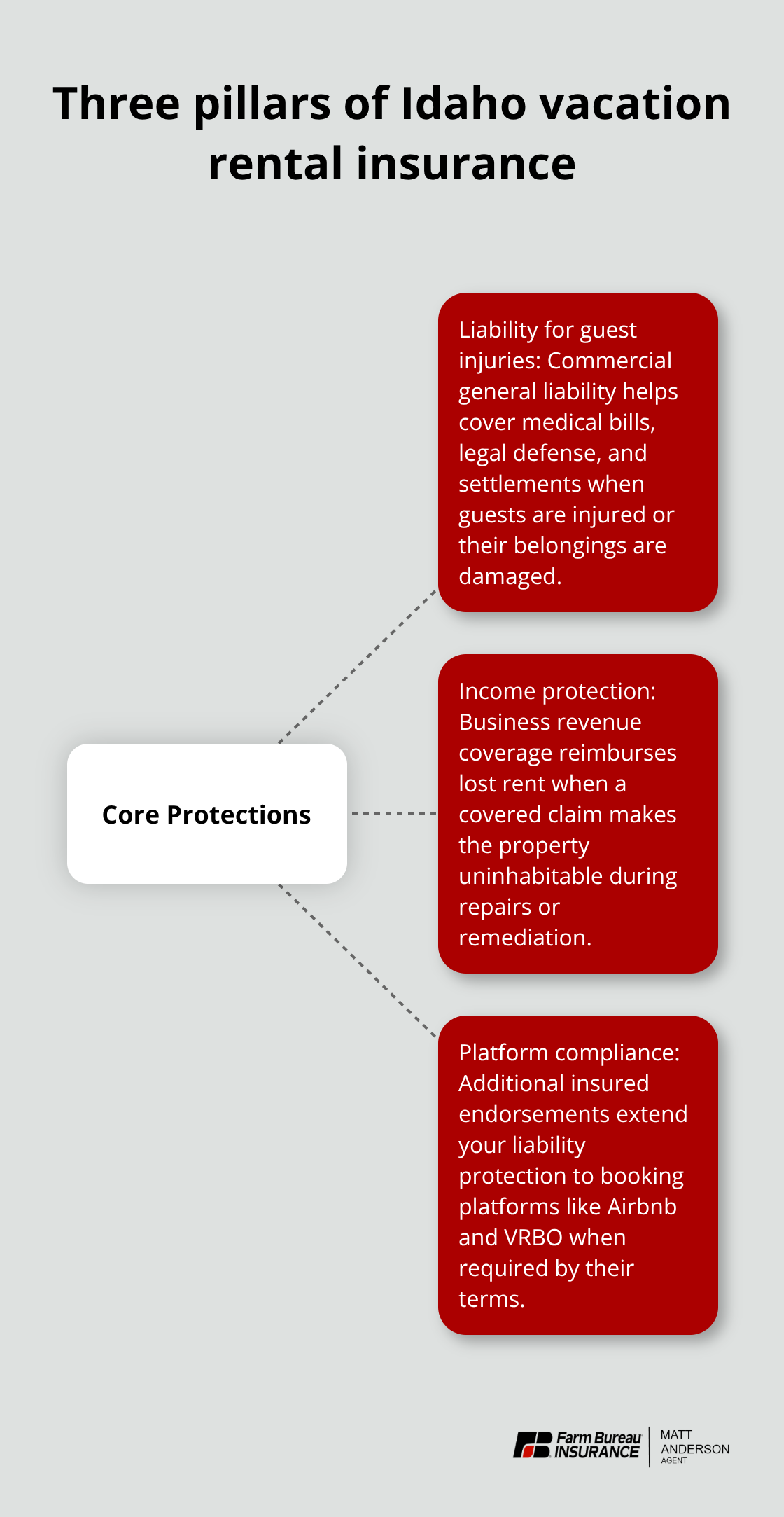
Vacation rental insurance in Idaho covers three distinct areas that standard homeowners policies refuse to touch: liability when guests suffer injury, income protection when you cannot rent, and requirements that property management platforms demand. Understanding these three pillars helps you select a policy that actually matches your operation instead of discovering gaps after a claim.

Core protections: liability, income protection, and platform requirements for Idaho vacation rentals

Liability Coverage Starts at $1 Million for Guest Injuries

Liability protection in vacation rental policies operates differently than homeowners coverage. Most vacation rental policies start with $1 million in commercial general liability coverage, which protects you when a guest suffers injury on your property or you accidentally damage their belongings. This $1 million threshold matters because guest injury claims escalate quickly-medical bills from a serious fall can exceed $50,000 within days, and legal defense costs add another $10,000 to $30,000 before settlement. A guest who slips on your deck and fractures their hip, or someone injured by a faulty hot tub railing, creates exposure that a standard homeowners policy’s $100,000 to $300,000 liability limit cannot handle. Vacation rental policies also cover incidents caused by guests themselves-if your guest’s dog bites a visitor, or a guest causes property damage to a neighbor’s home, the policy responds. This guest-caused liability protection does not exist in homeowners insurance, making it essential for properties with multiple visitors annually. Idaho hosts with amenities like pools, fire pits, or hot tubs should confirm their policy includes coverage for these specific features, as some insurers add extra premiums or exclude certain amenities entirely.

Income Protection Pays You When Guests Cancel

Loss of income coverage, sometimes called business revenue protection, reimburses you for rental income lost when a covered claim makes your property temporarily uninhabitable. If a guest causes a fire that forces you to close for three weeks of repairs, the policy pays the income you would have earned from bookings during that period. This coverage matters because platform protections like Airbnb’s AirCover explicitly exclude lost rental income, leaving you to absorb weeks or months of cancelled bookings while repairs happen. Some Idaho-approved vacation rental insurers offer business revenue protection with no time limit, meaning if repairs take two months, you receive two months of lost income up to your chosen limit. You determine your coverage limit based on your average monthly revenue-a host earning $3,000 monthly should carry at least $9,000 to $15,000 in revenue protection to cover a typical repair period. Without this coverage, a single water damage claim or guest-caused destruction costs you more in lost bookings than the actual property damage repair bill.

Property Management Platforms Require Additional Insured Status

Airbnb, VRBO, and other platforms increasingly require that they receive status as additional insured on your policy, meaning they obtain protection under your liability coverage if a guest sues both you and the platform. This requirement protects platforms from liability while shifting responsibility to you as the host. Your policy must explicitly allow this additional insured endorsement-not all vacation rental policies include it, and some charge extra to add it. Before purchasing a policy, confirm with the insurer that adding your booking platform as additional insured is possible and whether it costs extra. This becomes critical if you use multiple platforms; your policy should accommodate naming each platform without limitations. When you work with a local Idaho agency, we help you navigate these platform requirements and verify that policies include the endorsements your booking sites demand.

Matching Your Policy to Your Idaho Property

Document Your Guest Volume and Revenue

Selecting a vacation rental policy requires matching coverage limits to your specific property setup, guest volume, and amenities rather than accepting whatever a general agent recommends. Start by documenting your actual guest capacity and turnover rate, since these directly determine your liability and income protection needs. A property hosting four guests monthly faces entirely different risk than one hosting four guests weekly. Count your average annual guests, then multiply your nightly rate by the number of nights you typically book to calculate your actual monthly revenue-this number becomes your baseline for loss of income coverage.

Most Idaho hosts should carry loss of income protection equal to at least three months of average revenue, which means a property earning $4,000 monthly needs $12,000 in revenue coverage minimum. This protects you through typical repair timelines without leaving gaps.

Assess Your Amenities and Regional Risks

Next, assess your amenities honestly. Hot tubs, pools, fire pits, and similar features increase liability exposure dramatically and often require additional premiums or specific endorsements in vacation rental policies. Ask your insurer directly whether your amenities are covered at full premium or excluded entirely-some policies simply won’t cover properties with pools, forcing you to shop elsewhere.

Properties in mountain towns like McCall or Ketchum face avalanche, wildfire, and heavy snow exposure that flat properties in Boise don’t encounter, so verify that your policy addresses Idaho’s regional weather risks without gaps.

Prioritize Coverage Limits Over Deductibles

Coverage limits matter more than deductibles when protecting vacation rental income. A $2,500 deductible saves you perhaps $100 annually on premiums but costs you thousands if you face a claim, since you’ll pay that amount before coverage kicks in. Try keeping deductibles low on vacation rental policies-$1,000 or less-because the financial stakes are higher when guest injuries or property damage interrupt your income stream.

Six quick steps to tailor coverage for Idaho vacation rentals - Idaho vacation rental insurance

Review Exclusions and Platform Requirements

Review what your policy explicitly excludes before purchasing, particularly around damage from tenant-caused incidents, theft by guests, or bed bug infestations, since these exclusions often surprise hosts after claims occur. Some policies exclude coverage during vacancy periods, which matters if you schedule maintenance between bookings or experience seasonal slowdowns. Confirm that your policy covers temporary living expenses if a covered loss makes your property unrentable, and verify whether the policy responds to guest-caused damage or treats it as your responsibility.

Ask your insurer whether additional insured endorsements for Airbnb and VRBO are included in the base premium or cost extra, since some carriers charge $200 to $500 annually to add platforms. Request sample policies from multiple insurers and compare their actual language rather than marketing summaries-the specific coverage definitions, exclusions, and conditions determine whether you’re protected or exposed when claims happen.

Final Thoughts

Vacation rental insurance protects both your property investment and the income stream that makes hosting worthwhile. Standard homeowners policies leave you exposed to the exact risks that matter most-guest injuries, property damage, and lost bookings. Specialized Idaho vacation rental insurance fills those gaps with liability coverage starting at $1 million, income protection when repairs force closures, and the additional insured endorsements that platforms require.

The right policy depends on your specific property, guest volume, amenities, and regional risks. A property in McCall faces different exposure than one in Boise, and a rental with a hot tub requires different coverage than one without. Your monthly revenue determines how much income protection you actually need, since these details matter because generic policies leave gaps while customized coverage protects your operation completely.

Contact Matt Anderson Insurance today to discuss your Idaho vacation rental insurance needs and speak with an agent who understands vacation rental operations across the state. We help you assess your guest capacity, document your amenities, and build coverage that protects your investment without overpaying for unnecessary limits. Protecting your property and income takes one conversation-start that conversation now.

The information provided in this blog is for general informational purposes only and does not constitute legal, financial, or insurance advice. Coverage options, terms, and availability may vary. Please consult with a licensed professional for advice specific to your situation. Artificial intelligence may have been used to generate text and images in some blog articles.
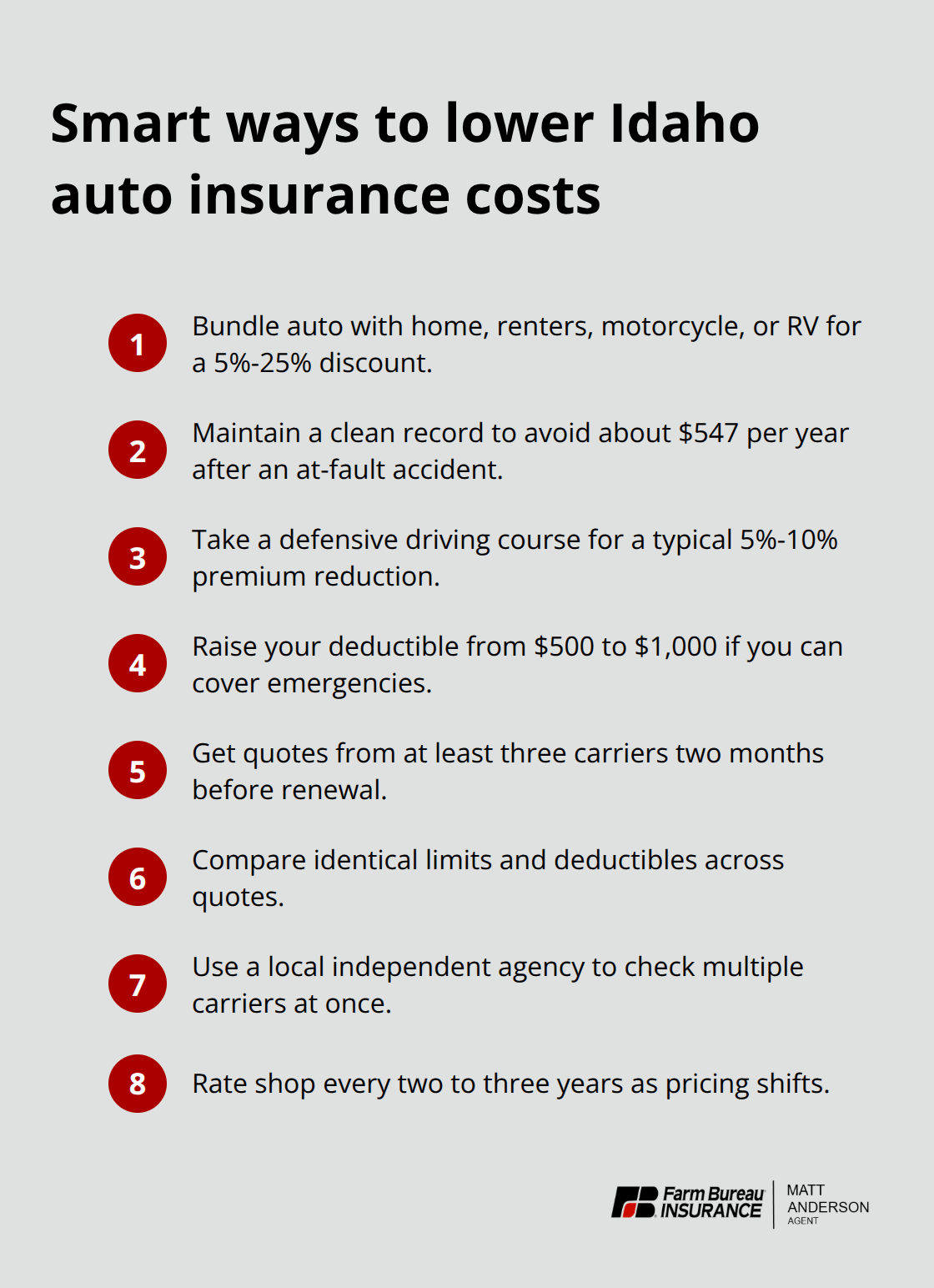
Idaho Vacation Home Insurance: Coverage For Your Seasonal Getaway

Owning a vacation home in Idaho comes with unique insurance needs that standard homeowners policies simply don’t cover. Your seasonal getaway requires specialized protection tailored to part-time occupancy, guest liability, and seasonal risks.

At Matt Anderson Insurance, we help Idaho property owners understand exactly what Idaho vacation home insurance should include. Let’s walk through your coverage options and show you how to protect your investment without overspending.

What Vacation Home Insurance Actually Covers

Vacation home insurance differs fundamentally from standard homeowners coverage because it accounts for part-time occupancy and guest interactions. This type of policy protects the structure of your seasonal property, your personal belongings inside it, and your liability if a guest gets injured or their belongings are damaged while staying with you. Standard homeowners policies assume you occupy the home year-round and often exclude or severely limit coverage for properties you don’t live in full-time. Many insurers will outright deny claims if they discover your home sits vacant for extended periods-exactly what happens with seasonal properties.

Chart highlighting a 37% increase in Idaho homeowners insurance premiums from 2022 to 2024.

Idaho homeowners insurance premiums rose 37 percent from 2022 to 2024, making it critical to obtain the right coverage the first time rather than discovering gaps after a loss.

Why Your Current Homeowners Policy Won’t Protect Your Seasonal Home

Standard homeowners policies contain explicit exclusions for non-owner-occupied properties and business use. If you rent out your vacation home on Airbnb or Vrbo, your regular homeowners insurance will not cover guest-related incidents, theft by guests, or damage during rental periods. The platforms themselves offer some host protection, but these limits are typically low and loaded with exclusions. Landlord policies designed for long-term rentals won’t work either because they’re structured for properties where tenants occupy the home continuously under lease agreements. Idaho vacation home owners face additional pressure from the state’s wildfire risk and rising construction costs, which means rebuilding costs are substantially higher if disaster strikes, and standard policies may not provide enough coverage to actually rebuild your property.

How Vacation Home Coverage Protects Your Financial Investment

A proper vacation home policy covers dwelling damage from named perils like fire, lightning, and theft, plus liability protection when guests are injured on your property. Loss of income coverage is included in many vacation home policies, meaning if a covered claim makes the property temporarily uninhabitable or unrentable, you receive compensation for the rental income you lose during that period. This matters significantly in Idaho’s seasonal markets where summer and holiday weeks generate the bulk of annual rental income. Dwelling coverage typically uses replacement cost rather than actual cash value, meaning the insurer pays what it costs to rebuild today rather than depreciating the structure’s value. You should also confirm that your policy covers the property during vacancy periods because Idaho vacation homes sit empty for months at a time, and many standard policies void coverage when a home is unoccupied beyond a certain threshold.

What Happens When You Choose the Wrong Policy

Selecting an inadequate policy can leave you exposed to significant financial loss. A policy that doesn’t account for your rental activity won’t protect you if a guest causes damage or suffers an injury on your property. Policies with low liability limits may not cover serious guest injuries, leaving you personally liable for medical bills and legal costs. Additionally, policies that exclude loss of income coverage mean you absorb all revenue loss if the property becomes temporarily unrentable due to a covered claim. The cost of vacation home insurance varies by location, building construction type, fire risk, natural disasters, crime, and unique features of the property, so a policy that works for a friend’s vacation home in McCall may not work for your property in Coeur d’Alene. Understanding these differences upfront prevents costly coverage gaps later.

Getting Coverage That Matches Your Seasonal Use

A local Idaho agency understands seasonal occupancy patterns and can align your coverage with your actual usage, not generic assumptions about how you use the property. Your agent should ask specific questions about how many months you occupy the home, whether you rent it out, what amenities you provide to guests, and what natural disaster risks apply to your location. This conversation determines whether you need additional endorsements for specific exposures and helps you avoid overpaying for coverage you don’t need. The right policy protects your structure, your belongings, and your liability exposure while accounting for the months when your seasonal home sits empty. With these fundamentals in place, you’re ready to explore the specific coverage options that fit your Idaho vacation property and budget.

What Coverage Do You Actually Need for Your Idaho Vacation Home

Dwelling and Personal Property Protection

Dwelling protection forms the foundation of any vacation home policy and covers the structure itself against named perils like fire, lightning, wind, and theft. In Idaho, replacement cost coverage matters far more than actual cash value. Replacement cost means the insurer pays what it costs to rebuild today, not a depreciated figure that leaves you short when disaster strikes. Your personal property inside the home-furniture, electronics, kitchen equipment-receives separate coverage with its own limit, usually between 50 and 70 percent of the dwelling limit.

If you store expensive items at your seasonal home like art, collectibles, or high-end outdoor equipment, verify these limits cover your actual belongings. Standard policies cap coverage on individual items like jewelry or electronics, so you may need additional endorsements for valuable possessions.

Liability Coverage for Guest Injuries

Liability coverage protects you when a guest is injured on your property or their belongings suffer damage during their stay. We recommend minimum limits of 300,000 dollars, though 500,000 dollars or higher makes sense given Idaho’s litigation environment and the potential for serious injuries. Most vacation home policies include medical payments coverage separate from liability, which covers minor guest injuries regardless of fault up to 1,000 or 5,000 dollars. This coverage helps you avoid small claims that could otherwise damage your rental reputation.

Water Damage, Theft, and Guest-Related Risks

Water damage from burst pipes, plumbing failures, or ice dam damage should be explicitly covered in your policy because standard homeowners policies often exclude or limit water damage claims. Theft coverage becomes critical when guests have access to your home, and property entrustment coverage specifically protects against theft or vandalism by guests-a gap many vacation home owners discover only after a loss.

Checklist of essential protections for Idaho vacation homes covering water damage and guest-related risks. - Idaho vacation home insurance

Natural Disaster Coverage for Idaho Locations

Natural disaster coverage varies significantly by location within Idaho, so a property near the Snake River Plain faces wildfire exposure that requires explicit coverage or endorsements. Properties near rivers or floodplains need separate flood insurance through the National Flood Insurance Program (NFIP). Loss of use coverage compensates you for rental revenue lost when a covered claim makes the property temporarily uninhabitable. This protection proves essential in Idaho’s seasonal markets where summer bookings generate the majority of annual rental income.

Choosing the Right Coverage Limits

The specific coverage limits you select depend on your property’s replacement cost, the value of your personal belongings, your guest liability exposure, and your location’s natural disaster risks. A property in McCall with high wildfire exposure requires different endorsements than a property in Coeur d’Alene near water. Your agent should ask specific questions about how many months you occupy the home, whether you rent it out, what amenities you provide to guests, and what natural disaster risks apply to your location. This conversation determines whether you need additional endorsements for specific exposures and helps you avoid overpaying for coverage you don’t need. Once you understand what coverage protects your property and your liability, the next step involves evaluating how much you’ll actually pay for that protection and where you can reduce costs without sacrificing essential coverage.

How Bundling and Seasonal Adjustments Lower Your Vacation Home Costs

Multi-Policy Discounts That Add Up Fast

Bundling your vacation home policy with auto, home, or other coverage through one insurer typically saves 10 to 25 percent on your total premiums. This discount applies whether you insure your primary residence, your seasonal property, or both. The actual discount depends on which policies you combine and your insurer’s specific incentive structure, but most carriers reward customers who consolidate coverage rather than shopping policies separately. If you currently insure your primary home elsewhere, moving your vacation home coverage to that same insurer often qualifies you for a bundling discount on both policies. This strategy makes financial sense because the savings frequently exceed what you’d pay for a standalone vacation home policy at a different company. Start by requesting quotes that include bundled rates from your current homeowners insurer, then compare those against standalone vacation home quotes to see which approach saves more money.

How Seasonal Usage Patterns Affect Your Premium

Seasonal usage patterns directly affect what you pay because insurers charge lower premiums for properties you occupy only part of the year compared to full-time residences. Properties occupied fewer than six months typically qualify for seasonal discounts, though the exact threshold varies by insurer. However, this discount only applies if your property actually sits vacant during off-season months; if you rent it out year-round, the insurer may charge standard rates or higher.

Hub-and-spoke infographic showing strategies that reduce Idaho vacation home insurance costs.

Understanding your specific occupancy pattern helps you select the right policy tier and avoid overpaying for coverage that assumes year-round use.

Loss-Prevention Measures That Cut Premiums Substantially

Implementing specific loss-prevention measures cuts your premium substantially more than seasonal discounts alone. Installing a new roof can reduce premiums by 10 to 15 percent because it lowers fire risk, which matters enormously in Idaho’s wildfire zones. Adding deadbolts, upgrading to a monitored security system, or installing storm shutters all generate measurable discounts that compound when combined. Properties with updated electrical systems, fire extinguishers, and clear defensible space around the structure also qualify for better rates.

Prioritizing Home Improvements for Maximum Savings

Ask your agent specifically which improvements your property needs to qualify for the largest available discounts. Prioritize the upgrades with the fastest payback period against your annual premium savings (this approach ensures you recoup your investment quickly through lower premiums). Some improvements, like clearing vegetation within 30 feet of your home, cost little but yield significant discounts in high-wildfire areas. Others, like roof replacement, require substantial upfront investment but deliver long-term savings that justify the expense over several years.

Final Thoughts

Protecting your Idaho vacation home requires specialized coverage that accounts for part-time occupancy, guest liability, and the wildfire and natural disaster risks specific to your location. Standard homeowners policies simply won’t cover seasonal use, and forcing one to fit your situation leaves you exposed to significant financial loss when a claim occurs. Idaho vacation home insurance designed for your actual usage pattern protects your structure, belongings, liability exposure, and rental income far more effectively than hoping a generic policy will work.

Bundling your vacation home policy with auto or primary home coverage saves 10 to 25 percent on premiums, while loss-prevention measures like roof upgrades or defensible space clearing cut costs even further. Local Idaho agents understand which natural disaster risks apply to your specific location and can explain why premiums have risen 37 percent since 2022 without overselling coverage you don’t need. An agent familiar with your region helps you navigate options that actually fit your property rather than forcing you into a one-size-fits-all approach.

Contact Matt Anderson Insurance to discuss your seasonal property needs and see how we can build coverage that protects your investment while keeping your premiums reasonable. Getting a quote takes minutes and costs nothing, and our licensed agents handle the details so you understand exactly what your policy covers and why those limits matter for your property.

The information provided in this blog is for general informational purposes only and does not constitute legal, financial, or insurance advice. Coverage options, terms, and availability may vary. Please consult with a licensed professional for advice specific to your situation. Artificial intelligence may have been used to generate text and images in some blog articles.

Idaho Contractor Workers Compensation: Keeping Your Team Protected

Running a contracting business in Idaho means managing multiple risks, and one of the biggest is protecting your workers when injuries happen on the job. Idaho contractor workers compensation insurance isn’t optional-it’s a legal requirement that shields both your team and your business from financial disaster.

At Matt Anderson Insurance, we help contractors understand their coverage options so they can make informed decisions. The right policy keeps your employees protected and gives you peace of mind.

Why Contractors Need Workers Compensation Coverage

Idaho law requires workers compensation coverage the moment you hire your first employee, including part-time and occasional workers. Operating without it is a misdemeanor that can result in criminal charges, fines, and potential jail time. The state takes this seriously because the financial consequences of an uninsured injury are catastrophic. If an employee gets hurt without coverage, you face liability for all medical expenses, recovery costs, and lost wages-costs that can easily exceed $100,000 for a serious injury. Idaho sets minimum coverage limits at $100,000 per occurrence for bodily injury and $100,000 per employee for bodily disease, though contractors in high-risk trades typically need higher limits to stay protected.

What Happens Without Coverage

The penalties extend far beyond fines. An injured worker without compensation coverage can sue you directly for damages, and you’ll have no insurance to back the claim. You could lose your business, your personal assets, and face wage garnishment. Misclassifying workers as independent contractors to avoid coverage is a serious violation with its own set of legal consequences. Beyond legal trouble, an uninsured injury devastates your team. Workers lose income during recovery while you lose productivity, and the stress of an unsupported injured worker often leads to retention problems. The damage to your reputation in Idaho’s contractor community spreads fast when word gets out that you don’t protect your team.

Medical Care and Wage Replacement

Workers compensation in Idaho covers immediate medical care-ambulance, emergency room visits, x-rays, surgery, and prescription medications-plus ongoing treatment like physical therapy for chronic injuries. Wage replacement typically covers about two-thirds of lost wages during recovery, which helps your injured worker stay afloat financially while you avoid the liability. Death benefits and funeral costs go to the worker’s family, protecting them from financial ruin.

Your Coverage Options in Idaho

You can choose from multiple paths: private insurance through licensed carriers, the Idaho State Insurance Fund as a backup option, the assigned risk pool for difficult-to-insure operations, or self-insurance if you meet payroll thresholds. An independent agent shops multiple carriers side-by-side, which matters because premiums vary significantly based on your industry risk, payroll size, and worker classifications. The right agent understands contractor operations and helps you find the right carrier without overpaying for coverage you don’t need.

Compact list of Idaho workers’ compensation coverage options for contractors - Idaho contractor workers compensation

What Your Idaho Workers Compensation Policy Actually Covers

Idaho workers compensation covers far more than just emergency room visits, and understanding exactly what your policy includes prevents nasty surprises when an injury happens. Medical benefits start immediately and include ambulance services, emergency room treatment, x-rays, surgery, and prescription medications. Ongoing care matters just as much as initial treatment-physical therapy for a construction worker’s back injury or chronic condition management for repetitive stress damage stays covered throughout recovery. Wage replacement typically covers approximately two-thirds of lost wages, which means an employee earning $3,000 monthly receives roughly $2,000 while unable to work. This partial income replacement keeps your injured worker financially stable and reduces the desperation that leads to rushed returns to work before full recovery. If a worker dies from a job-related injury, death benefits and funeral costs go directly to their family or beneficiaries, protecting them from financial collapse.

Disability Benefits Address Both Temporary and Permanent Injuries

Temporary disability covers the immediate period when an employee cannot work, but Idaho’s system also addresses permanent disabilities. Permanent partial disability applies when an injury causes lasting impairment that affects earning capacity-a roofer with a permanent knee injury that prevents climbing ladders receives compensation reflecting that reduced ability. Permanent total disability applies to severe injuries that prevent any gainful employment, and these benefits continue for life.

Hub-and-spoke chart showing core Idaho workers’ compensation benefits - Idaho contractor workers compensation

Vocational Rehabilitation Moves Workers Back Into Productive Roles

Vocational rehabilitation services help injured workers transition back to work when they cannot return to their original job. A worker with a permanent hand injury receives training for a different trade, with the employer’s insurance covering education costs, training supplies, and related expenses. This service protects both the worker and your bottom line by moving someone from permanent disability payments into productive employment.

Coverage Limits Matter for Your Contractor Operation

Idaho sets minimum coverage limits at $100,000 per occurrence for bodily injury and $100,000 per employee for bodily disease, though contractors in high-risk trades typically need higher limits to stay protected. A serious injury in roofing, excavation, or heavy equipment operation can exceed these minimums quickly, leaving you exposed if your policy falls short. Assess your specific risks with an independent agent who understands contractor operations and can recommend appropriate limits for your trade.

The right coverage means your injured workers receive the support they need while you avoid the catastrophic costs of uninsured claims. Understanding these benefits helps you choose a policy that actually protects your operation when injuries happen.

Selecting the Right Policy for Your Contractor Operation

Choosing a workers compensation policy requires matching your actual business structure to the coverage you buy, not the other way around. Many Idaho contractors overpay because they select limits based on state minimums rather than their specific risk profile. An excavation contractor working with heavy machinery needs dramatically different coverage than a painting crew, yet both often settle for the $100,000 per occurrence minimum that Idaho requires.

Document Your Workforce and Job Classifications

Start with your workforce composition in detail: how many full-time employees you carry, how many seasonal or occasional workers you bring on, and which job classifications your team performs. The Idaho Industrial Commission tracks workers compensation rates by industry classification, and your premium reflects this directly. A roofer costs significantly more to insure than an office administrator because roof work carries higher injury frequency and severity. Misclassifying workers to lower your premium creates legal exposure that dwarfs any savings. If you classify a laborer as an independent contractor to avoid coverage, and that worker gets injured, Idaho’s right-to-control test examines whether you directed their work, set their hours, provided equipment, and controlled the means of production. If those factors point to employment, you face liability for the injury plus penalties for misclassification.

Match Coverage Limits to Your Actual Risk

Your coverage limits should reflect your actual risk exposure, not regulatory minimums. A serious fall from scaffolding or a crushing injury from equipment can generate medical bills exceeding $250,000 before accounting for permanent disability payments. Talk with an independent agent who works across multiple Idaho carriers rather than accepting one company’s standard products. That agent shops your operation against carriers who specialize in your trade, securing better rates and appropriate limits. Beyond workers compensation, contractor liability insurance shields your business from third-party injury and property damage claims that workers compensation doesn’t cover.

Evaluate Deductibles Against Your Cash Flow

Deductibles matter more than most contractors realize because they reduce your premium but increase your out-of-pocket exposure on each claim. A $1,000 deductible versus a $5,000 deductible might save you 15 percent annually, but a single serious injury costs you that deductible amount immediately. An independent agent familiar with Idaho contractor operations understands which deductible levels work for your cash flow and claims frequency.

Percentage showing potential annual savings from a higher deductible

Use Experience Modification Ratings to Drive Better Rates

Experience modification ratings, called mods, function like a credit score for workers compensation. After three years of premium payments, your mod reflects your safety record and claims history. A favorable mod cuts your rates substantially, while a poor mod raises them significantly. This creates financial incentive to invest in genuine safety practices rather than just compliance paperwork. An agent who helps you track safety performance uses that data to shop better rates annually as your mod improves.

Final Thoughts

Idaho contractor workers compensation protects your team when injuries happen and keeps your business operating legally. Without proper coverage, you face criminal penalties, devastating financial liability, and the knowledge that your workers lack support during their most vulnerable moments. The right policy eliminates that risk entirely and gives you peace of mind.

Your specific operation determines what coverage you actually need. Your workforce size, job classifications, industry risk, and injury exposure shape the limits and deductibles that work for your business rather than forcing you into a standard product. An independent agent who understands contractor operations matches your policy to your actual risks instead of settling for state minimums.

Contact an independent agent today to document your workforce, assess your injury risk honestly, and shop multiple carriers on your behalf. That agent handles the paperwork, explains your options clearly, and manages your policy as your business grows. We at Matt Anderson Insurance work with multiple carriers to find the right coverage for your Idaho contractor workers compensation needs without overpaying for protection you don’t need.

The information provided in this blog is for general informational purposes only and does not constitute legal, financial, or insurance advice. Coverage options, terms, and availability may vary. Please consult with a licensed professional for advice specific to your situation. Artificial intelligence may have been used to generate text and images in some blog articles.
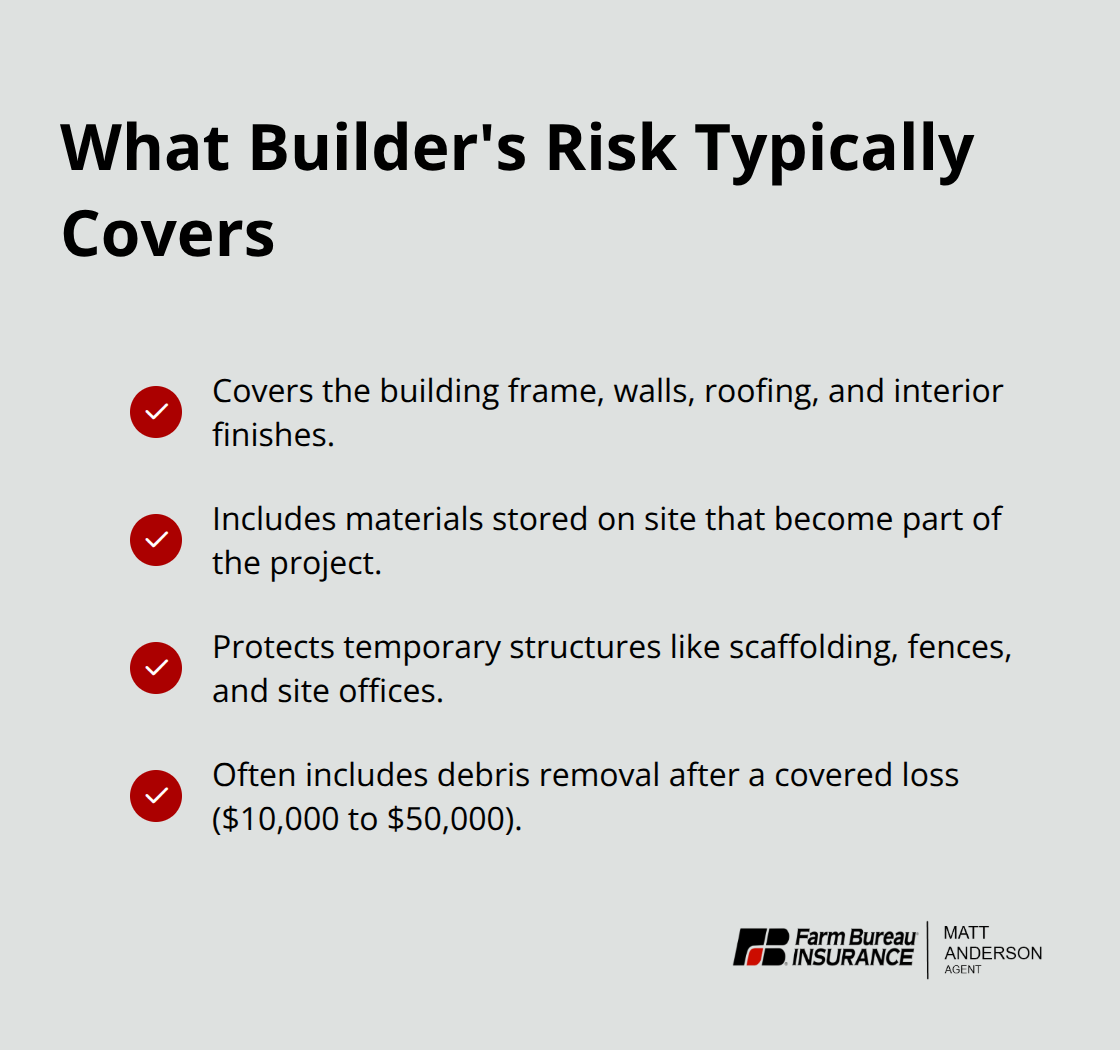
Idaho Contractor General Liability: Essential Coverage For Construction Work

One accident on a job site can cost your business thousands of dollars. Without proper coverage, you’re personally liable for injuries and property damage claims.

At Matt Anderson Insurance, we help Idaho contractors protect themselves with general liability coverage. This protection isn’t optional-most clients and lenders require it before you start work.

What General Liability Coverage Actually Covers

General liability insurance protects you when someone gets hurt on your job site or you accidentally damage a client’s property. If a homeowner trips over your equipment and breaks their arm, or your crew accidentally puts a hole in their wall, your general liability policy covers the medical bills, repair costs, and legal fees that follow. The Idaho Contractors Board requires a minimum of $300,000 in coverage to register, but that baseline is inadequate for real-world construction work. Most Idaho contractors now carry $1,000,000 per occurrence with $2,000,000 aggregate because clients and contract requirements demand it.

Hub-and-spoke showing key protections in a contractor general liability policy - Idaho contractor general liability

A single injury claim or property damage lawsuit can easily exceed $300,000-a fall from a ladder, a back injury from lifting, or structural damage during renovation can push costs well beyond six figures when you factor in medical treatment, lost wages, and legal defense.

Medical Bills and Injury Claims

Your general liability policy pays for emergency room visits, surgeries, physical therapy, and ongoing medical care when someone is injured at your job site. It also covers lost wages if an injured party cannot work during recovery. The policy covers not just your direct actions but also injuries caused by your equipment, materials, or unsafe conditions you created. Legal defense costs are included as part of the policy, meaning your insurer pays for attorneys, court filing fees, and expert witnesses whether or not you’re ultimately found liable. This protection matters because serious injuries generate substantial medical and legal expenses before any settlement or judgment is issued.

Property Damage You’re Responsible For

If your crew damages a client’s property-a roof, flooring, plumbing, electrical system, or personal belongings-your general liability policy covers the repair or replacement costs. This includes damage caused by negligence, accidents, or mistakes during the construction process. The policy also protects you if materials you bring to the job site cause damage, such as paint spilling on hardwood floors or tools scratching finished surfaces. Without this coverage, you’re personally responsible for paying out of pocket, which can wipe out your profit margin on a project or force you into debt. A kitchen renovation can become a significant loss if your crew damages cabinets, appliances, or countertops and you lack insurance to cover it.

Why the $300,000 Minimum Falls Short

Idaho law sets a $300,000 single-limit minimum, but this amount rarely matches what modern construction projects actually demand. Clients now commonly require $1,000,000 per occurrence and $2,000,000 aggregate before they sign contracts or permit site access. The difference between a $300,000 limit and $1,000,000 per occurrence can be decisive on high-value projects, as a single injury or property damage claim can exceed a six-figure amount. When you bid on residential or commercial work, inadequate coverage signals risk to potential clients and can cost you jobs. Carrying limits that align with industry expectations positions you as a safer, more professional contractor and supports competitive bids.

Why Your Business Needs General Liability Coverage Now

Idaho’s Contractors Board requires a minimum of $300,000 in general liability coverage to register for projects exceeding $2,000, but registration alone won’t protect you from financial ruin. Without adequate coverage, a single job site accident drains your personal bank account, forces you to sell assets, and destroys your ability to bid on future work. More importantly, clients won’t hire you without proof of coverage. Modern contract requirements in Idaho construction demand $1,000,000 per occurrence and $2,000,000 aggregate before homeowners or commercial property owners sign agreements or grant site access. If you carry only the $300,000 minimum, you face a competitive disadvantage-potential clients view that as a red flag that you cut corners on protection. General liability coverage isn’t just a regulatory checkbox; it’s the foundation that separates contractors who win bids from those who stay small and struggle to land quality projects. A serious injury claim or property damage lawsuit can result in substantial costs when medical expenses, legal defense, and settlements combine. Your personal homestead, savings, and future income sit at stake without proper limits.

Registration Proves You Exist-Insurance Protects You

Idaho registration proves you meet baseline requirements, but your general liability policy actually covers claims. Many contractors mistakenly think registration protects them-it doesn’t. You can be fully registered and still lose everything in a lawsuit if your coverage limits are too low or nonexistent. The state requires you to show proof of $300,000 in general liability at registration, but that’s a legal floor, not a practical ceiling. Clients, lenders, and surety bond companies expect $1,000,000 per occurrence as the industry standard. If you apply for a construction loan or bonding, lenders ask for certificates of insurance naming them as additional insured, and they reject anything below $1,000,000 per occurrence. This isn’t negotiable on projects valued above $500,000.

Why Certificates of Insurance Matter Now

When you bid on work, providing a current certificate of insurance is now table stakes-many contractors lose bids simply because they can’t produce the required proof within 24 hours. Digital certificates from most insurers are available within hours of purchase, so delays cost you opportunities. Clients require certificates naming them as additional insured before they permit your crew on site or sign contracts. Without this documentation ready, you can’t move forward on a project, even if your coverage is solid. The certificate proves your limits, your policy dates, and your insurer’s contact information-all details that clients verify before work starts. Having certificates prepared and accessible means you respond to requests immediately and demonstrate professionalism that wins contracts.

What Happens When Coverage Falls Short

A $300,000 limit sounds substantial until a serious claim arrives. Medical costs for a spinal injury, multiple surgeries, and years of physical therapy easily exceed $300,000. Add legal defense costs, expert witness fees, and court settlements, and your coverage evaporates fast. Once your policy limit is exhausted, your personal assets become the target. Clients also won’t work with contractors whose coverage doesn’t match project scope-a $500,000 renovation project demands $1,000,000 in coverage, not $300,000. Inadequate limits signal to potential clients that you operate on a shoestring budget and can’t handle their work professionally. This perception costs you bids on larger, more profitable projects. The contractors who consistently win quality work carry limits that match industry expectations and client demands.

How to Choose the Right Coverage Limits

Start with your actual project values, not the legal minimum. If you regularly bid work under $50,000, a $500,000 per occurrence limit may technically work, but you’ll lose jobs the moment a client asks for $1,000,000 coverage. The practical reality in Idaho construction is that clients now demand $1,000,000 per occurrence and $2,000,000 aggregate before they sign contracts or allow your crew on site. This expectation isn’t negotiable on residential renovations, commercial builds, or any project over $500,000. You should align your limits to the high end of your typical project value, not the low end. If your average job runs $150,000 to $300,000, carrying $1,000,000 per occurrence positions you to win bids without constant coverage objections. Higher limits also signal professionalism to potential clients and make you competitive for larger work that generates better margins. Many Idaho contractors who stuck with the $300,000 minimum have discovered they can’t bid on projects valued above $250,000 because clients won’t accept that coverage.

What Top Insurers Offer in Idaho

The Hartford offers general liability limits from $300,000 up to $2,000,000 per occurrence, with aggregate limits up to twice the per-occurrence amount. ERGO NEXT provides similar flexibility with per-occurrence limits up to $2,000,000 and $4,000,000 aggregate, plus contractor-focused endorsements like completed operations coverage that close gaps in standard policies. Both carriers give you the range you need to match your actual business risk.

Coverage Costs Less Than You Lose in Missed Bids

The Hartford’s rates for Idaho contractors start around $77 per month for basic coverage, while Simply Business, Nationwide, and Progressive average $91 to $95 per month depending on your trade and claims history. If you’re currently operating with the minimum $300,000 limit and losing bids because of it, the extra $30 to $40 monthly for $1,000,000 coverage pays for itself the moment you land one additional project that requires higher limits. A single $150,000 job that you win because you carry adequate coverage generates far more profit than the annual insurance cost.

Deductibles also influence your premium; choosing a $1,000 deductible versus a $5,000 deductible can reduce your monthly cost by 15 to 20 percent, but only if you can comfortably cover that deductible from operating cash when a claim arrives. Most contractors should avoid stretching for the lowest premium if it forces them to choose a deductible they can’t actually afford to pay. When you request quotes from at least three Idaho-licensed insurers, ask whether defense costs are included within your policy limits or paid separately. This distinction matters because legal defense on a serious injury claim can consume $50,000 or more in attorney fees, expert witnesses, and court costs before any settlement is reached. If defense costs eat into your policy limit, a $1,000,000 limit effectively becomes $900,000 or less for actual claim settlement. Insurers that pay defense costs outside the policy limit protect your full coverage amount for actual damages.

Endorsements Close Gaps That Cost You Jobs

Standard general liability policies exclude professional errors, so if you offer design services or structural advice, you need professional liability or errors and omissions coverage on top of your general liability. Contractual liability coverage should be added to your policy so that you’re protected when you sign client agreements that require you to hold them harmless from their own negligence. Products and completed operations endorsements protect you after project completion when faulty workmanship causes injury or property damage months or even years later. Without this endorsement, your coverage ends when you leave the job site, leaving you exposed on warranty claims and post-completion defects. The Hartford and ERGO NEXT both offer these endorsements, but you must request them explicitly because they don’t come standard. Many contractors discover too late that their policy has gaps exactly when a claim arrives and the insurer denies coverage because the incident falls outside their basic policy language.

Getting Certificates Ready for Client Requests

Requesting certificates of insurance naming clients as additional insured is standard practice, and most Idaho insurers provide digital certificates within hours of purchase. This documentation proves your coverage to clients and keeps you moving forward on bids without delays. Review your coverage annually and immediately after major business changes like hiring additional crew, expanding into new services, or moving to a different county, because your risk profile shifts and your coverage should shift with it.

Final Thoughts

General liability coverage separates contractors who win bids from those who struggle to land quality work. Idaho contractor general liability insurance protects your business from financial devastation after a single job site accident, but only if your limits match what clients actually demand. The $300,000 minimum required for registration is a legal floor, not a practical ceiling-clients now expect $1,000,000 per occurrence and $2,000,000 aggregate before they sign contracts or grant site access.

Start by gathering your basic business information: annual revenue, number of employees, types of construction work, and your typical project values. Request quotes from at least three Idaho-licensed insurers and compare their per-occurrence limits, aggregate limits, deductible options, and whether defense costs are paid outside your policy limit. Ask about endorsements like contractual liability and completed operations coverage that close gaps in standard policies, since The Hartford, ERGO NEXT, and Nationwide all serve Idaho contractors with flexible limits and competitive rates starting around $77 to $98 per month.

Once you select coverage, obtain digital certificates of insurance immediately and keep them accessible for client requests. Certificates naming clients as additional insured are now table stakes on most projects, and delays in providing them cost you opportunities. Contact Matt Anderson Insurance today to discuss your general liability needs and get quotes that position your business for growth and financial security.

The information provided in this blog is for general informational purposes only and does not constitute legal, financial, or insurance advice. Coverage options, terms, and availability may vary. Please consult with a licensed professional for advice specific to your situation. Artificial intelligence may have been used to generate text and images in some blog articles.